
Reddit Subscriber Counts Disappeared From Subreddits: How to Read Them From the API, and What 120 Subreddits Say About Whether the Number Ever Meant Anything
Reddit replaced the member count with Visitors and Contributions in September 2025. The data API still returns subscribers. We measured 120 subreddits to test Reddit's reason for the swap, and the data agrees with Reddit.

A subreddit's subscriber count is the cumulative number of accounts that have ever joined that community, and since 9 September 2025 Reddit no longer shows it on the subreddit page. It was replaced by two seven-day metrics, Visitors and Contributions. The number itself still exists and the Reddit data API still returns it as an integer field called subscribers, one request per subreddit, which is the short answer if that is all you came for.
The longer answer is the useful one. Reddit justified the removal with a specific claim about the data, that subscriber counts measured a subreddit's age rather than its current activity. We tested that claim across 120 subreddits, expecting to refute it, and the measurement went the other way.
TL;DR: Reddit removed the Member count from every subreddit page on 9 September 2025 and replaced it with Visitors and Contributions, two seven-day metrics. The number itself was not deleted. The Reddit data API still returns it as
subscribers, and it came back for all 200 subreddits we sampled on 12 September 2026. Reddit justified the swap by saying subscriber counts measured a subreddit's age rather than its current activity, so we tested that claim across 120 subreddits. Reddit is right. Subscriber count correlates with age at +0.459 and with weekly posting at +0.058.
If you are looking for a subreddit's member count and cannot find it, it is not hidden behind a setting and you have not missed a button. That is the display change. What follows is what the number is worth now that you have gone to the trouble of recovering it, measured rather than argued.

What happened to the subreddit member count?
Reddit replaced it. On 9 September 2025 the company published an announcement stating that, starting that day, the Member count metric on each subreddit's page would be swapped for two new signals called Visitors and Contributions. There was no deprecation window and no setting to restore the old display. The change reached the modern web interface and the mobile apps first, and eventually stripped the figure from the old.reddit sidebar as well, which is why moderator threads about it were still appearing in February 2026, five months after the fact.
- Removed: the Member count on every subreddit page, and eventually the old.reddit sidebar figure
- Added: Visitors, a seven-day unique-user count on a rolling 28-day average
- Added: Contributions, a seven-day total of non-removed posts and comments
- Unchanged: the
subscribersfield in the data API, which still returns the same integer
It was reported contemporaneously in the trade press, which is the only editorial coverage still ranking for the query today. The change also went largely unremarked outside Reddit's own communities, which is part of why the confusion persisted. One SEO practitioner noting it a month later captured the tone:

Nick LeRoy
@NickLeRoy
This one got kinda buried, but last month, Reddit removed Member Count as a public-facing metric for subreddits. They now focus on visitor and contribution metrics. https://t.co/rYY62yLyw7 https://t.co/4EvPN3F8Dm


The reaction inside Reddit was not small. A thread on r/technology carrying the news reached 7,233 upvotes and 790 comments, and a joke post about it on r/whenthe reached 13,373 upvotes. Those are the two largest public reactions we found, and both still rank for the query today. The more useful thread is quieter and comes from the people who lost an operational number rather than a talking point, where a moderator asks where the count went and gets 218 upvotes and 130 comments of agreement:
Why did Reddit get rid of the user count on sub sidebars? It's a very strange change.
I JUST realized that Reddit completely removed the total user counts from sub sidebars. On the new version of Reddit, it just shows "weekly contributors" with no total user count, and on old.Reddit they removed all user…
What Reddit said, and when
| Date | Event | Evidence | Source |
|---|---|---|---|
| 2025-09-09 | Reddit announces Member count is replaced by Visitors and Contributions | Reddit company announcement | published |
| 2025-09-10 | r/technology thread reaches 7,233 upvotes and 790 comments | Thread score via the data API | published |
| 2025-09-13 | r/whenthe thread reaches 13,373 upvotes | Thread score via the data API | published |
| 2025-09-20 | A community developer publishes a Devvit app to restore the stat in sidebars | App listing and author comments | published |
| 2026-09-12 | The data API returns subscribers for 200 of 200 sampled subreddits | Our own measurement | measured |
What makes this more than a cosmetic change is that subscriber count was, for most of Reddit's existence, the only community-size number the platform exposed publicly. Every tool that ranked subreddits, every media kit that sized a Reddit audience, and every founder deciding where to post their launch was reading that one integer. Removing it from the page did not remove the decisions that depended on it.
Why did Reddit remove the subscriber count?
Reddit gave a specific, falsifiable reason rather than a vague one, which is unusual and turns out to matter. The announcement states that unlike subscribers, which were often a measure of a subreddit's age and not current activity, the new metrics show how many people are actively participating in communities and how much content is being created. That is a claim about what the data does, and it can be checked.
- The stated reason: subscribers measured a subreddit's age rather than its current activity
- The supporting argument: redditors do not need to join a community to post or comment in it
- The framing: displaying active participation rather than subscriber totals
- The part we could test: only the first, because it is a claim about data
The company framed the change as putting Reddit ahead of other platforms on transparency, noting that most redditors do not need to be a member of a community to post or comment in it, so member totals never fully reflected engagement. That second point is structurally true and easy to verify from any subreddit's own comment section.
Not everyone accepted the stated reason. The most upvoted counter-theory in the r/whenthe thread, at 733 upvotes, was that the change exists to make advertisers think the numbers are bigger than they actually are. We are recording that as a widely held opinion because it is one, and we are not going to assert it as fact, because nothing in the public record establishes motive and our data cannot speak to intent. What our data can speak to is whether the stated reason is technically correct, and that section is further down.
Does the Reddit API still return a subreddit's subscriber count?
Yes. As of 12 September 2026, the subreddit about endpoint returns a subscribers field carrying an integer, and every one of the 200 subreddits we collected from the popular listing that day carried a value. The display changed. The data did not.
This is worth stating plainly because the opposite claim circulates widely, and it comes from a credible place. In the thread announcing the community-built app that restores the statistic to subreddit sidebars, the app's own author wrote that with the recent changes, Reddit has removed that statistic everywhere including the API. That is the single most credentialed-sounding statement in the entire public discussion, which is precisely why it spread.
The subreddit about response, on a subreddit whose page shows no member count
subscribers
21,807,074
Requests needed
1
Shown on the page
No
Read from r/dataisbeautiful on 12 September 2026. The value is a reading at a moment, not a constant, which is why step five of the recovery list is to store the timestamp.
We are not going to treat that as a gotcha, because there is a reasonable reading under which it is correct: the Devvit developer platform exposes its own API surface, and a statement about what is available inside Devvit is not a statement about the public data API. We did not measure the Devvit surface and will not assert anything about it. What we did measure is narrow and reproducible: the public data API served the field, for 200 of 200 subreddits, on a stated date.
One caveat about our own evidence, stated rather than buried. We could not independently re-verify the field against reddit.com directly, because an unauthenticated request to Reddit from our network returns HTTP 403, which is a block rather than a missing field and therefore proves nothing in either direction. Our reading comes through the data API. That is a real limit on the claim and it is why the claim is phrased as "the data API returns it" rather than as a statement about Reddit's entire infrastructure.
Which endpoint returns the subscriber count, and what else comes with it?
The subreddit about endpoint. One request, keyed on the subreddit name without the r/ prefix, returns the community's public metadata: title, public description, subscriber count, creation timestamp, subreddit type and the NSFW flag. The subscriber count arrives as a plain integer with no formatting or abbreviation, which is already better than the page ever gave you, since the interface abbreviated large counts.
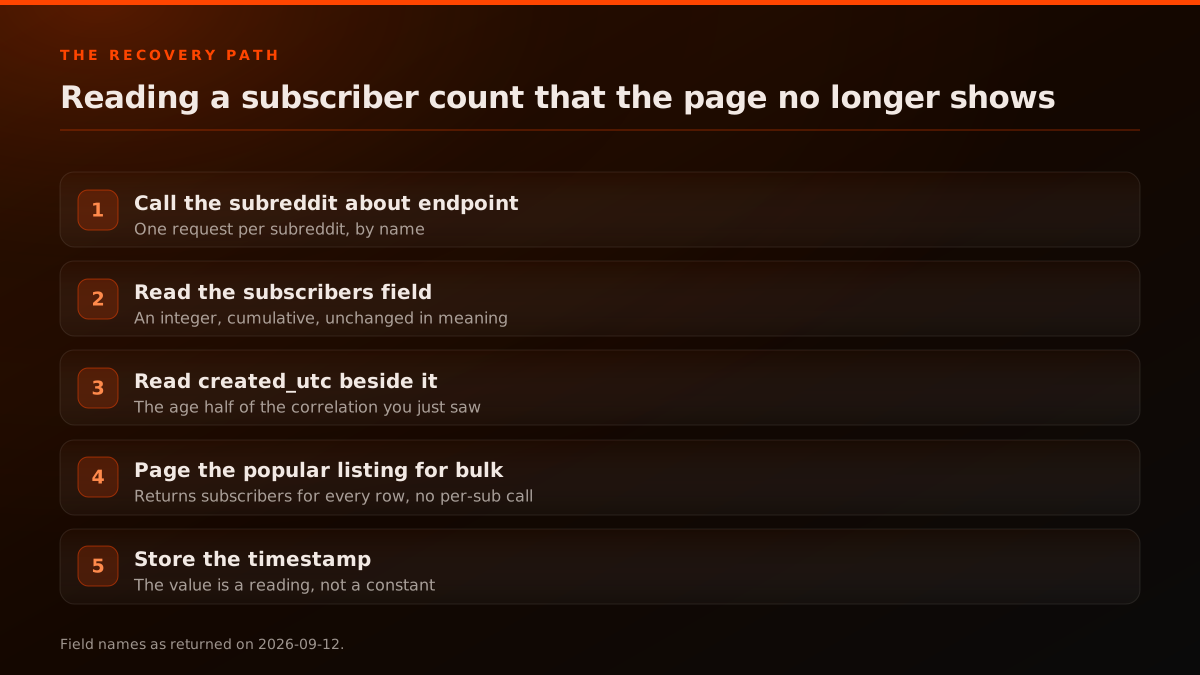
Two fields in that response matter more than people expect. created_utc is the subreddit's creation timestamp, and it is the age half of the correlation this post is built on, so if you are pulling subscribers you should pull it in the same call rather than going back for it later. active_user_count is present as a key but came back null on every subreddit we sampled, so treat it as unavailable rather than as a zero. A null that gets stored as a zero is one of the most common ways a Reddit dataset quietly becomes wrong, and the same trap applies across Reddit audience research generally.
Neither Visitors nor Contributions appears in the about response. The two metrics that replaced the member count on the page are not available through the same endpoint that still serves the metric they replaced, which is a genuinely awkward state of affairs and the main practical reason this post exists.
How do you pull subscriber counts for many subreddits at once?
Page the popular subreddits listing instead of calling the about endpoint once per name. The listing returns full metadata per row, including subscribers and created_utc, so a single request covers up to 100 communities. We collected 200 subreddits in two requests this way, which is 198 requests fewer than the naive approach and a meaningful difference once rate limits are in play.
The choice between the two endpoints is really a choice about whether you know the names in advance. If you have a fixed watchlist of specific communities, the per-subreddit about call is correct and there is no bulk shortcut for it. If you want a ranked slice of Reddit by popularity, the listing is both cheaper and more complete, and how the popular listing ranks is worth understanding before you treat its order as a leaderboard, because popular is not the same as largest.
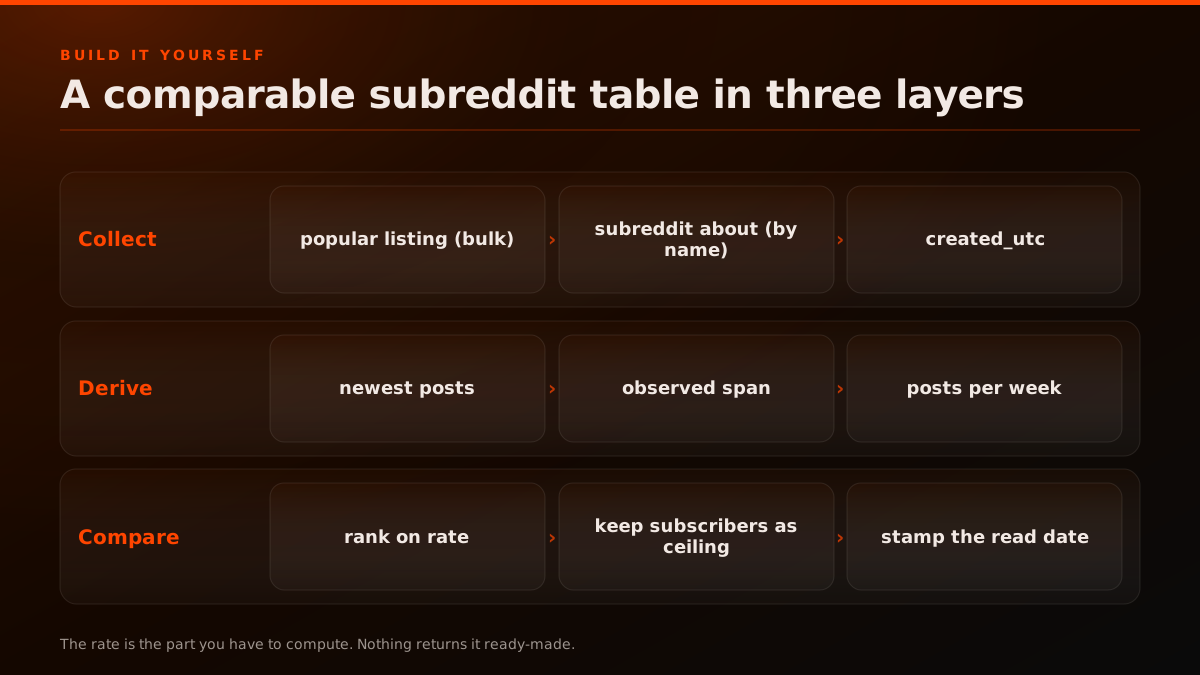
The one thing neither endpoint gives you is a rate. Nothing in the API returns posts per week, growth per month, or any derivative of two readings. That is the layer you build, and it is the layer that turns out to carry all the signal.
What are Visitors and Contributions, exactly?
They are both seven-day metrics, defined precisely in Reddit's announcement, and the precision is what makes them incomparable to what they replaced. Visitors is how many different users visited a subreddit in the past seven days, based on a rolling 28-day average. Contributions is the total number of non-removed posts and comments made in a community in the past seven days.
- Visitors: different users who visited in the past 7 days, on a rolling 28-day average
- Contributions: non-removed posts plus comments made in the past 7 days
- Both: windowed, so both fall when a community goes quiet
- Neither: available through the data API, which is the awkward part
Two details in those definitions do real work. The rolling 28-day average on Visitors means the number you see is smoothed, so a single viral day will not spike it the way a raw seven-day count would. The word "non-removed" in Contributions means the figure is net of moderation, so a heavily moderated community reports lower than its raw submission volume, and two subreddits with identical posting rates can show different Contributions purely because one removes more.
The swap
Members against Visitors and Contributions, on the dimensions that change your work
| Members | Visitors | Contributions | |
|---|---|---|---|
| What it counts | Accounts that subscribed | Unique users who visited | Posts plus comments |
| Window | All time, cumulative | 7 days, rolling 28-day average | 7 days |
| Goes down when a community dies | No | Yes | Yes |
| Shown on the subreddit page today | No | Yes | Yes |
| Returned by the data API | Yes | No | No |
| Comparable across subreddits of different ages | Poorly, it compounds with age | Yes | Yes |
Why are Members, Visitors and Contributions not comparable?
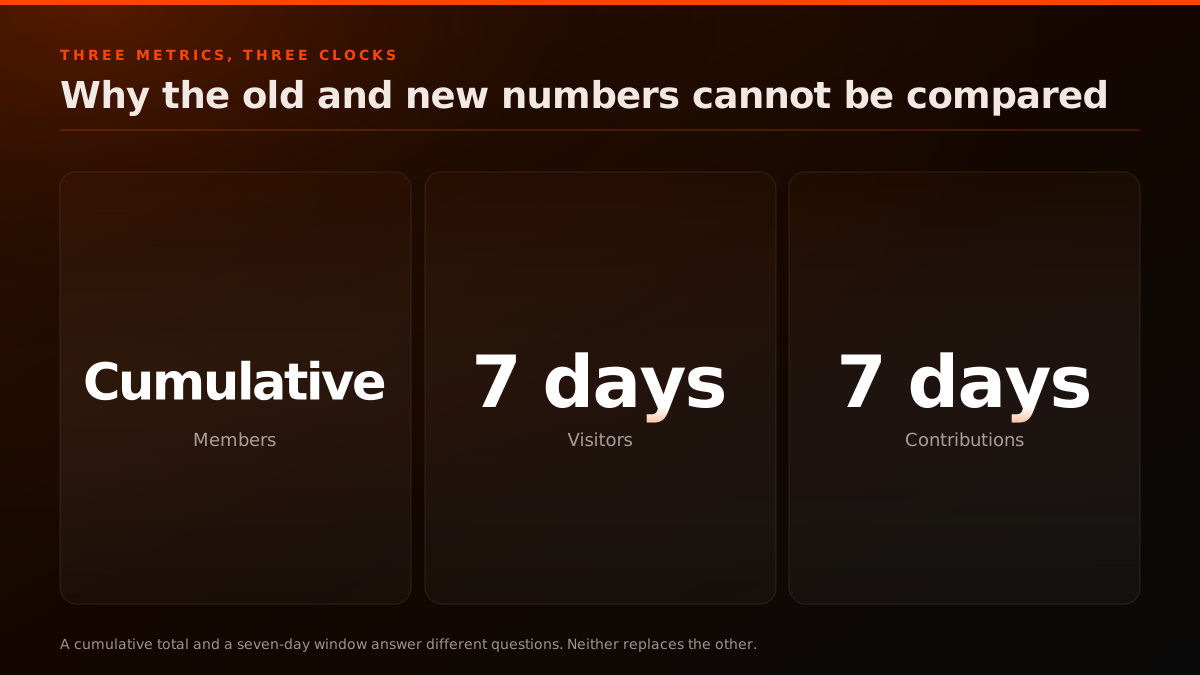
Because they run on different clocks, and one of them does not decay. Members counted every account that ever subscribed, cumulatively, since the subreddit was created, and never went down when those accounts went dormant or were deleted. The two replacements count activity inside a seven-day window. A cumulative lifetime total and a weekly snapshot are not two versions of the same measurement.
- Members: cumulative since the subreddit was created, never decreases
- Visitors and Contributions: seven-day windows, reset continuously
- The predictable misreading: a large drop from the old number read as decline
- The actual cause: a changed denominator, not a changed community
This produces a predictable misreading that showed up constantly in the reaction threads. A community that accumulated ten million subscriptions over eighteen years now displays a Visitors figure that is orders of magnitude smaller, and the natural inference is that the community collapsed. It did not. The denominator changed. Nothing about a seven-day visitor count was ever going to approach an eighteen-year subscription total, and the gap between them is arithmetic rather than evidence.
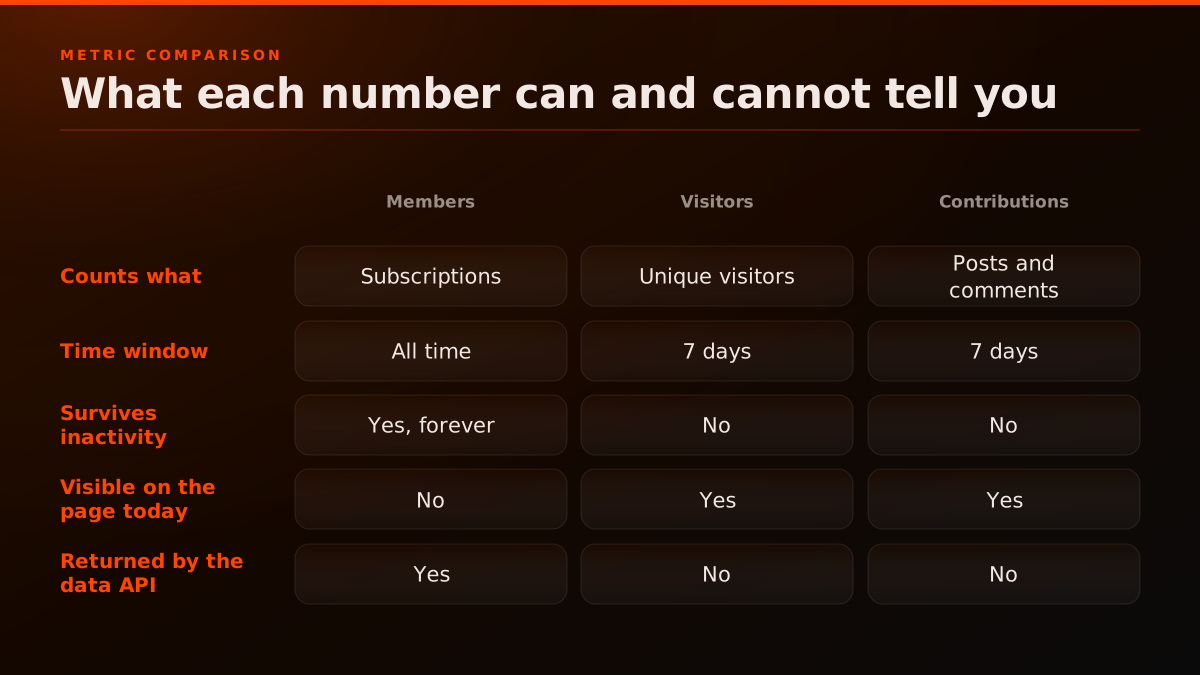
The practical consequence is that any historical comparison you have is now broken. If you recorded member counts for a set of subreddits in 2024 and you try to compare them against what the page shows in 2026, you are comparing two different quantities and the trend you compute will be meaningless. The only way to extend a members time series across the change is through the API, which is one more reason the field still being served matters.
Was Reddit right that subscriber count measures age, not activity?
Yes, and we did not expect that answer. This is the part of the post where we stopped reading the announcement and started measuring, because Reddit made a claim about data and a claim about data can be checked.
- Our prior, written before the run: activity would dominate age
- What we found: age dominates, and activity is effectively uncorrelated
- Sample: 120 subreddits from Reddit's own popular listing
- Verdict: Reddit's stated reason survives the test
We wrote the prior into the measurement script before running it, in the script's own docstring, so that it could not be adjusted afterwards. The prior was that Reddit would be wrong: our expectation was that activity would dominate age, on the reasoning that subscriptions accumulate because people show up, so the communities with the most subscribers should also be the ones with the most going on. That reasoning is intuitive and the data does not support it.
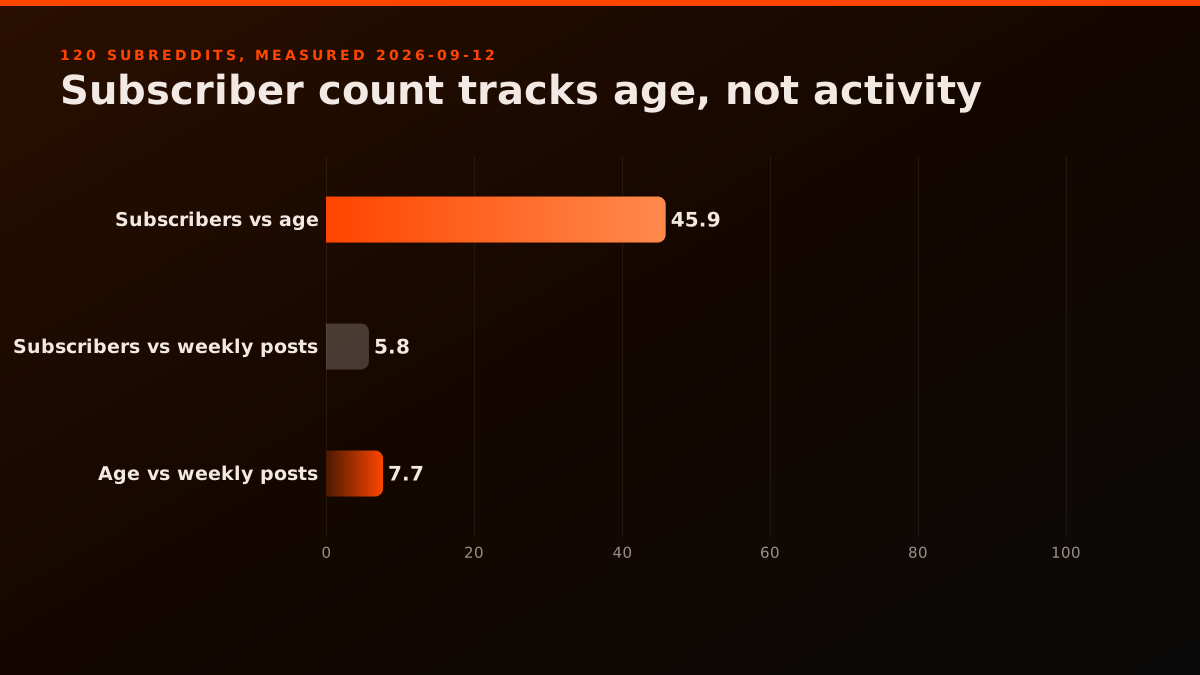
Across 120 subreddits, subscriber count correlates with subreddit age at a Spearman coefficient of +0.459, and with current weekly posting at +0.058. The first is a moderate relationship. The second is close enough to zero that subscriber count carries essentially no information about how much gets posted in a community. Age and activity are similarly unrelated to each other at +0.077, which rules out the tidy story that old subreddits are simply quiet ones.
Does subscriber count track age or activity?
| Relationship | Spearman | Reading | Source |
|---|---|---|---|
| Subscribers vs subreddit age | +0.459 | Moderate. Older subreddits have more subscribers | measured |
| Subscribers vs weekly posts | +0.058 | Effectively none. Size does not predict activity | measured |
| Subreddit age vs weekly posts | +0.077 | Effectively none. Age does not predict activity either | measured |
How was the measurement built, and what would falsify it?
Sample first. We took 200 subreddits from the Reddit data API's own popular listing across two requests and measured the first 120 for activity. Using Reddit's listing rather than a hand-picked set matters because it removes our judgment from the sample: we did not choose which communities to include, and the selection is reproducible by anyone with API access.
For each subreddit we read subscribers and created_utc straight from the listing. For activity we pulled the 100 most recent posts and derived a weekly rate from the real time span those posts cover, rather than counting how many fell inside a fixed seven-day bucket. That choice is the methodological core of the whole study. A bucket count saturates: for a busy subreddit, all 100 posts land inside the window and the count reads 100 no matter whether the true figure is 200 or 20,000. A rate does not saturate, because a busier community simply produces a shorter span.
What 120 subreddits returned, and what that rules out
Subreddits measured
120
Returned a subscriber count
200 of 200
Usable activity reading
120 of 120
The third row is the limitation that governs every number in this post. Nothing here is a claim about the long tail of small subreddits, which were not sampled.
Spearman rank correlation was used rather than Pearson because both distributions are heavily skewed, with a handful of enormous subreddits and a long tail of merely large ones.
What would falsify this: re-run the script against a fresh sample and look at the second row of the correlation table. If subscriber count genuinely tracked activity, that number would be large. Anyone can check it, and the script is preserved with this post's research rather than described in prose.
Why Spearman and not a straight correlation?
Because both distributions are severely skewed, and a Pearson correlation on skewed data reports the influence of the largest few points rather than the shape of the relationship. Our sample runs from 87,115 subscribers to 67,589,868, and from 0.8 weekly posts to 22,418.8. A handful of enormous values at the top of each range would dominate a Pearson coefficient and the number would end up describing r/AskReddit rather than describing Reddit.
- The problem: both distributions are severely skewed
- What Pearson would report: the influence of the few largest subreddits
- What Spearman reports: whether the two orderings agree, which is what ranking uses
- Why it is the conservative choice: it is likelier to find a weak real relationship, and did not
Spearman's rank correlation sidesteps that by replacing each value with its rank before correlating, so it measures whether the ordering of subreddits by subscribers matches their ordering by activity. That is the question we actually care about, because ranking is what people do with these numbers: they sort a list of candidate communities and work down it.
The choice is also the more conservative one for our conclusion. Rank correlation is generally more forgiving of a noisy relationship than Pearson is, so if a real monotonic link between size and activity existed, Spearman is the method more likely to find it. It returned +0.058.
What does "non-removed" do to the Contributions number?
It makes Contributions a measure of moderation as much as a measure of activity, which is worth understanding before you treat it as ground truth. Reddit's definition is explicit that Contributions counts non-removed posts and comments in the past seven days. A submission that AutoModerator pulls, a comment a moderator deletes, and a post caught by a spam filter all vanish from the figure.
- Excluded: anything AutoModerator pulls, a moderator deletes, or a spam filter catches
- Effect: a heavily moderated community reports lower at the same raw submission rate
- For a researcher: a confound you cannot see or correct for
- For a poster: arguably the more honest number, since removed posts reach nobody
The practical effect is that two communities with identical raw submission rates will report different Contributions if one moderates harder than the other, and the more heavily moderated one looks less active. For a researcher that is a confound. For a poster it is arguably the more honest number, because a post that gets removed never reaches anyone, so counting it would overstate the community's real throughput from your point of view.
Our own submission-rate measure sits on the other side of this line. We counted posts the listing returned, which is the post-moderation view as well, since removed submissions do not appear in a subreddit's recent listing. So our rates and Reddit's Contributions are measuring adjacent things rather than the same thing, and we have not measured how closely they track, because Contributions is not exposed through the API and we could not compare them directly.
What does the API return when a subreddit is private, banned or misspelled?
Not a subscriber count, and the three cases are distinguishable, which matters because a pipeline that treats them identically will quietly corrupt a dataset. A misspelled or nonexistent name is a straightforward miss. A private subreddit exists but withholds most of its metadata. A banned or quarantined community behaves differently again.
The failure worth guarding against is the one that does not throw. If your code reads a subscriber count into a variable with a default of zero, every one of those three cases becomes a subreddit with zero subscribers, and a zero is a perfectly plausible-looking value that will sit in your table forever. The same trap applies to active_user_count, which is present as a key and came back null on every subreddit in our sample: stored naively, that null becomes a zero and you have manufactured a fact.
Write the loader so that missing and zero are different states, log the ones that missed, and check the log rather than the row count. A sweep that returns 118 rows when you asked for 120 has told you something, but only if something is watching.
Start building with Redditapis
Reads $0.0015, votes $0.005, writes $0.012, DMs $0.025. $0.50 free credits.
How often should you re-read the number?
Less often than most dashboards do, because the field is cumulative and moves slowly, and more often than never, because a single reading is not a series. Subscriber counts drift upward by small percentages over weeks for most communities, so a daily read on a stable watchlist is mostly spent confirming that nothing changed.
- Weekly: a sensible default, and it lines up with Reddit's own seven-day windows
- Daily: justified only while watching a specific event or launch
- Once: not a series, and therefore not a growth rate
- Never assume: posting rates move between runs, so stamp every reading
Weekly is a reasonable default for a growth series, and it lines up with the seven-day window Reddit's own replacement metrics use, which makes the two easier to reason about together. If you are tracking a community during a specific event, a launch or a news cycle, daily is justified for that window because the subscription rate is exactly what you are trying to observe.
The thing to avoid is reading it once and treating that reading as a property of the subreddit. Every figure in this post carries the date 12 September 2026 for that reason. Posting rates in particular are live and move between runs: our two re-measurements of r/WTF returned 5.3 and 6.3 posts per week hours apart, which is the same community and the same method reading a genuinely fluctuating quantity.
A worked pass: ranking a watchlist on something that predicts
The whole argument of this post collapses into about twenty lines of work. For each subreddit on your list, make one call for metadata and one for recent posts, then derive the rate.
# One metadata read and one listing read per subreddit.
# The rate is the part nothing returns ready-made.
import time

def profile(client, name, page=100):
    about = client.get(f"/api/reddit/sub/{name}/about")
    posts = client.get("/api/reddit/posts",
                       {"subreddit": name, "sort": "new", "limit": page})["posts"]
    if not posts:
        return {"name": name, "subscribers": about.get("subscribers"),
                "posts_per_week": None, "note": "no posts returned"}

    now = time.time()
    oldest = min(p["created_utc"] for p in posts)
    span_days = max((now - oldest) / 86400, 0.01)     # never divide by zero
    rate = len(posts) / span_days * 7                  # a rate, not a bucket count

    return {
        "name": name,
        "subscribers": about.get("subscribers"),       # the reach ceiling
        "age_years": (now - about["created_utc"]) / 31557600,
        "posts_per_week": round(rate, 1),              # what you rank on
        "comments_on_recent": sum(p.get("comments") or 0 for p in posts),
        "read_at": time.strftime("%Y-%m-%dT%H:%M:%SZ", time.gmtime(now)),
    }

watchlist = ["NoStupidQuestions", "WTF", "funny", "AskReddit"]
rows = [profile(client, n) for n in watchlist]
rows.sort(key=lambda r: r["posts_per_week"] or 0, reverse=True)
Three details in that snippet are the difference between a number and a measurement. span_days is floored so a subreddit that posted its last 100 submissions inside a minute cannot divide by zero and produce infinity. posts_per_week is None rather than 0 when the listing comes back empty, so an absent reading never masquerades as a dead community. And read_at is stored on every row, because the rate is a snapshot and a row without a timestamp cannot be compared against a later one.
Run that against the four communities above and the ordering inverts against the member count. That inversion is the entire finding, reproduced in a loop you can run in a minute. Authentication for the client is covered in the OAuth walkthrough; if you are working in TypeScript rather than Python the same two calls are in the Node walkthrough.
Where the old number still shows up, and why that matters
The member count did not stop circulating when Reddit stopped displaying it. Third-party subreddit statistics sites still publish it, media kits still quote it, and every dashboard built before September 2025 that has not been repointed is either showing a stale cached figure or showing nothing. That creates a situation where the number is simultaneously harder to find and more widely republished than before, which is the worst of both.
- Third-party stat sites: still publishing it, mostly read from the same API field
- Media kits and decks: still quoting it, often with no date attached
- Old dashboards: showing a stale cached value or nothing at all
- The real risk: provenance and staleness rather than accuracy
The republished figures are not necessarily wrong. Most of the tools showing you a subreddit's size are reading the same API field we are, which is why they kept working when the page stopped showing it. The risk is not accuracy, it is staleness and provenance: a quoted member count with no date attached could have been read yesterday or cached in 2024, and nothing in the presentation tells you which.
This is the same provenance problem that makes platform-level Reddit statistics hard to trust generally, where headline user figures trace back through aggregators to a small number of primary sources and the date gets lost at each hop. We have written about that chain in detail for audience figures in Reddit demographics and where published numbers come from, and the lesson transfers directly: read the number yourself, stamp it with a date, and treat any undated figure as unusable rather than as approximately right.
If you want Reddit's own view of what data it holds and exposes, the developer documentation and the public API listing are the primary sources, and moderator-facing product changes are announced in r/modnews rather than in the moderator support community, which is itself the subject of a well-upvoted complaint quoted earlier in this post.
How does this compare to what other platforms do?
Reddit is unusual in the direction it moved, and the comparison explains why the reaction was so large. Most platforms have drifted toward hiding or abbreviating engagement numbers rather than replacing them with activity measures: rounded follower counts, hidden like counts, and view counts that appear and disappear by product decision. The most upvoted prediction in the r/whenthe thread, at 454 upvotes, was that Reddit would follow that pattern and simply abbreviate the counts.
- The common pattern: hide or abbreviate counts, which is what most readers predicted
- What Reddit did instead: replace a vanity metric with two participation metrics
- The direction: defensible, and our data supports it
- The execution: each number now lives on a surface the other audience cannot reach
That is not what happened. Reddit replaced a vanity metric with two participation metrics, which is a more interesting move and, on our data, a defensible one. The company framed it as becoming one of the first major platforms to publicly display active participation rather than subscriber numbers.
The awkwardness is in the execution rather than the direction. The old number remains available to developers and unavailable to readers, the replacements are available to readers and unavailable to developers, and no single surface carries both. A researcher comparing forty communities now needs the API for one half of the picture and a browser for the other, which is a strange place for a platform to land when the stated goal was clarity. The uneven distribution of participation that motivates the whole change is itself an old observation, usually discussed as the one percent rule about how few members of an online community ever contribute.
Could the result be an artefact of the sample?
This was the first thing we tried to break, because a near-zero correlation is exactly the shape a broken measurement produces. The obvious suspect is range restriction: if every subreddit in the sample is already highly active, then activity barely varies and a correlation against it collapses toward zero for reasons that have nothing to do with subscribers.
- The suspect: range restriction, where everything sampled is already active
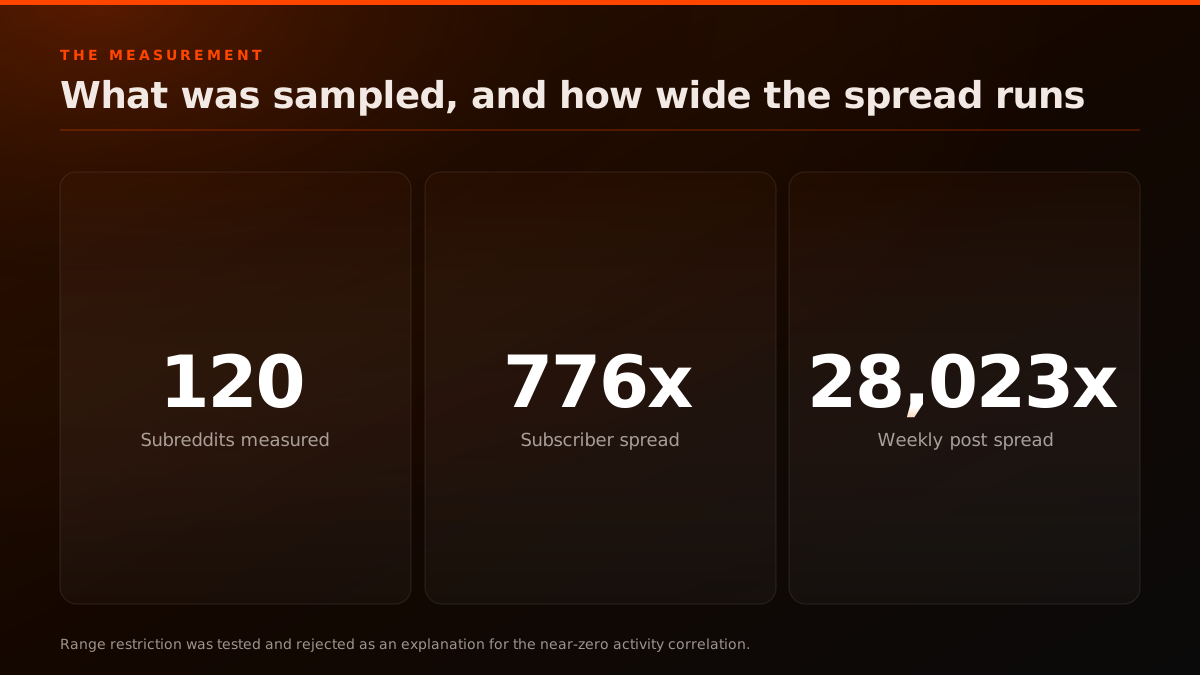
- Subscriber spread: 776x, from 87,115 to 67,589,868
- Weekly post spread: 28,023x, from 0.8 to 22,418.8
- Verdict: the activity variable has the widest spread, which is the opposite of compression
We checked, and range restriction does not explain it. Subscriber counts in the sample span a factor of 776, from 87,115 to 67,589,868. Weekly posting spans a factor of 28,023, from 0.8 posts per week to 22,418.8. Age spans 3.8 to 19.1 years. The activity variable has the widest spread of the three by a large margin, which is the opposite of the compression that a range-restriction artefact requires.
We also re-measured the two most surprising rows independently before publishing them, because a number that surprises you deserves a second instrument. r/WTF returned 100 posts spanning 110.5 days, with the oldest dated 25 May 2026, and r/facepalm returned 100 spanning 77.9 days. Both reproduced their low rates on a second run at a later timestamp. These are live readings and they move slightly between runs, which is exactly why every figure in this post carries a measurement date.
Which subreddit pairs prove the point fastest?
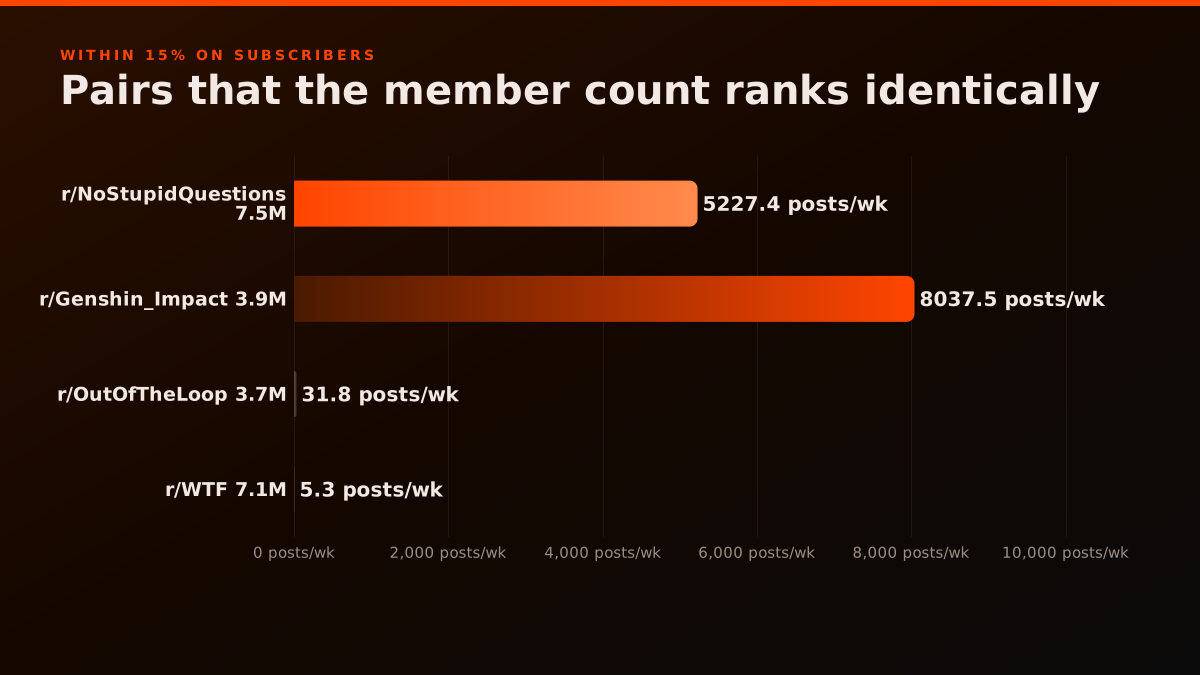
The correlations are the finding, but a pair of named communities is what makes it stick. Our sample contains 81 pairs that sit within 15 percent of each other on subscriber count and at least ten times apart on weekly posting. The member count ranks every one of those pairs as near equals.
- r/funny vs r/AskReddit: near-identical member counts, 189x apart on weekly posts
- r/NoStupidQuestions vs r/WTF: 7,482,385 against 7,087,557 members, 986x apart on posting (our measurement, 12 September 2026)
- r/Genshin_Impact vs r/OutOfTheLoop: 3,901,632 against 3,731,363 members, 253x apart (our measurement, 12 September 2026)
- In total: 81 such pairs in a 120-subreddit sample
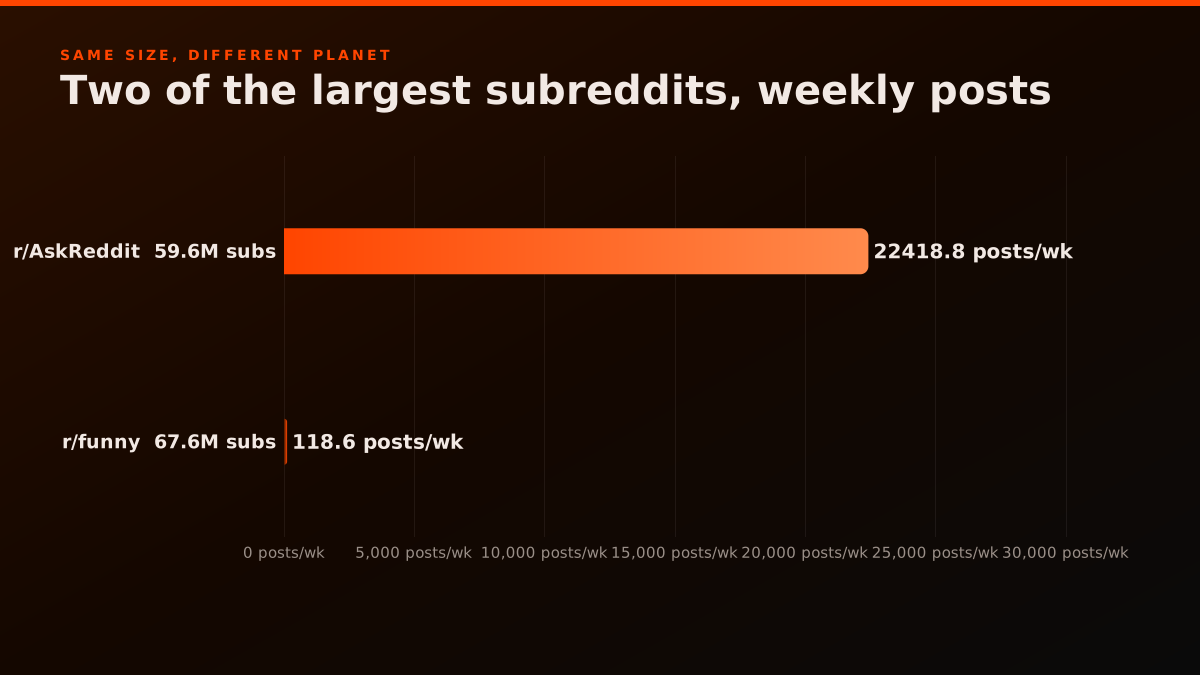
The cleanest example is the biggest. r/funny has 67,589,868 subscribers and posts 118.6 times a week. r/AskReddit has 59,590,037 subscribers and posts 22,418.8 times a week. On the metric Reddit removed, those two communities are peers and r/funny is the larger of the pair. On actual submission volume they differ by a factor of 189, in the other direction.
Subreddits the member count ranks as equals
| Pair | Subscribers | Posts per week | Activity ratio | Source |
|---|---|---|---|---|
| r/NoStupidQuestions vs r/WTF | 7,482,385 vs 7,087,557 | 5,227.4 vs 5.3 | 986x | measured |
| r/NoStupidQuestions vs r/facepalm | 7,482,385 vs 8,106,863 | 5,227.4 vs 9.0 | 581x | measured |
| r/Genshin_Impact vs r/OutOfTheLoop | 3,901,632 vs 3,731,363 | 8,037.5 vs 31.8 | 253x | measured |
| r/AskReddit vs r/funny | 59,590,037 vs 67,589,868 | 22,418.8 vs 118.6 | 189x | measured |
The widest pair in the sample is more extreme still. r/NoStupidQuestions and r/WTF are within six percent of each other on members, at 7,482,385 and 7,087,557, and their weekly posting rates are 5,227.4 and 5.3. That is a factor of 986.

Does subscriber count predict anything at all?
It predicts age, moderately, and that is genuinely the bulk of what it carries. A subreddit with a very large subscriber count is very likely to be old, because subscriptions accumulate and never decay, so eighteen years of slow accumulation beats four years of fast accumulation in most cases. That is a real relationship and it is the one Reddit named.
- Yes: subreddit age, moderately, at +0.459
- No: current posting activity, at +0.058
- The quintile check: median weekly posts do not climb with subscriber band
- The reading: a trace of information, nowhere near enough to rank on
The quintile view makes the absence of an activity relationship easier to see than a correlation coefficient does. Split the 120 subreddits into five equal bands by subscriber count and the median weekly posting rate does not climb with size. The largest band posts a median of 347.1 times a week, the second-largest posts 532.6, and the smallest band, spanning 87,115 to 1.4 million subscribers, posts 398.9. The band with the most subscribers is not the band with the most posting, and the band with the fewest is not the band with the least.
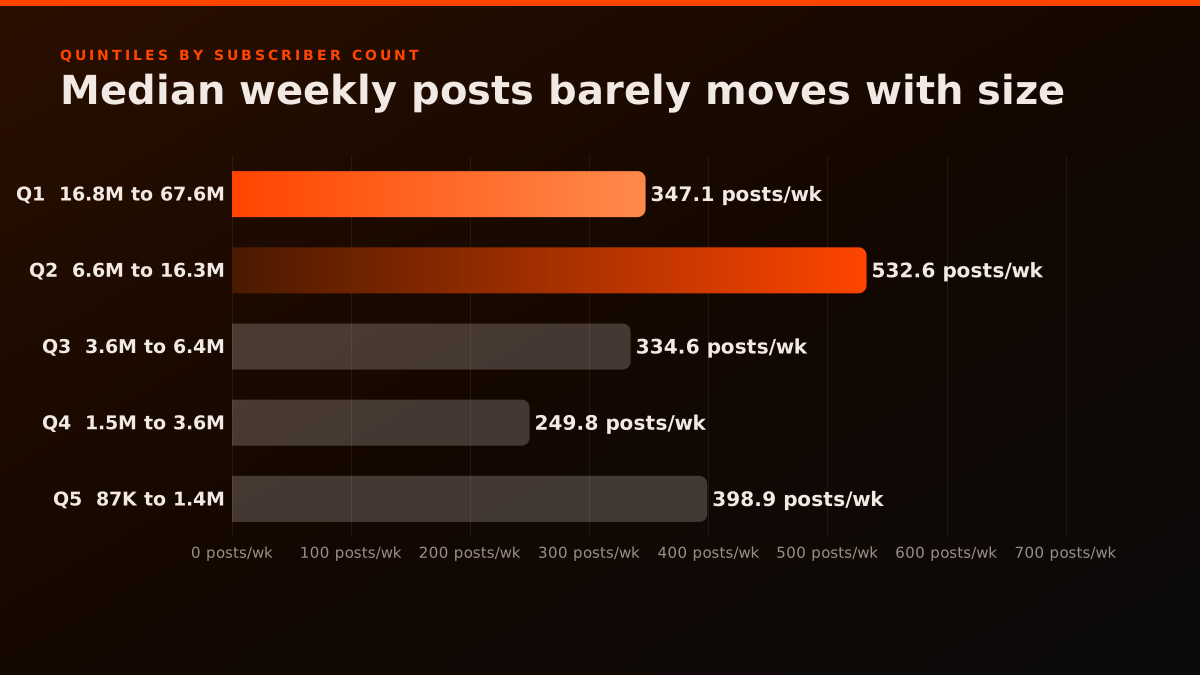
Median weekly posts by subscriber quintile
| Quintile | Subscriber range | Median posts per week | Median age | Source |
|---|---|---|---|---|
| Q1, largest | 16,790,908 to 67,589,868 | 347.1 | 18.3 years | measured |
| Q2 | 6,640,601 to 16,279,471 | 532.6 | 16.5 years | measured |
| Q3 | 3,597,840 to 6,387,295 | 334.6 | 13.3 years | measured |
| Q4 | 1,533,778 to 3,573,153 | 249.8 | 14.0 years | measured |
| Q5, smallest | 87,115 to 1,397,455 | 398.9 | 13.6 years | measured |
Fifteen percent of the sample, 18 of 120 subreddits, posts under 100 times a week despite appearing in Reddit's own popular listing. Fourteen of them carry more than five million subscribers.
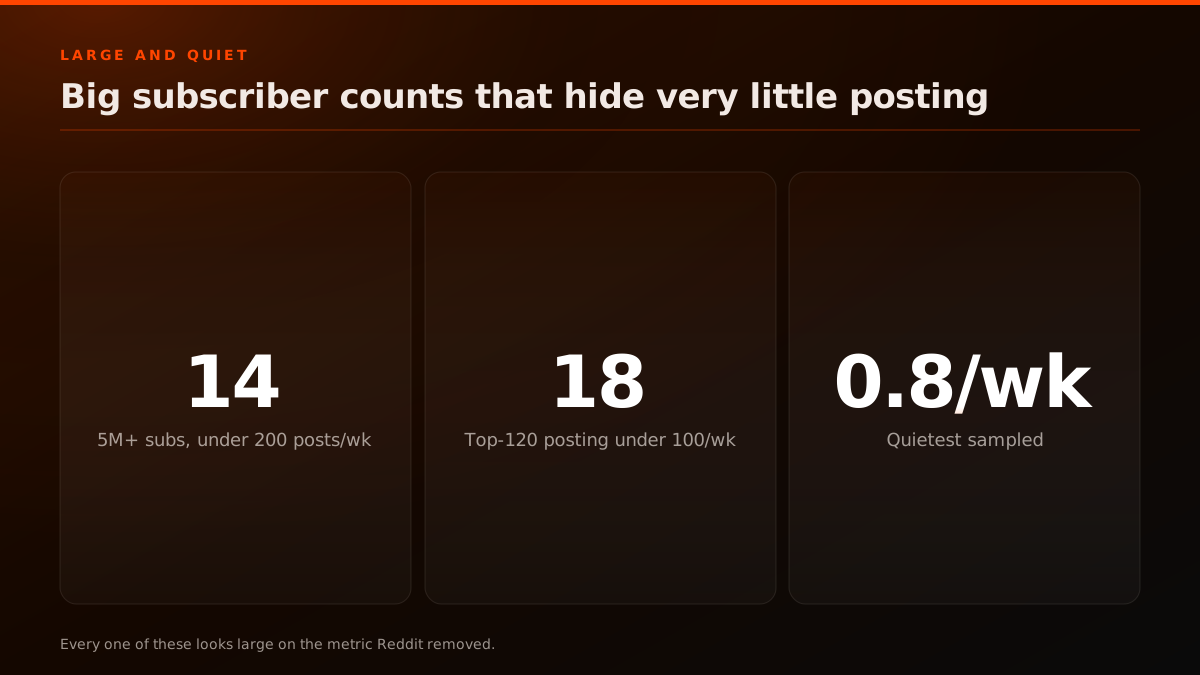
Is Reddit a ghost town, then?
No, and this is where the data cuts against a popular conclusion rather than for it. The observation that huge subreddits can be quiet has been circulating for years, and its most viral expression is a post that reached over 1.3 million views arguing that Reddit is a ghost town, citing r/funny at 60 million members with only 44 posts in twenty-four hours.
- The claim: a viral post citing r/funny at 60M members and 44 posts a day
- Our corroboration: r/funny posts 118.6 times a week, the same order of magnitude
- The counter-evidence: r/AskReddit posts 22,418.8 times a week in the same sample
- The conclusion: enormous variance between communities, not a dying platform

Reddit Lies
@reddit_lies
Reddit is a ghost town now. The largest subreddit (r/funny) has 60 million members but had only 44 posts in the past 24 hours. r/Apple, 5 million, only had 9 posts over 24 hours. TBH I don’t think Reddit survives past the 2024 election after the bots turn off. https://t.co/6L9… Show more


Our measurement independently corroborates the observation. We found r/funny posting 118.6 times a week, roughly 17 a day, which is the same order of magnitude as that post's figure taken two years earlier. The specific claim about r/funny is fair.
The conclusion drawn from it is not. In the same sample and on the same day, r/AskReddit posted 22,418.8 times a week and r/Genshin_Impact posted 8,037.5. A platform where one large community produces 17 posts a day and another produces more than 3,000 is not a dying platform, it is a platform with enormous variance between communities. The correct reading of the r/funny number is that r/funny is quiet, and the reason the ghost-town framing feels persuasive is precisely the failure this post is about: if you rank communities by member count, the quiet giants are the ones you look at first.
What can you still legitimately use the subscriber count for?
Two things, and they are both real. The first is as a reach ceiling. Subscriber count tells you the maximum number of accounts that have ever opted into seeing a community's posts in their feed, which is a genuine upper bound on passive distribution even if most of those accounts are inactive. No other Reddit metric gives you that ceiling, and Visitors explicitly does not, because it excludes everyone who did not show up this week.
- A reach ceiling: the maximum accounts that ever opted into the community
- A growth series: cumulative and monotonic, so two readings give a rate
- Not a health check: it cannot tell you whether anyone posted this week
- Not a substitute: neither replacement metric can be differenced into a growth rate
The second is as a growth series, and this is the use that the removal actually damaged most. Because the field is cumulative and effectively monotonic, two readings taken weeks apart give you a growth rate. Nothing in the API returns growth directly, and neither Visitors nor Contributions can be differenced into one, because both are already windowed and both fluctuate with events. If you want to know whether a community is gaining ground, you have to store timestamped subscriber readings yourself and diff them.
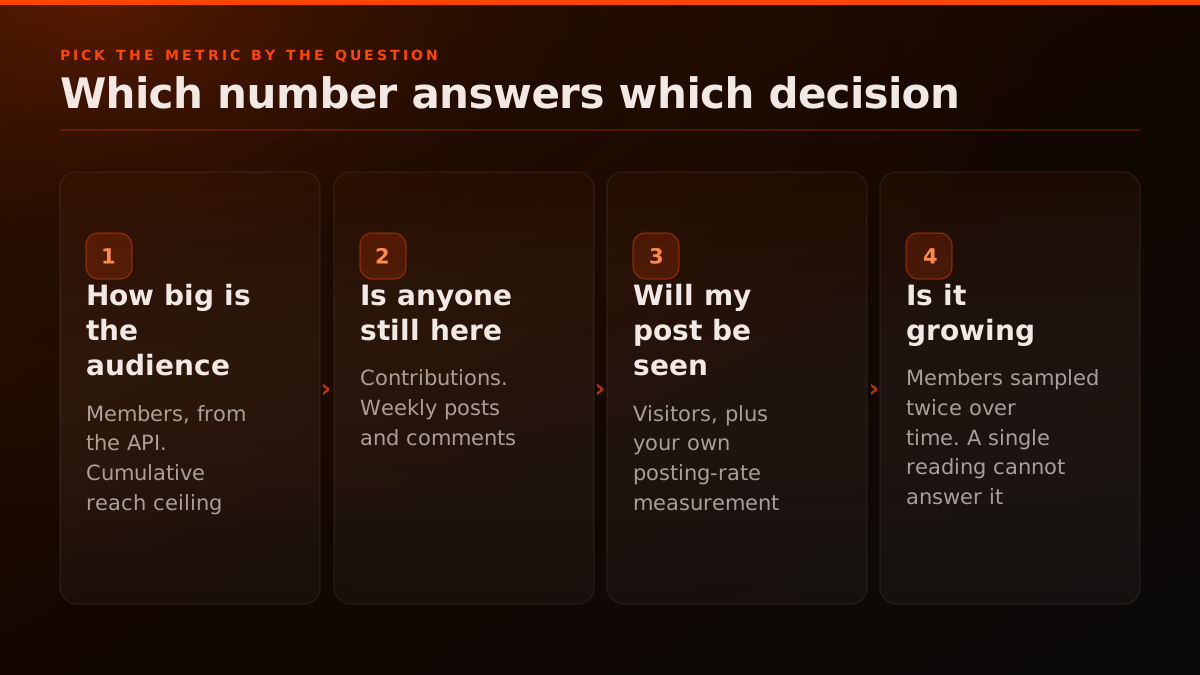
What it cannot do is tell you whether anyone is posting right now, which is the question most people are asking when they look it up. That is the mismatch at the centre of everything above.
How do you measure real subreddit activity yourself?
Derive a rate from the newest posts. Pull a page of recent submissions, take the timestamp of the oldest post in that page, and divide the post count by the real span it covers. That is the method we used across 120 subreddits and it is about fifteen lines of work on top of a call you are already making.
- Pull: a page of recent submissions
- Take: the timestamp of the oldest post in that page
- Divide: post count by the real span, giving posts per week
- Add: comment counts and the subreddit's rules in the same pass
The reason this beats the obvious alternative is saturation. Counting how many of the last 100 posts fall inside a seven-day window returns 100 for every busy subreddit, which flattens r/AskReddit and a community posting 200 times a week into the same value. Deriving the rate from the span keeps them apart, and in our sample it kept apart communities that differ by four orders of magnitude.
Two refinements are worth the effort once the basic rate is working. Sum the comment counts on those recent posts alongside them, because submission volume and discussion depth are different things and a subreddit can be busy on one and dead on the other. And pull the subreddit's rules in the same pass, because a community that posts 5,000 times a week is useless to you if its rules forbid what you intend to post, which is the subject of what it actually takes to post and of reading subreddit rules as JSON.
If you are building this as a standing dashboard rather than a one-off script, the endpoint selection and storage shape are covered in building a Reddit analytics dashboard from the API, and the tooling landscape in subreddit analytics approaches compared.
What workarounds did the community build, and where do they stop?
Three, and the pattern across all three is instructive: each one restores the number for the person who already has the most access, and none of them helps the person asking about someone else's community.
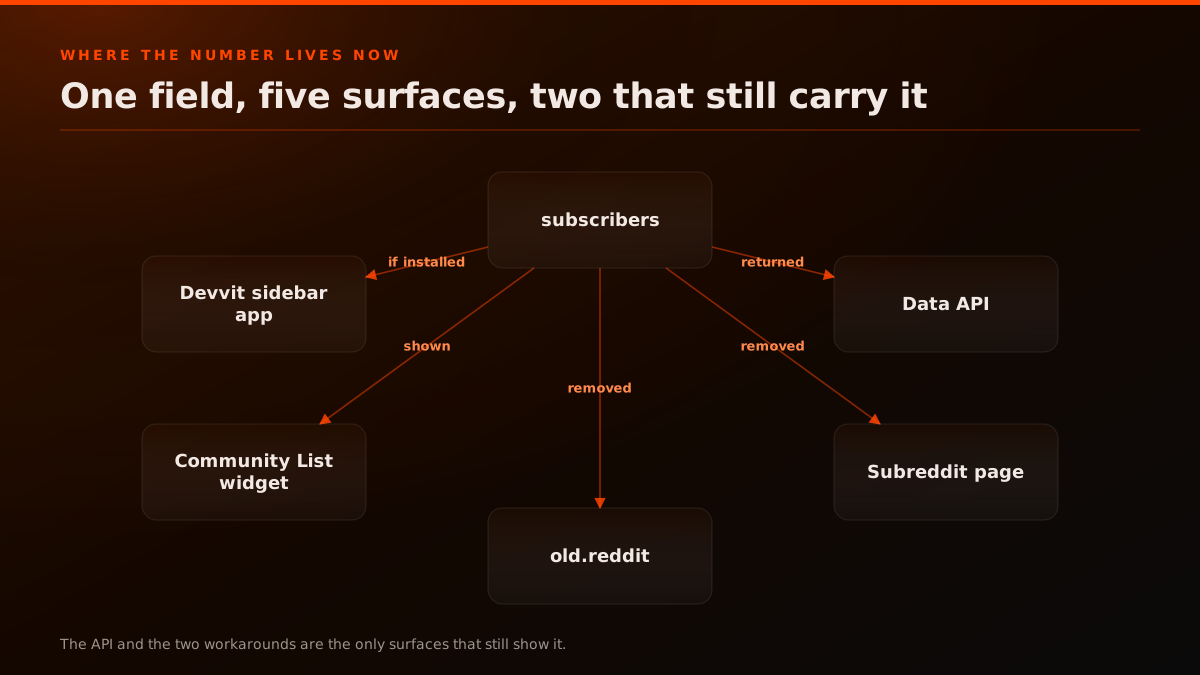
- Community List widget: works on modern Reddit, not old.reddit, your own subreddit only
- Userscript: restores it in your browser, for you alone
- Devvit Subscriber Sidebar: the most complete, and only where a moderator installs it
- The gap all three share: none helps with a community you do not control

The first is a Community List sidebar widget. Add your own subreddit to the widget and the member count renders there, which works on the modern web interface and not on old.reddit. The second is a userscript that restores the counter in your own browser, which works for you and nobody else. The third is a Devvit app called Subscriber Sidebar, published by a community developer and installable by moderators, which puts the statistic back in the sidebar of subreddits where it is installed.
When reddit replaced the subscriber count with its new metrics, this left Old Reddit with nothing — is there a way to get the subscriber count back?
For context, see [this question](https://old.reddit.com/r/help/comments/1niqyki/where_is_the_subscriber_count/) and its replies (e.g.…
That app is the most complete of the three and its author stated its limit clearly in the same thread: Devvit apps cannot make changes to subreddits that they are not installed in. So a moderator can restore the number for their own community, and a researcher comparing forty communities they do not moderate is no better off than before.
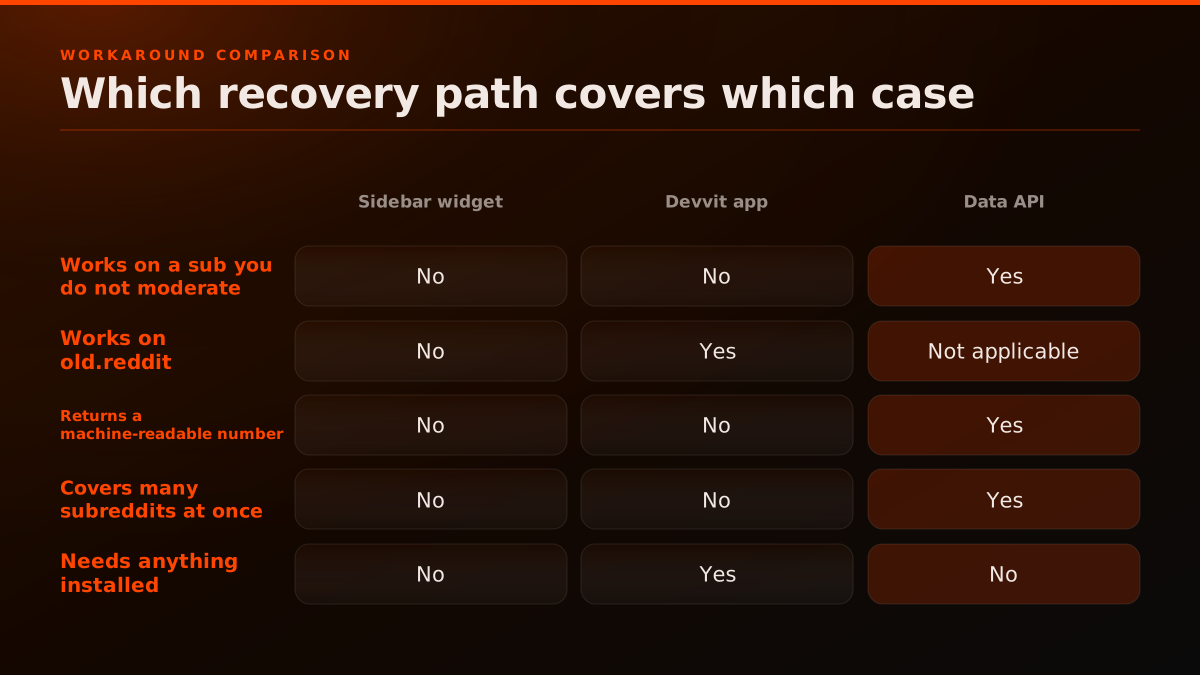
The API is the only route in that comparison that returns a machine-readable number, covers subreddits you do not control, and handles many communities in one pass. That is not a marketing claim, it is what the columns say.
What breaks when you compare subreddits on the wrong number?
Community selection, mostly, and it breaks quietly. The decision that depends on subreddit size more than any other is where to post, and the default sort everyone reaches for is members. Our sample contains 81 pairs where that sort is actively misleading by a factor of ten or more.
- Community selection: the decision most dependent on size, and the one that breaks quietly
- Rule eligibility: whether links are allowed in posts as opposed to comments
- Hidden gates: unstated karma or account-age requirements
- Demand: whether anyone in that community ever asks for what you sell
Operators say this out loud. A thread posted on 8 September 2026, four days before this research ran, is built around the claim that picking a subreddit by subscriber count is why launches die, and the replies add checks that have nothing to do with size: whether the community's rules permit links in posts as opposed to comments, whether an unstated karma or account-age gate exists, and whether anyone in that community ever asks for the kind of thing you sell.
That last point is the sharpest one, and it is a demand check rather than a supply check. A subreddit can be large, active, open to links and well moderated, and still never produce a thread where someone asks for what you have built. Size tells you none of that, activity tells you only part of it, and the only way to answer it is to search the community's own history, which is what search with boolean operators and the comment search endpoint are for.
The cheapest Reddit API. Try it free.
Reads from $0.0015 per call. $0.50 free credits. No credit card required.
How should you actually choose a subreddit to post in?
Work down from the question you are really asking, because each of the three metrics answers a different one and only one of them is a size question. If you want the reach ceiling, use members from the API. If you want to know whether the community is alive, count recent posts and comments and derive a rate. If you want to know whether your specific post will survive, read the rules and check the posting requirements, because eligibility is a separate gate from either number.
- Filter on eligibility first: rules, link policy, karma and account-age gates
- Rank on derived activity: posts per week, computed rather than read
- Use members as a tie-breaker: reach ceiling among communities that already passed
- Check demand last: search the community's own history for your problem
A workable order is to filter first on eligibility, then rank on derived activity, then use the subscriber count only as a tie-breaker for reach among communities that already passed the first two filters. That inverts the usual sequence, which starts with size and discovers the other two constraints after a post gets removed. Finding candidate communities in the first place is covered in finding subreddits through the API, and a worked example of ranking communities for one specific audience is in the measured subreddit list for agent builders.
If your interest is monitoring rather than posting, the same ranking logic applies but the endpoints differ, and how Reddit monitoring actually works covers the cadence question that governs it.
What does this change for anyone tracking subreddits at scale?
Three things, in descending order of how much work they are. First, any pipeline that scraped the member count off a subreddit page stopped working in September 2025 and has been returning nothing, or worse, a stale cached value, ever since. If you have a dashboard with a members column that has not moved in a year, this is why. Moving that read to the API is a small change and it is the whole fix.
- Any page-scraping pipeline: broken since September 2025, silently
- Any series spanning the change: two different measurements glued together
- Any members-sorted dashboard: ranking on a column that carries almost no signal
- The fix for all three: re-derive from the API and rank on something you computed
Second, any historical series that spans the change is now two different measurements glued together, and the join is invisible unless you know the date. The fix is to re-derive the whole series from the API rather than to patch the recent end of it.
Third, and most usefully, the swap is a good prompt to stop leading with the member column at all. Our measurement says it carries almost no information about the thing most dashboards are built to show. Keep it, because the reach ceiling and the growth series are real, but rank on something you derived. The same argument applies to building a dataset from the API rather than a static dump, where the live figure and the frozen one diverge for exactly the same reason.
Authentication and the request shape for all of the above are in the OAuth walkthrough, and if you are fanning out across many communities the pagination and bulk fetch endpoints are what keep the request count sane.
Does this mean Visitors and Contributions are good metrics?
Better for the job the member count was being misused for, and still not sufficient on their own. Our measurement supports Reddit's diagnosis, that subscriber count was answering a question nobody was asking. It does not automatically follow that the two replacements answer the question people actually have.
- Visitors, strength: it decays, which members never did
- Visitors, weakness: the rolling 28-day average smooths exactly the spikes you watch for
- Contributions, strength: closest to what people mean by activity
- Contributions, weakness: net of moderation, and it fuses posts with comments
Visitors has a genuine advantage and a genuine weakness. The advantage is that it decays: a community that empties out will show a falling visitor count, which is exactly what members could never do. The weakness is the rolling 28-day average baked into the definition, which smooths the series. If you are watching a community during a news cycle or a launch, smoothing is the opposite of what you want, because the spike is the signal.
Contributions is the closer match to what most people mean by activity, and it is the one we would most like to have through the API. Its complication is the moderation net discussed above, plus the fact that it fuses posts and comments into a single figure. A community with 50 posts and 5,000 comments and a community with 2,000 posts and 3,050 comments report the same Contributions and behave completely differently if you are deciding where to submit something.
The honest summary is that Reddit swapped one imperfect number for two better-targeted ones, kept the old number available to developers only, and made the new ones available to readers only. Every individual decision there is defensible and the combination is inconvenient.
Reading the quintile table correctly
The quintile table is the part of this study most likely to be misread, so it is worth being precise about what it does and does not show. It splits 120 subreddits into five equal bands of 24 by subscriber count and reports the median weekly posting rate in each band. The medians, in order from largest band to smallest, are 347.1, 532.6, 334.6, 249.8 and 398.9 posts per week.
- What it shows: no monotonic climb from the smallest band to the largest
- What it does not show: that size is irrelevant in every sense
- Why the medians are all high: the sample is drawn from Reddit's popular listing
- Why it is not exactly zero: +0.058 is a very weak positive, not nothing
What that shows is the absence of a monotonic relationship. If subscriber count predicted activity, those five numbers would climb steadily from the smallest band to the largest. They do not climb at all: the second-largest band is the most active, the fourth is the least, and the smallest band out-posts three of the four bands above it.
What it does not show is that size is irrelevant in every sense. The medians do sit in a band from roughly 250 to 530 posts per week, so these are all substantial communities, which is a consequence of the sample being drawn from Reddit's own popular listing rather than a finding about Reddit. A random sample including genuinely small subreddits would almost certainly show lower medians at the bottom, and we did not run that study.
It also does not show that the relationship is exactly zero. A Spearman coefficient of +0.058 is a very weak positive, not a negative and not a mathematical nothing. The correct reading is that subscriber count carries a trace of information about activity and nowhere near enough to rank on.
What the four largest subreddits look like up close
Zooming in on individual communities is where the aggregate becomes intuitive, and the four largest subreddits in our sample happen to make the case unusually well. A correlation coefficient is a summary that asks you to trust the arithmetic. A pair of named communities with their real numbers beside them asks you to trust nothing, because you can open both and look.
- r/funny: 67,589,868 subscribers, 118.6 posts per week, 100 posts spanning 5.9 days
- r/AskReddit: 59,590,037 subscribers, 22,418.8 posts per week, 100 posts inside an hour
- r/Nijisanji: 87,115 subscribers, 0.8 posts per week, 100 posts spanning 897 days
- The common factor: format determines posting, and members do not encode format
r/funny, at 67,589,868 subscribers, is the largest subreddit in the sample and posts 118.6 times a week. Its 100 most recent submissions covered 5.9 days when we read them. r/AskReddit, at 59,590,037, posts 22,418.8 times a week, and its 100 most recent submissions covered less than an hour. Those two communities sit beside each other at the top of any member-sorted list and are not remotely comparable as places to post.
The explanation is not mysterious once you look at what each community is for. r/funny is an image-sharing community with heavy moderation and a submission rate constrained by what gets approved. r/AskReddit is a question-asking community where the entire format invites a new submission from anyone with a thought. Nothing about the subscriber count encodes that difference, because subscriptions measure how many people once clicked join, and format determines how many of them post.
A third example sharpens it further. r/Nijisanji, the smallest community in our sample at 87,115 subscribers, posts 0.8 times a week. Its 100 most recent submissions covered 897 days, meaning the community took nearly two and a half years to accumulate a single page of posts. On a member-sorted list it looks like a small but real community. On a rate-sorted list it is dormant, and only one of those two descriptions would change your decision.
How should you describe subreddit size in a report now?
Give the number, give the date, and give a second number next to it. That is the whole convention, it costs one extra clause per community, and it removes most of the ways a subreddit size claim goes wrong in a document somebody else will read and act on months later.
- Give the number: the subscriber count, unabbreviated
- Give the date: it is a cumulative reading that drifts
- Give a second number: a posting rate beside it
- Sort on the rate: readers trust the sort key, so put the stronger metric there
The date matters because the figure is a cumulative reading that drifts, and because the display change means undated figures could have come from either side of September 2025 and mean different things. The second number matters because a member count on its own invites exactly the ranking mistake this post measured, and pairing it with a posting rate makes the mistake visible instead of silent.
A line like "r/WTF, 7,087,557 members as of 12 September 2026, posting roughly 5 times a week" is longer than "r/WTF, 7.1M members" and carries information the short version actively obscures. If you are producing a deck or a client report, that pairing is also the cheapest way to look like you checked, because almost nobody does.
For a table of many communities, sort on the rate and keep members as a column rather than as the sort key. The sort key is what readers trust; putting the weaker metric there is how the weaker metric keeps governing decisions long after everyone agrees it should not.
What we would want to measure next
Three gaps in this study are worth naming, because each is a study somebody could run and we have not. Naming them is not throat-clearing: each one marks a place where this post's conclusion could turn out to be narrower than it sounds, and a reader deciding how much weight to put on the result deserves to know where the edges are.
- The long tail: our sample bottoms out at 87,115 subscribers and says nothing below that
- Contributions parity: how closely our derived rate tracks Reddit's own figure
- Growth: whether size predicts future activity, which needs months of readings
- Why each is open: no random-subreddit endpoint, no API access to Contributions, no time series yet
The first is the long tail. Our sample is drawn from Reddit's own popular listing and bottoms out at 87,115 subscribers, so it says nothing about the vast majority of subreddits, which are far smaller. It is entirely plausible that subscriber count is a better activity proxy down there, where a community with 500 members and one with 50,000 differ in kind rather than only in degree. Testing that requires a sampling frame we do not have, because Reddit does not expose a random-subreddit endpoint.
The second is the relationship between our derived posting rate and Reddit's own Contributions figure. They should correlate strongly and we cannot check, because Contributions is not served through the API. Someone with access to both, a moderator reading their own insights alongside an API pull, could close that gap for their own communities and it would be a genuinely useful thing to publish.
The third is growth. Every figure here is a single-timepoint reading, so this study measures whether size predicts current activity and says nothing about whether size predicts future activity. That requires storing subscriber readings over months and correlating the growth rate against activity change, which is the study we would most like to see and the one that takes the longest to run.
What this looks like if you are not a developer
The core of this post is reproducible without writing any code, and it is worth saying so, because the API framing makes it sound more technical than the underlying decision is.
- Open the community: sort by new
- Read the timestamps: on the first page of posts
- Judge from the tenth: this morning means busy, three weeks ago does not
- Reach for the API when: you are comparing more than about five communities
If you are choosing where to post and you cannot see a member count, the useful move is not to hunt for the missing number. It is to open the community, sort by new, and look at the timestamps on the first page. If the tenth post from the top is from this morning, the community is busy. If it is from three weeks ago, the community is not, whatever its size once was. That is the same measurement this post automated, done by eye, and it answers the decision you are facing better than the number you were looking for.
The Visitors and Contributions figures now on the page do a version of this for you, and for a single community they are perfectly adequate. The reason to reach for the API at all is comparison across many communities at once, where reading timestamps by hand stops scaling somewhere around the fifth subreddit.
Who this change actually hurt
Worth separating, because the reaction threads blurred three groups with very different problems, and only one of those groups is left without a workaround. The volume of complaint came mostly from the two groups who had one, which is a normal thing for complaint volume to do and a bad guide to where the actual gap sits.
- Casual readers: lost a glanceable number, gained two more useful ones
- Moderators: lost an operational figure and a milestone, and have two workarounds
- Researchers and operators: lost the most, and have no workaround short of the API
- The mismatch: complaint volume came mostly from the groups that kept an option
Casual readers lost a number they glanced at. The replacement metrics are arguably more useful to them, since a seven-day visitor count answers "is anyone here" better than a lifetime subscription total ever did. This group is fine, and the volume of complaint is mostly about change rather than about capability.
Moderators lost an operational figure and a milestone. The milestone part sounds trivial and is not: communities mark subscriber thresholds, run events around them, and use the number as a shared reference point. One moderator's reaction, at 32 upvotes, was simply that it feels nasty not seeing the number, and that they work hard for those numbers. Both community workarounds exist for this group and both solve it, on subreddits they already moderate.
Researchers and operators comparing communities they do not run lost the most, and are the only group with no workaround short of the API. If your job is to decide which of forty communities to approach, neither the sidebar widget nor the Devvit app helps, because both require installation rights you do not have. That gap is the practical reason this post is about an endpoint rather than about a setting.
The irony recorded by moderators themselves is that the change was announced in the community built for announcements rather than the one built for moderator support, which a highly upvoted comment pointed out has fewer weekly visitors even as it has more subscribers. Those two communities rank in opposite orders depending on which metric you pick, which is the entire subject of this post appearing spontaneously in a joke.
Why this question matters for AI search in 2026
Because the answer engines are currently answering it badly, and that is measurable rather than rhetorical. We probed Google's AI Overview for the head term five times on 12 September 2026 using the canonical probe. It fired on all five usable trials, carried a median of three reference slots, and cited nobody with first-hand data on the question.
- AI Overview fires: 5 of 5 usable trials on the head term
- Reference slots: a median of 3
- Cited with first-hand data: nobody
- Why: five of the ten ranking results are questions rather than answers
That is an unusual state for a query with this much demand behind it. The reason is visible in the SERP: five of the ten ranking results are people asking the question rather than pages answering it, so an answer engine assembling a response has thin material to draw on. It can tell you the count was removed, because Reddit's announcement and one trade-press piece say so. It cannot tell you the field is still served by the API, because until now no page said that, and it certainly cannot tell you whether the number predicts anything, because nobody had measured it.
This has a practical consequence for anyone doing Reddit research in 2026 rather than an abstract one about citations. If you ask a chat assistant where a subreddit's member count went, you will get the removal story. If you then ask whether you can still get the number, you are relying on the assistant to have found a source that says yes. Until this post, the most authoritative-sounding statement available to it said the opposite, and it came from a credible developer in a Reddit thread.
The general lesson is worth separating from this specific query. When a platform changes what it displays, the written record splits into three layers that decay at different speeds: the vendor announcement, which is accurate and narrow; the reaction, which is voluminous and full of confident inference; and the operational answer, which is often never written at all. Answer engines see all three and weight them by the signals available, which is why the missing third layer is the one worth writing.
What none of this can tell you
The sample is the limitation, and it is a real one. Our 120 subreddits come from Reddit's own popular listing, which means every community in the study is already large and already surfaced by Reddit's own ranking. The smallest subreddit in the sample still has 87,115 subscribers. Nothing in this post is a claim about the long tail, where most subreddits live, and it is entirely possible that subscriber count behaves differently down there.
- The long tail: every subreddit sampled has at least 87,115 subscribers
- Contributions parity: our submission rate is adjacent to, not the same as, Reddit's figure
- A stable snapshot: posting rates move between runs, so every figure is dated
- Motive: the stated reason checks out, which is not the same as it being the only reason
Two further limits worth stating. Our activity measure is submission rate, not the Contributions metric Reddit displays, because Contributions is not available through the API and includes comments net of moderation. The two will correlate but they are not the same quantity, and we have not measured how closely they track. And every posting rate here is a live reading taken on 12 September 2026, which moves between runs, so the ratios are stable but the individual figures are snapshots.
One adjacent question we are asked often and are not answering here: none of this concerns your own account data, which Reddit exposes through a separate data request process that has nothing to do with subreddit metadata. We also cannot tell you why Reddit made this change. The stated reason checks out against the data, which is not the same as it being the only reason, and we have no visibility into anything beyond the announcement.
The verdict
The subscriber count is still available, it is one API call away, and it is worth less than the effort most people are spending to recover it. Reddit removed the right number for close to the right reason, and our own data says so despite our having expected the opposite.
The number is not useless. As a ceiling on how many accounts have ever opted in, and as the only cumulative series on Reddit that can be differenced into a growth rate, it does two jobs nothing else does. What it does not do, at a correlation of +0.058 across 120 communities, is tell you whether a subreddit is alive. If that is the question, count the posts.
The practical move is short. Read subscribers from the about endpoint or the popular listing, store it with a timestamp so it becomes a series rather than a fact, derive a posting rate from recent submissions in the same pass, and rank on the rate. The member count then becomes one column among several instead of the column everything else is sorted by, which is roughly where the evidence says it belongs.
If you want the endpoints behind all of this in one place, the Reddit data API overview is the map, and you can start pulling subscriber counts and posting rates against your own watchlist from a free account.
Where these numbers come from.
Each row is a figure in this post and the artefact it was read from. Reddit's access rules and the third-party archives around them keep moving, so check the date on a source before you build against it.
- Reddit, New Ways to See Community Activity on Reddit
- The first-party announcement, published 9 September 2025. Source of the removal date and of the quoted definitions of Visitors and Contributions.
- The Verge, Reddit is dropping subscriber counts on subreddits
- Trade press coverage of the announcement, used to confirm the change was reported contemporaneously outside Reddit's own channels.
- r/ModSupport, why the user count left the sidebar
- 218 upvotes and 130 comments. Source of the moderator perspective and of the observation about where the change was announced.
- r/ModSupport, what the swap left old.reddit with
- 104 upvotes and 48 comments. Source of the old.reddit consequence described in the FAQ.
- r/help, whether any way to see subscribers remains
- Source of the sidebar widget workaround and of the reader observation that large member counts sit beside low weekly metrics.
- Subscriber Sidebar on Reddit for Developers
- The published app listing, confirming the workaround exists and is installable by moderators. Its author is also the source of the two statements quoted in this post: that Devvit apps cannot act on subreddits they are not installed in, and that the statistic was removed everywhere including the API, which our 200-subreddit measurement does not support for the public data API.
- Our 120-subreddit measurement
- Collected 12 September 2026 from the Reddit data API popular listing and per-subreddit post listings. 200 subreddits collected, 120 measured for activity. Raw rows, the analysis output and the script are preserved with this post's research dossier.
Frequently asked questions.
Yes. Measured on 12 September 2026, the subreddit about endpoint returns a subscribers field, and every one of the 200 subreddits we collected from the popular listing carried a value. Reddit removed the Member count from the subreddit page and from the old.reddit sidebar in September 2025, but that was a display change. The underlying subscription count is still tracked and still served. If you have read that the field was removed from the API as well, that claim circulates widely and did not match what we measured. See how to read it in one call or the broader Reddit data API overview.
9 September 2025. Reddit's own announcement states that starting that day the Member count metric on each subreddit's page would be replaced with two new signals, Visitors and Contributions. The change rolled out to the subreddit page and eventually stripped the figure from the old.reddit sidebar entirely, which is why moderator threads about it continued into 2026. The reaction was large: a thread on r/technology reached 7,233 upvotes and 790 comments, and one on r/whenthe reached 13,373 upvotes. For the endpoint that still returns the figure, see the Reddit data API overview.
They are the two metrics Reddit now shows in place of the member count, and both are seven-day measures. Reddit defines Visitors as how many different users visited a subreddit in the past seven days, based on a rolling 28-day average, and Contributions as the total number of non-removed posts and comments made in the community in the past seven days. Neither is cumulative, so neither is comparable to the old member count, and a large drop in the displayed number is arithmetic rather than a collapse in the community. For what the API does expose about an audience, see Reddit demographics through the API.
No, and we measured it rather than assuming it. Across 120 subreddits sampled on 12 September 2026, subscriber count correlates with subreddit age at +0.459 and with current weekly posting at +0.058, which is effectively zero. The starkest case in the sample is r/NoStupidQuestions against r/WTF: their member counts are within six percent of each other and their weekly posting rates differ by a factor of 986. If you need to know whether a community is alive, count recent posts, not members, which is the approach in building a Reddit analytics dashboard.
Page the popular subreddits listing rather than calling the about endpoint once per community. The listing returns full metadata for each row, including subscribers and created_utc, so one request covers up to 100 subreddits and you avoid a request per name. We collected 200 subreddits in two requests this way. For a fixed list of specific subreddits you already know by name, the per-subreddit about call is the right instrument, and pagination rules and rate limits apply as normal.
No. The removal hit old.reddit hardest, because the sidebar there had no replacement widget to fall back on. A moderator thread from 17 September 2025 exists specifically about old.reddit being left with nothing after the swap, and it drew 104 upvotes and 48 comments. Two community workarounds restore the figure on new Reddit, a Community List sidebar widget and a Devvit app, and neither works on old.reddit for a subreddit you do not moderate. The API route is covered in the Reddit data API overview.
Two published routes exist, and both only work on subreddits you moderate. The first is a Community List sidebar widget: add your own subreddit to it and the member count renders in the widget. The second is a Devvit app called Subscriber Sidebar, built by a community developer, which puts the statistic back in the sidebar. The app's author has confirmed publicly that Devvit apps cannot change subreddits they are not installed in, so neither route answers the question for someone else's community. For that, use the API, starting from OAuth authentication.
Because the two numbers count different things over different time spans, so the comparison is not meaningful. Members was cumulative across the subreddit's entire life, counting every account that ever subscribed and never decreasing when those accounts went dormant. Visitors counts unique users in a seven-day window. A community that accumulated ten million subscriptions over eighteen years will show a seven-day visitor figure orders of magnitude smaller, and that gap says nothing about whether the community declined. Ranking subreddits through the API covers what popular does and does not mean.
Treat it as a reach ceiling and a growth series, not a health check. As a ceiling it tells you the maximum number of accounts that have ever opted into seeing the community, which is a real upper bound on distribution. As a growth series it is genuinely useful, because it is cumulative and monotonic, so two readings taken weeks apart give you a growth rate that no Reddit surface exposes directly. What it cannot do is tell you whether anyone is posting today, which is the question most people are actually asking, and which finding the right subreddits depends on.
Derive a rate rather than reading a count. Pull the subreddit's most recent posts, take the timestamp of the oldest one in that page, and divide the number of posts by the real span they cover. That gives posts per week and does not saturate at the page size the way counting posts inside a fixed window does. We used exactly this method across 120 subreddits. Pair it with comment counts on those posts if you care about discussion depth rather than submission volume, and see subreddit analytics approaches compared.
Keep reading.
Continue exploring related pages.
Reddit API documentation
The complete 2026 reference: auth, all 74 endpoints, and code.
Get a Reddit API key
Instant bearer token, no waitlist and no enterprise contract.
Reddit Responsible Builder Policy
Why Reddit denies API applications, and the managed REST bypass.
Reddit API use cases
14 use cases from AI training to brand monitoring and DMs.
Reddit Search API
Search posts, comments, users, and communities over one REST endpoint.
Reddit MCP server
Wrap the REST API as MCP tools for Claude, Cursor, and any MCP client.
Reddit MCP hub
Install tabs for every client, the full tool table, pricing and fixes.
Reddit API for AI agents
Live Reddit context for tool calls, MCP servers, and RAG pipelines.
Redditapis pricing
Endpoint-level costs and quick monthly totals - reads from $0.0015 / call.
Reddit API cost calculator
Estimate monthly spend using your request volume.
Reddit API guides and tutorials
Tutorials, walkthroughs, and API deep-dives for developers.
Reddit API alternatives
Evaluate alternatives by cost model, limits, and integration fit.
Cheap Reddit API
The cheapest way to get Reddit data: $0.0015 per call, no contract, no minimum.
Official Reddit API vs Redditapis
Access, setup, rate limits, and pricing, side by side.
PRAW alternative
A hosted Reddit REST API for any language, no app registration or OAuth.
Reddapi alternative
A maintained Reddit REST API with published pricing and write endpoints.
Reddit comment scraper alternative
The raw comment API: search and filter comments, historical and live, clean JSON.
Reddit scraper API
Hosted scraper API vs building your own: no proxies to manage, clean JSON.
RapidAPI Reddit alternative
A direct, maintained Reddit API with published pricing and write endpoints.
Bright Data Reddit alternative
A purpose-built Reddit API vs a general scraping platform: structured JSON, plus writes.
ScraperAPI Reddit alternative
A Reddit-native API vs a generic HTML fetcher: auth and pagination handled, typed JSON.
TikHub alternative
TikHub's Reddit surface is read-only; get comment, vote, and DM endpoints too.
EnsembleData alternative
No $100/month floor: pay per call from $0.0015, plus write, vote, and DM endpoints.
Scrape Creators alternative
7 read-only Reddit endpoints vs a dedicated API with real write, vote, and DM paths.
FetchLayer alternative
Posts, comments, and search only; add vote, comment, and DM over the same REST auth.
PullPush alternative
PullPush is free but volunteer-run and goes offline for reindexing; a maintained REST API that stays up.
Reddit monitoring API
Build your own keyword and brand-mention monitor: search, comment search, and subreddit streams over REST.
F5Bot vs Redditapis
F5Bot's Slack and Discord delivery needs its $49.99/mo Gold tier; Redditapis includes it from $19/mo.
Syften vs Redditapis
Syften caps you at 100 to 500 results a day; Redditapis allows 10,000 a day per monitor at the entry plan.
Octolens vs Redditapis
Octolens meters by mention with overage fees; Redditapis is flat-priced by subreddit slot from $19/mo.
Affiliate program
Earn 20% lifetime commissions - capped at $5,000/yr.
Reddit Vote API tutorial
Upvote and downvote a post programmatically via the REST API.
Reddit Data API: REST, no PRAW
REST endpoints for Reddit data with no PRAW and no OAuth dance.
Reddit scraping benchmarks
Real throughput, error rates, and cost benchmarks for Reddit scraping.
Reddit API answers
Direct answers on cost, access, rate limits, endpoints, and auth.
How much the Reddit API costs
Per-call pricing from $0.0015 a read, with $0.50 in free credits.
Reddit API in Python
One requests call with a bearer token, no PRAW and no OAuth flow.
Reddit shadowban checker
Check if a Reddit account is shadowbanned in seconds, free and no login.
Subreddit stats checker
See any subreddit's live subscriber count, active users, and age, free and no login.
Similar reads.
More guides on the Reddit API, scraping, pricing, and MCP servers.

Subreddit AI-Rule Index 2026: 52.8% of the 250 Most Popular Subreddits Prohibit AI-Generated Posts or Comments
We read the rules of the 250 most popular subreddits. 132, or 52.8%, prohibit AI-generated posts or comments. 27 of the 50 largest do. 9 require disclosure.

Reddit API Limitations in 2026: What the API Will Not Do, Beyond Rate Limits
Every Reddit API ceiling that is not a rate limit: the 1,000-item listing cap we measured, search depth, deleted content, access approval and commercial terms.

Reddit Comment IDs Are Now 13 Characters and Out of Order: What Breaks in Your Code
Reddit's new comment IDs are 13 characters and no longer increasing. When the change went live, what it breaks in your code, and the fix for each case.

Reddit Stops New Data API Requests on October 31: What to Do If You Have Not Applied
Reddit stops accepting new Data API requests on October 31, 2026. What closes, why the request form keeps failing, and how a new project reads Reddit after.

Reddit Data for Market Research After ChatGPT's Citation Drop (2026)
ChatGPT now cites Reddit about 88% less than six months ago. Here is what Reddit data is still worth pulling, and how to mine it through an API.

Reddit RSS Feeds End November 13, 2026: What Breaks and What Replaces Them
Reddit stops supporting RSS feeds on November 13, 2026. What breaks, what Reddit offers moderators instead, the 2027 API dates, and how to replace a feed.

How to Estimate Your Reddit API Bill: a Per-Call Cost Model in Python
A per-call Reddit API cost model in Python: price every read, write and DM, then size the monthly bill for a keyword monitor, a RAG refresh and a reply bot.

How to Run the Reddit MCP Server Remotely: Transport, Auth, and What Breaks in Production (2026)
The Reddit MCP server ships stdio only. Here is exactly what changes when you make it network reachable, measured from the published package: the transport, the auth boundary, and the failure modes nobody warns you about.