
Reddit Bulk Fetch by ID: Hydrate Posts in One API Call
Fetch many Reddit posts in one call with the by_id API. Hydrate t3_ fullnames from a stream, backfill archives, and dedup at scale, with copy-paste Python for 2026.

Bulk-fetching Reddit posts by ID means handing an endpoint a list of post fullnames you already have and getting all of those posts back in one call, instead of making a request per post. You pass a comma-separated list of t3_ fullnames, and the response is an array of full post objects with their titles, authors, scores, and comment counts. This is the endpoint you reach for whenever you already hold the IDs and just need the current data behind them: hydrating IDs off a stream, backfilling an archive, or re-checking scores in a dedup pipeline. This guide shows the whole path in copy-paste Python.
Not affiliated with Reddit Inc. redditapis.com is an independent third-party REST proxy for Reddit's API. This tutorial is vendor-neutral: it shows the native
/by_id/names.jsonpath and a managed REST option side by side so you can pick what fits your job.
TL;DR: To hydrate many Reddit posts at once, call
GET https://api.redditapis.com/api/reddit/by_id/t3_abc123,t3_def456, which returns apostsarray for up to 100 comma-separatedt3_fullnames in a single authenticated request. That one call replaces up to 100 separate per-post requests, so it is faster and lighter on your rate limit. An unknown or deleted id is simply absent from the result, so compare the IDs you asked for against thenamevalues that came back. The native equivalent ishttps://www.reddit.com/by_id/t3_abc123,t3_def456.json, free but rate-limited and 403-blocked from many cloud IPs. A managed endpoint returns the same posts through a clean pool and one bearer token for $0.002 per call (pricing).
What you will build:
- A single by_id call that turns a list of
t3_fullnames into full post objects - A batcher that chunks more than 100 IDs into one call per 100
- A dropped-ID diff that tells you which fullnames Reddit no longer serves
- The native
reddit.com/by_id/...jsoncomparison and its 403 and rate-limit pitfalls
What the by_id Endpoint Does
The by_id endpoint takes a list of post fullnames and returns the posts behind them in one response. A fullname is Reddit's global identifier for a thing: a short type prefix plus the base-36 id you see in a URL. For posts the prefix is t3_, so the post at reddit.com/r/redditdev/comments/abc123/... has the fullname t3_abc123. You already have these on every object a search or listing hands you, because each post carries both a short id (abc123) and a name (t3_abc123). The job of by_id is to take those name values and give you the current data behind each one.
The call itself is one authenticated GET with the fullnames in the path, comma-separated:
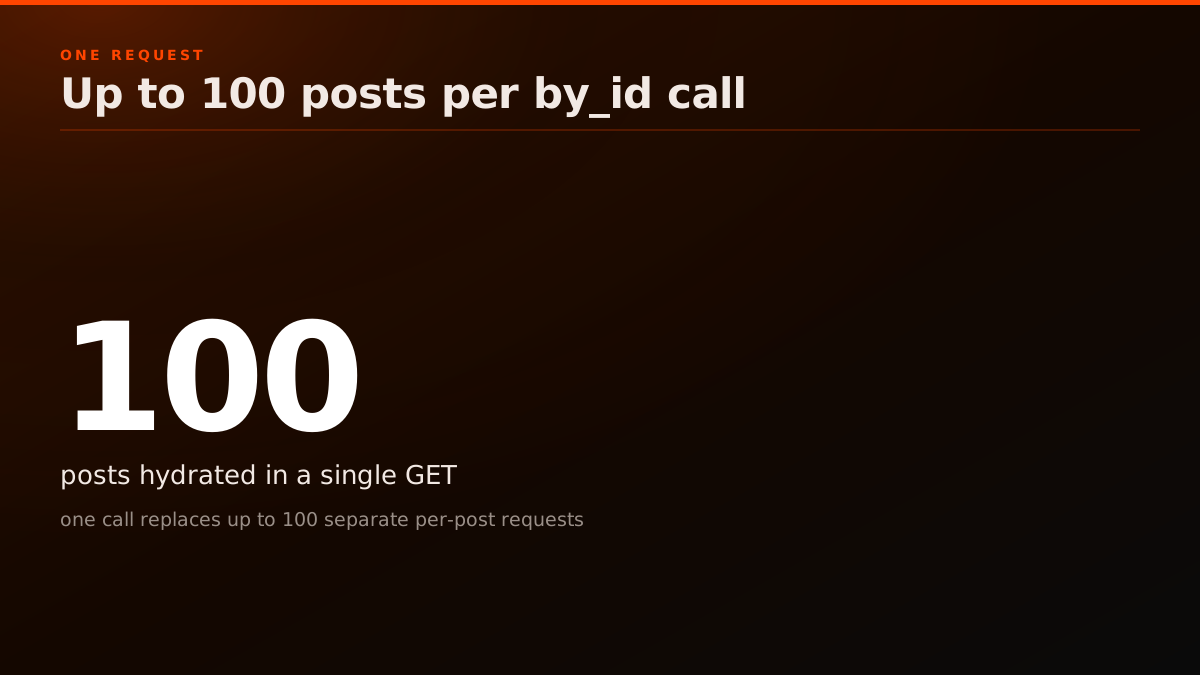 One call, up to a hundred posts
Up to 100 fullnames come back per call, which is the whole reason the endpoint exists. If you are holding a set of IDs, you do not want to spend one HTTP request per id to learn what happened to each. You want to hand over the batch and get the batch back. The endpoint is deliberately narrow: it takes t3_ post fullnames and returns posts. A t1_ comment id or a t5_ subreddit id is rejected at the request boundary, because the post shape and the comment shape are different and mixing them would hand you an array you cannot iterate cleanly.
The distinction between by_id and a search is worth holding in your head. A search answers "which posts match this query"; by_id answers "give me the current state of these exact posts I already know." You use search to discover IDs and by_id to hydrate them, and most real pipelines do both in sequence: discover once, then re-hydrate the same IDs on a schedule as their scores and comment counts change.
The N Plus One Problem
The reason bulk fetch matters is the request-per-post trap, the same shape backend engineers call the N plus one problem. If you have 100 post IDs and hydrate them by calling a single-post endpoint in a loop, you make 100 HTTP requests: 100 sequential round trips, 100 hits against your per-minute rate ceiling, and 100 chances for one to time out and complicate your retry logic. Every one of those costs is linear in the number of IDs, so the loop that felt fine on 10 posts falls over on 10,000.
by_id collapses that into one request for every 100 posts. The difference is not a micro-optimization; it is the difference between a pipeline that fits inside a rate limit and one that does not.
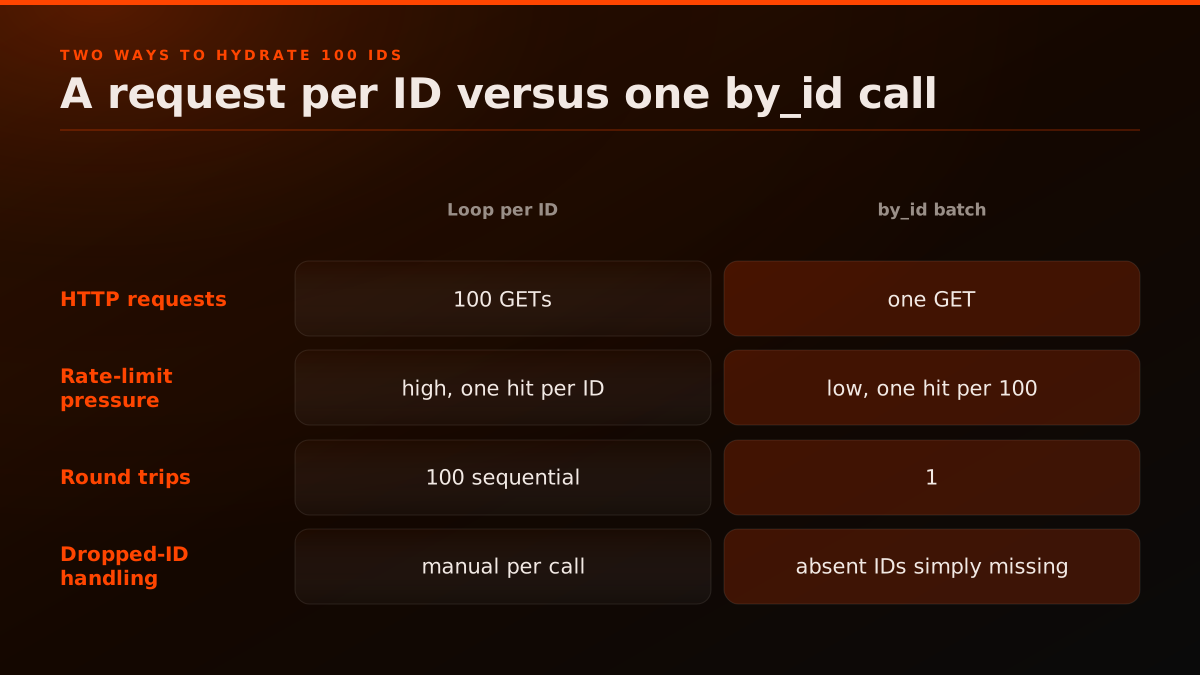 A request per ID versus one batched call
The grid makes the tradeoff concrete. A per-id loop is 100 GETs, 100 units of rate-limit pressure, and 100 round trips to hydrate 100 posts. The by_id path is one GET, one unit of pressure, and one round trip for the same 100 posts. The one place the loop looks simpler is error handling, because each call maps to exactly one id and a 404 tells you that specific post is gone. by_id trades that for a set difference: it drops missing IDs silently, so you learn what is gone by comparing what you asked for against what came back. That is a few lines of code, covered below, and a fair trade for cutting your request count by two orders of magnitude.
Developers hit this exact wall on Reddit's API constantly. One asked how to update the recorded score of a database of submissions without querying a single object every couple of seconds, which is the per-id loop failing under its own weight:
[praw] GET multiple objects by 'thing_id' in 1 query?
I have a database of specific submissions and comments. I would like to periodically update the recorded score of those. I understand I can get a single object with praw (by id), but it would take me an insane amount of…
The answer to that question is by_id. It is built for exactly the periodic-refresh job: you keep a table of IDs, and every so often you re-hydrate them in batches of 100 to pick up new scores and comment counts.
One Call Hydrates a Hundred IDs
Here is the whole hydration call. You join your fullnames with commas, put them in the path, attach one Authorization: Bearer header, and read the posts array off the response:
import os
import requests

API_KEY = os.environ["REDDITAPI_KEY"]
BASE = "https://api.redditapis.com"
HEADERS = {"Authorization": f"Bearer {API_KEY}"}

def hydrate(fullnames):
    ids = ",".join(fullnames)
    resp = requests.get(
        f"{BASE}/api/reddit/by_id/{ids}",
        headers=HEADERS,
        timeout=60,
    )
    resp.raise_for_status()
    return resp.json()["posts"]

wanted = ["t3_1abd8hb", "t3_1avv96a", "t3_1cw07hd"]
posts = hydrate(wanted)

for p in posts:
    print(f"[{p['upvotes']:>6} up, {p['comments']:>4} com] r/{p['subreddit']}: {p['title']}")
The response carries a posts array, and each element is a full post object with the same shape as any listing: id and name (the fullname), title, author, subreddit, permalink, url, upvotes (the net score), comments (the comment count), upvote_ratio, text (the self-post body), created_utc, and the moderation flags like over_18, stickied, and locked. Note the field is upvotes, not score, and comments is the count, not the comment tree. That naming is stable across every read endpoint, so code that reads a search result reads a by_id result without changes.
If all you have is a short id like abc123 rather than a full t3_abc123, prefix it before you call. Building the fullname is a string join, not another request:
def to_fullname(short_id):
    return short_id if short_id.startswith("t3_") else f"t3_{short_id}"

short_ids = ["1abd8hb", "1avv96a"]
posts = hydrate([to_fullname(s) for s in short_ids])
This is the step people expect to be harder than it is. The demand to pull Reddit data without fighting the access layer for every read is a constant refrain, and hydrating a known set of IDs is the cleanest version of it:

Alvaro Cintas
@dr_cintas
your ai agent doesn't need a single paid api to browse the internet anymore 🤯 it's called agent-reach. one pip install and your agent can read twitter posts, browse reddit threads, search github, and watch youtube - without paying for a single api subscription. what your http… Show more

One call in, a batch of full posts out. The only thing left to handle well is scale and the posts that are no longer there.
Start building with Redditapis
Reads $0.002, votes $0.005, writes $0.012, DMs $0.025. $0.50 free credits.
Batch More Than a Hundred IDs
The 100-fullname ceiling is a per-call limit, not a total. When you hold more than 100 IDs, you chunk them into groups of 100 and make one call per chunk. A managed endpoint rejects a call carrying more than 100 fullnames rather than quietly truncating it, so the chunking is not optional politeness, it is how you avoid a rejected request. Here is the batcher:
def chunked(seq, size=100):
    for i in range(0, len(seq), size):
        yield seq[i:i + size]

def hydrate_all(fullnames):
    out = []
    for batch in chunked(fullnames, 100):
        out.extend(hydrate(batch))
    return out

# 250 IDs become 3 calls (100 + 100 + 50), not 250
all_ids = [f"t3_{s}" for s in load_my_ids()]
posts = hydrate_all(all_ids)
print(f"hydrated {len(posts)} of {len(all_ids)} requested")
The arithmetic is the point. A per-id loop over 250 IDs is 250 requests; the batcher is 3. Across a table of 10,000 IDs it is 100 requests instead of 10,000, which is the difference between a job that finishes inside your rate window and one that spreads across an hour of backoff. Reddit's own listing depth caps at 1,000 posts per feed, so re-hydration by known id is often the only way to keep a larger archive current after the live feed has moved past it.
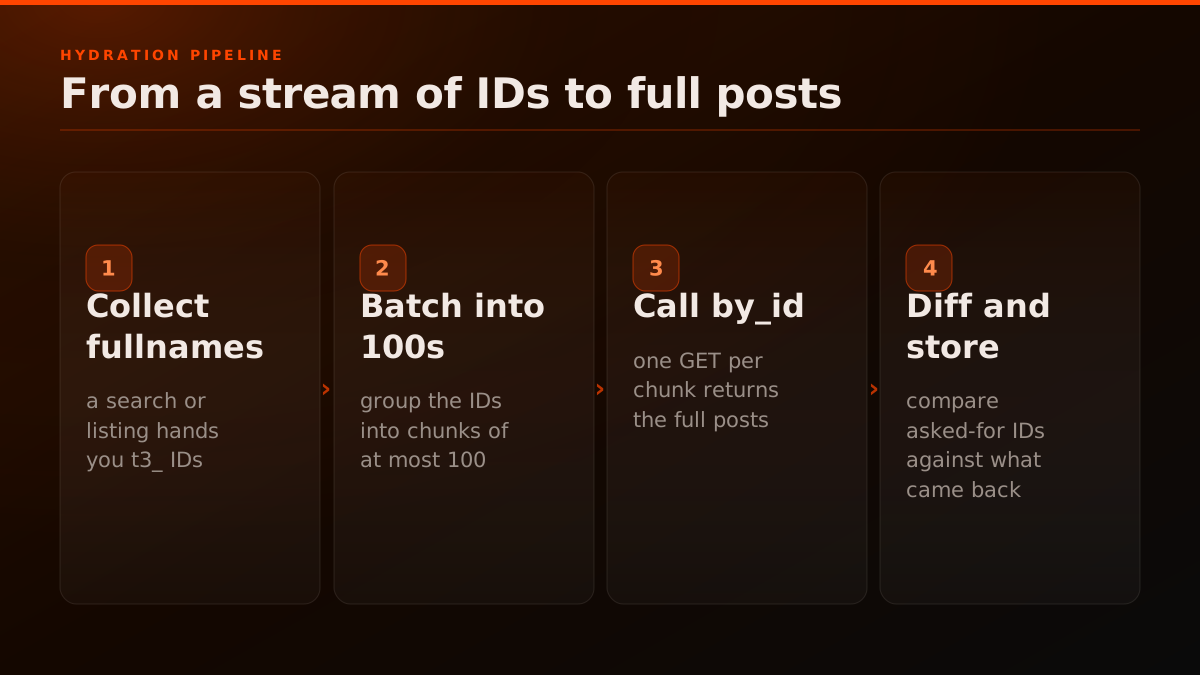 The hydration pipeline, end to end
The pipeline above is the shape of nearly every real by_id job. You collect fullnames from wherever they arrive (a search, a listing, a stream, a database), batch them into 100s, call by_id per batch, then diff and store. The state you carry between steps is just the list of IDs, so it parallelizes cleanly: independent batches can run concurrently up to your rate limit, and the diff step catches anything that fell out.
The pattern is old and well worn. Developers have been feeding multiple fullnames into by_id for years, sometimes tripping over the exact comma-separation contract this endpoint standardizes:
[PRAW] Getting multiple submissions using by_id
Using PRAW, it is possible to get a single submission by passing the submission's ID to Reddit.submission(id). This returns an instance of models.Submission. ​ I cannot see that it's possible to get multiple…
The Dropped-ID Contract
Here is the one behavior that separates a correct by_id pipeline from a broken one: the response is not guaranteed to match your request. When a fullname points at a post that was deleted, removed, or never existed, Reddit does not return an error or a null placeholder for it. It simply leaves that post out of the array. Ask for 100, and if 4 are gone, you get 96 posts back with nothing to flag the 4 that vanished.
That means you cannot assume posts[i] corresponds to wanted[i], and you cannot trust len(posts) == len(wanted). The correct pattern is a set difference between the fullnames you asked for and the name values that came back:
def hydrate_with_diff(fullnames):
    posts = hydrate(fullnames)
    returned = {p["name"] for p in posts}
    missing = [fn for fn in fullnames if fn not in returned]
    return posts, missing

wanted = ["t3_1abd8hb", "t3_1avv96a", "t3_deleted99"]
posts, missing = hydrate_with_diff(wanted)
print(f"got {len(posts)} posts, {len(missing)} gone: {missing}")
Treat the missing list as authoritative: those posts are no longer available through the API, whether they were removed by a moderator, deleted by the author, or belong to a suspended account. For a dedup or archive job, that is a signal worth recording, because a post dropping out of by_id is often the first machine-readable sign that it was taken down. Building the diff also makes your pipeline idempotent: re-running the same batch returns the same live posts and the same missing set, so a retry never double-counts or silently skips.
This is the subtle failure that bites teams who assumed a one-to-one mapping. If you index posts positionally against your request list, a single dropped id shifts every entry after it, quietly corrupting your data with no error to warn you. Key on name, diff the sets, and the shift is impossible.
What Developers Build on Bulk Hydration
by_id is rarely the whole job. It is the refresh step inside a larger pipeline, and three jobs cover most of what teams build on it. Knowing which one you are doing tells you how often to re-hydrate and how to treat the dropped IDs.
Stream hydration is the first. A live pipeline (a keyword monitor, a mention tracker, a subreddit firehose) surfaces IDs faster than it can afford to fetch each one individually. You buffer the incoming fullnames, batch them, and hydrate in groups of 100, which keeps your request count flat even when the stream spikes. The IDs arrive over time; the hydration happens in efficient batches.
Backfill is the second. You have a stored set of post IDs (from an old scrape, a partner feed, or a listing you paged through months ago) and you need the current data behind them. Reddit's live listings only reach back so far, so re-hydrating known IDs is the way to refresh an archive after the feed has scrolled past. One call per 100 IDs turns a backfill that would be thousands of single requests into a short, rate-friendly batch job.
Dedup and score-refresh is the third. You keep a table of posts you have already seen and periodically re-check their scores, comment counts, and removal status. This is precisely the "update the recorded score of a database of submissions" job from r/redditdev earlier, and by_id is the tool built for it: hydrate the batch, update your rows, and use the dropped-ID diff to mark posts that have since been removed.
All three share the same skeleton, and all three break in the same way if you skip the dropped-ID diff. Build that diff once and reuse it everywhere.
The cheapest Reddit API. Try it free.
Reads from $0.002 per call. $0.50 free credits. No credit card required.
The Native reddit.com/by_id Path (and Its Limits)
Reddit exposes by_id directly. Append .json to the by_id path and you get the same data unauthenticated: https://www.reddit.com/by_id/t3_abc123,t3_def456.json. It is free, needs no developer app, and is the right tool for a quick hydration from your own machine. Here is the native call:
import requests

URL_TMPL = "https://www.reddit.com/by_id/{ids}.json"
HEADERS = {"User-Agent": "by-id-tutorial/1.0 (by u/your_username)"}

def hydrate_native(fullnames):
    ids = ",".join(fullnames)
    resp = requests.get(URL_TMPL.format(ids=ids), headers=HEADERS, timeout=30)
    resp.raise_for_status()
    children = resp.json()["data"]["children"]
    return [c["data"] for c in children]

posts = hydrate_native(["t3_1abd8hb", "t3_1avv96a"])
for p in posts:
    print(f"[{p.get('score', 0)} up] {p['title']}")
The native response is a standard Reddit listing: a data.children array where each child wraps a post under a {"kind": "t3", "data": {...}} envelope, so you reach the post fields at child["data"] and the score lives under score rather than a flattened upvotes. The dropped-ID behavior is identical: a missing fullname is simply absent from children, so you apply the same set diff.
Two things limit the native path in production. First, the rate ceiling: 60 requests per minute unauthenticated is fine for a handful of batches and tight for a service. Second, and more disruptive in 2026, the IP filter. Reddit blocks a large share of cloud and datacenter IP ranges, so the same call that works from your laptop returns 403 from an AWS, GCP, or DigitalOcean box no matter how clean your headers are. This is the single most common reason a correct hydration script fails on a server. A quick way to confirm it is to run the identical script locally: if it works on your laptop and 403s on the box, you have an IP filter, not a code bug. The managed path trades the dollar cost of the call for a clean pool, one bearer header, and a flat posts array. For the broader access picture, see the authentication and OAuth guide and the rate-limits reference.
What It Costs at Volume
Bulk hydration has a cost shape that rewards batching. The native .json path is free in dollars but costs engineering time: an IP pool to dodge 403s, OAuth-app upkeep, and the rate-limit backoff you maintain. A managed REST path prices per call instead, at $0.002 per GET (pricing), with the first $0.50 of credit free at signup and no card required.
The number that matters is calls, not IDs, and batching is what keeps it low. Hydrating 10,000 IDs is 100 by_id calls, roughly $0.20 in GETs, because each call carries up to 100 fullnames. The same 10,000 IDs through a per-post loop would be 10,000 calls, both far slower and 100 times the request volume against your rate limit. That is the whole argument for by_id in one line: the price and the rate-limit cost both scale with your call count, and batching cuts your call count by up to 100x. Model your real numbers with the cost calculator before you commit, and cross-check the per-operation detail on the pricing page.
Verdict
For a one-off hydration of a couple of IDs from your own machine, the native reddit.com/by_id/...json path is the right answer: free, no OAuth, and you can paste the code above and have posts in two minutes. The moment hydration becomes a recurring job (a stream buffer, a nightly backfill, a dedup refresh) the math flips to batching, because a per-post loop is one request per id and by_id is one request per hundred. The pipeline is small and the same every time: collect fullnames, chunk into 100s, call by_id per chunk, and diff the returned name values against what you asked for so a dropped post never shifts your data. The native path does the fetch for free until the 60-per-minute ceiling and the cloud-IP 403s push the job onto a managed pool. Start with the free path, measure how often you re-hydrate, and move to a managed endpoint like https://api.redditapis.com/api/reddit/by_id/... when the limits bite. The comments guide covers hydrating a post's discussion, the search tutorial covers discovering the IDs in the first place, and the pagination guide covers paging a listing into the IDs you then hydrate. Grab a free key and run the batch call.
Where these numbers come from.
Each row is a figure in this post and the artefact it was read from. Reddit's access rules and the third-party archives around them keep moving, so check the date on a source before you build against it.
- Reddit API documentation (GET /by_id/names)
- Reddit's own reference for the by_id endpoint this guide wraps, including the comma-separated fullnames contract.
- Reddit Data API Wiki
- Reddit's access documentation for the official data path, fullname scheme, and rate ceilings referenced here.
- PRAW documentation
- The PRAW library behind the reddit.info(fullnames=...) comparison used in this guide.
- The Verge, Reddit API terms change (April 2023)
- The 2023 repricing reporting cited for why per-call cost and rate ceilings now matter for bulk reads.
Frequently asked questions.
Use the by_id endpoint. Pass a comma-separated list of post fullnames (each a t3_ prefix followed by the base-36 id) and one call returns all of them. On a managed REST path that is GET https://api.redditapis.com/api/reddit/by_id/t3_abc123,t3_def456 with a single Authorization: Bearer header, and the response is a posts array with the same shape as any listing. The native equivalent is https://www.reddit.com/by_id/t3_abc123,t3_def456.json. Up to 100 fullnames come back per call, so a batch of 100 IDs is one request instead of 100. See the one-call section.
A fullname is Reddit's global id for a thing: a type prefix plus a base-36 id, like t3_abc123 for a post. The prefixes are t1_ for a comment, t3_ for a post (link), and t5_ for a subreddit. You already have fullnames on every object a search or listing returns: each post carries both a short id (abc123) and a name (t3_abc123). The by_id endpoint takes the t3_ post fullnames. Build one from a short id by prefixing t3_. The fullname section covers the format.
Up to 100 per call. Pass 1 to 100 comma-separated t3_ fullnames and you get the matching posts back in a single request. If you have more than 100 IDs to hydrate, chunk them into groups of 100 and make one call per chunk. A managed endpoint rejects a call with more than 100 fullnames rather than silently truncating, so you find out at the boundary instead of missing rows. The batching section has the chunking code.
Reddit simply drops it. An unknown, removed, or deleted fullname is absent from the result rather than returning an error or a null placeholder, so a call for 100 IDs can return 96 posts. That means you cannot assume the response is one-to-one with your request. The correct pattern is to compare the set of IDs you asked for against the set of name values that came back and treat the difference as gone. The dropped-ID section shows the diff in code.
You can, but it is one HTTP request per post, which is slow and burns your rate limit fast. Hydrating 100 IDs one at a time is 100 sequential round trips and 100 hits against your per-minute ceiling. by_id collapses that into one request for the same 100 posts, so it is faster, cheaper on the rate limit, and simpler to reason about. Loop the single-post endpoint only when you have exactly one id to hydrate. See the loop-versus-batch grid.
The redditapis by_id endpoint is for posts: every fullname must be a t3_ post id, and it rejects a t1_ comment id at the request boundary. For a post's comment tree you fetch by permalink and walk the nested nodes, which is a different shape and a different endpoint. See the Reddit comments guide for the comment tree, and keep by_id for hydrating post metadata like title, author, score, and comment count.
Yes, for public posts. The native https://www.reddit.com/by_id/t3_x,t3_y.json path returns the same data unauthenticated at up to 60 requests per minute, as long as you send a descriptive User-Agent. The 2026 catch is the IP filter: calls from AWS, GCP, or other datacenter ranges frequently return 403 no matter how correct your headers are, so the public path works from a laptop but often fails from a server. A managed REST path routes through a clean pool with one bearer key. See the authentication guide.
Keep reading.
Continue exploring related pages.
Reddit API documentation
The complete 2026 reference: auth, all 59 endpoints, and code.
Get a Reddit API key
Instant bearer token, no waitlist and no enterprise contract.
Reddit Responsible Builder Policy
Why Reddit denies API applications, and the managed REST bypass.
Reddit API use cases
14 use cases from AI training to brand monitoring and DMs.
Reddit Search API
Search posts, comments, users, and communities over one REST endpoint.
Reddit MCP server
Wrap the REST API as MCP tools for Claude, Cursor, and any MCP client.
Reddit API for AI agents
Live Reddit context for tool calls, MCP servers, and RAG pipelines.
Redditapis pricing
Endpoint-level costs and quick monthly totals - reads from $0.002 / call.
Reddit API cost calculator
Estimate monthly spend using your request volume.
Reddit API guides and tutorials
Tutorials, walkthroughs, and API deep-dives for developers.
Reddit API alternatives
Evaluate alternatives by cost model, limits, and integration fit.
Cheap Reddit API
The cheapest way to get Reddit data: $0.002 per call, no contract, no minimum.
Official Reddit API vs Redditapis
Access, setup, rate limits, and pricing, side by side.
PRAW alternative
A hosted Reddit REST API for any language, no app registration or OAuth.
Reddapi alternative
A maintained Reddit REST API with published pricing and write endpoints.
Reddit comment scraper alternative
The raw comment API: search and filter comments, historical and live, clean JSON.
Reddit scraper API
Hosted scraper API vs building your own: managed proxies, clean JSON.
RapidAPI Reddit alternative
A direct, maintained Reddit API with published pricing and write endpoints.
Bright Data Reddit alternative
A purpose-built Reddit API vs a general scraping platform: structured JSON, plus writes.
ScraperAPI Reddit alternative
A Reddit-native API vs a generic HTML fetcher: auth and pagination handled, typed JSON.
TikHub alternative
TikHub's Reddit surface is read-only; get comment, vote, and DM endpoints too.
EnsembleData alternative
No $100/month floor: pay per call from $0.002, plus write, vote, and DM endpoints.
Scrape Creators alternative
7 read-only Reddit endpoints vs a dedicated API with real write, vote, and DM paths.
FetchLayer alternative
Posts, comments, and search only; add vote, comment, and DM over the same REST auth.
PullPush alternative
PullPush is free but volunteer-run and goes offline for reindexing; a maintained REST API that stays up.
Reddit monitoring API
Build your own keyword and brand-mention monitor: search, comment search, and subreddit streams over REST.
F5Bot vs Redditapis
F5Bot's Slack and Discord delivery needs its $49.99/mo Gold tier; Redditapis includes it from $19/mo.
Syften vs Redditapis
Syften caps you at 100 to 500 results a day; Redditapis allows 10,000 a day per monitor at the entry plan.
Octolens vs Redditapis
Octolens meters by mention with overage fees; Redditapis is flat-priced by subreddit slot from $19/mo.
Affiliate program
Earn 20% lifetime commissions - capped at $5,000/yr.
Reddit Vote API tutorial
Upvote and downvote a post programmatically via the REST API.
Reddit Data API: REST, no PRAW
REST endpoints for Reddit data with no PRAW and no OAuth dance.
Reddit scraping benchmarks
Real throughput, error rates, and cost benchmarks for Reddit scraping.
Reddit API answers
Direct answers on cost, access, rate limits, endpoints, and auth.
How much the Reddit API costs
Per-call pricing from $0.002 a read, with $0.50 in free credits.
Reddit API in Python
One requests call with a bearer token, no PRAW and no OAuth flow.
Reddit shadowban checker
Check if a Reddit account is shadowbanned in seconds, free and no login.
Subreddit stats checker
See any subreddit's live subscriber count, active users, and age, free and no login.
Similar reads.
More guides on the Reddit API, scraping, pricing, and MCP servers.

Reddit Subreddit Rules API: Pull Posting Rules as JSON
Pull any subreddit's posting rules as structured JSON with the rules API. Build pre-submit validation, compliance checks, and automod-aware bots, with copy-paste Python for 2026.

Reddit User API: Fetch Profile, Karma, and History
Fetch a Reddit user's profile, karma, and full comment plus submission history from one API. Real request and response JSON, copy-paste Python, and pagination for 2026.

How to Get Reddit Comments via the API: Fetch the Full Comment Tree (2026)
Fetch Reddit comments by permalink, walk the nested tree, expand the more / morechildren nodes, and flatten replies in Python. Copy-paste code and first-party numbers, 2026.

Reddit API Pagination: The after Cursor and Getting Past the 1000-Item Ceiling (2026)
How Reddit API pagination works: the after cursor, the 100-per-page cap, and getting past the ~1000-item ceiling. Copy-paste Python and first-party numbers, 2026.

How to Find Subreddits Programmatically: A Subreddit Finder API Guide (2026)
Find subreddits by keyword at scale in 2026. Discover communities with the search/communities API, rank them by real activity, and compare the native reddit.com/search.json path with copy-paste Python.

Reddit Search API Tutorial: Query Subreddits by Keyword in Python (2026)
Search Reddit posts by keyword in Python in 2026. Native /search.json, PRAW subreddit.search(), and a managed REST endpoint compared, with copy-paste code, parameters, and the 1,000-result cap explained.

Reddit API in Python: The Complete No-PRAW Tutorial (2026)
Use the Reddit API in Python without PRAW in 2026. Plain HTTP with requests or httpx, one bearer token. Code examples for posts, comments, search, votes, and DMs from $0.002 per call.

How to Detect Trending Topics on Reddit With an API
Detect trending topics on Reddit with an API: snapshot hot and top listings, compute score and comment velocity, and surface rising posts, subreddits, and topics.