
Reddit Sentiment Analysis With an API: A 2026 Guide
Build a Reddit sentiment analysis pipeline: pull posts and comments for a keyword through an API, score them with a model, and track brand sentiment over time.
Reddit sentiment analysis is the practice of pulling every post and comment that mentions a keyword, brand, or product, then scoring that text with a model so you can measure how a community feels and watch it move over time. It is a four-stage pipeline: collect the text through a Reddit data API, clean it, score each item positive, negative, or neutral, and aggregate the scores into a trend line. This guide builds the whole thing with copy-paste Python: the collection call against GET https://api.redditapis.com/api/reddit/search?q=<keyword>, the model choice that decides your accuracy, the scoring loop, the storage that turns scattered opinion into a tracked number, and the one data-layer decision that determines whether the pipeline keeps running in production.
Not affiliated with Reddit Inc. redditapis.com is an independent third-party REST API for Reddit data. This guide is vendor-neutral: it shows the collection, model, and tracking steps honestly, names the official Reddit API and open-source tooling where they fit, and points at the models so you can pick the pieces that suit your situation.
TL;DR: Reddit sentiment analysis is a four-stage pipeline. (1) Collect: pull posts and comments for your keyword with
GET https://api.redditapis.com/api/reddit/search?q=<keyword>andGET https://api.redditapis.com/api/reddit/search/comments/deep?q=<keyword>, both with aBearerkey. (2) Clean: strip markdown, links, and boilerplate. (3) Score: run eachtitleor commentbodythrough VADER (fast), a RoBERTa model (accurate), or an LLM (nuanced). (4) Track: store each score with its timestamp and average by day to build a trend line. The model side can be free; the cost is the Reddit data at about $0.002 a call, so light brand tracking is a couple of dollars a month. The one decision that decides whether it survives production is the data layer, because a raw call to Reddit from a server returns403from most datacenter IPs. The first $0.50 is free at /signup.
What this guide covers:
- What Reddit sentiment analysis is, and why Reddit is a high-signal source for it
- The four-stage pipeline: collect, clean, score, track
- Step 1: pulling posts and comments for a keyword through the API, with working Python
- Step 2: choosing a model (VADER vs a transformer vs an LLM), with the trade-off table
- Step 3: scoring the text, and Step 4: tracking brand sentiment over time
- The data-layer decision, the cost math, and the honest limitations
What Is Reddit Sentiment Analysis?
Reddit sentiment analysis is measuring how people feel about a topic on Reddit by collecting the posts and comments that mention it and scoring each one positive, negative, or neutral. The output is not a single verdict but a distribution you can track: what share of the discussion about your brand this week was negative, and whether that share is climbing. It differs from reading a thread by hand in one way that matters, it is measured and repeatable, so the same keyword scored every day becomes a number instead of an impression.
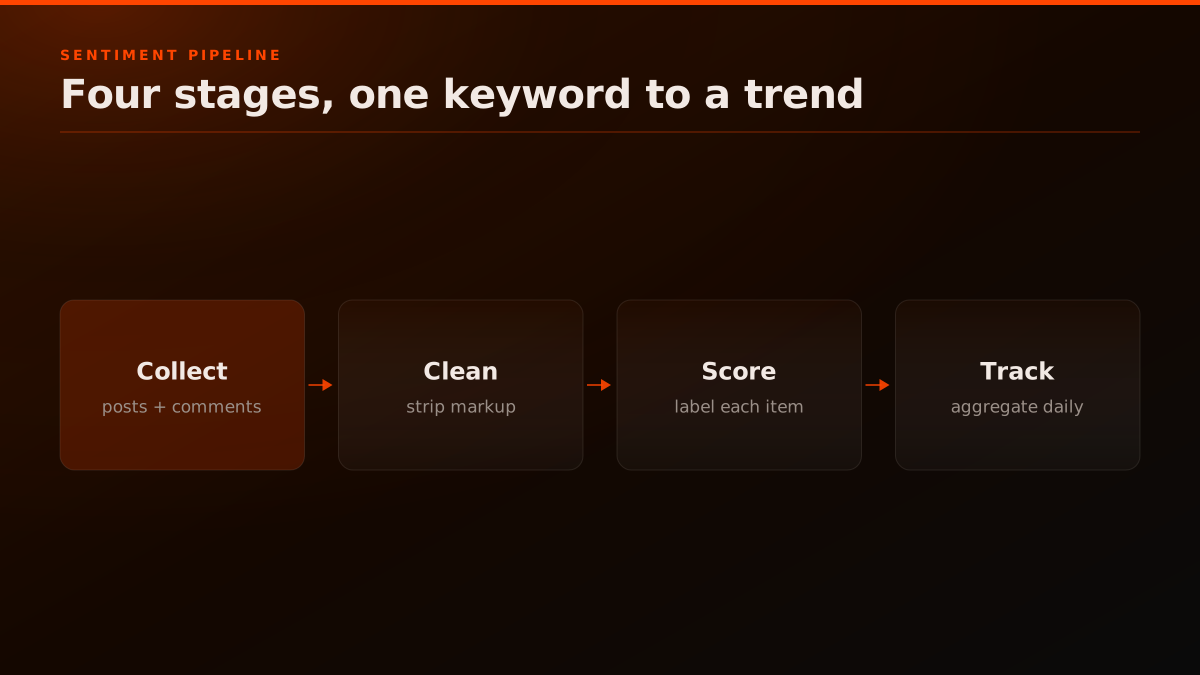 Sentiment analysis is a pipeline, not a lookup: collect, clean, score, then aggregate into a trend you can track
People build this for a handful of concrete jobs: tracking how a product launch landed, watching a brand's reputation between releases, comparing sentiment across competitors, or catching a spike of negativity early enough to respond. All of them are the same pipeline pointed at a different keyword, and all of them turn candid community opinion into a signal a team can act on.
Why Reddit Is a High-Signal Source for Sentiment
Reddit is one of the best places to measure sentiment because people post to their peers, not to a brand, so the opinions are candid, specific, and current. A review site collects opinions people know a company will read; Reddit collects the version people say to each other, which is closer to what they actually think. That candor is exactly what a sentiment score is trying to capture, and it is why so many monitoring tools reach for Reddit as a primary source.
The pattern shows up in the wild constantly, people build real tools on top of Reddit sentiment because the signal is genuinely useful.
View on RedditThat project tracks mention volume and sentiment of stocks across Reddit to find rising names, which is the same machinery this guide builds, pointed at tickers instead of a brand. Reddit gives a sentiment pipeline three things a generic web scrape does not:
- Candor: opinions written to peers, not to a company's review form
- Recency: what people are saying this week, updated continuously
- Specificity: the exact complaint or praise that keeps recurring, attached to a real community
The one caveat worth stating up front is that Reddit is candid but noisy: sarcasm, in-jokes, and brigading are all present, so a sentiment score is strong signal to reason over, not a verified fact. The rest of this guide is about turning that raw candor into a number you can trust enough to watch.
The Reddit Sentiment Pipeline: Four Stages
A Reddit sentiment pipeline has four stages, and keeping them separate is what makes it maintainable: collect the text, clean it, score it, and aggregate the scores over time. Each stage has one job, and you can swap the implementation of any one without touching the others, which matters because you will change your model long before you change your collection step.
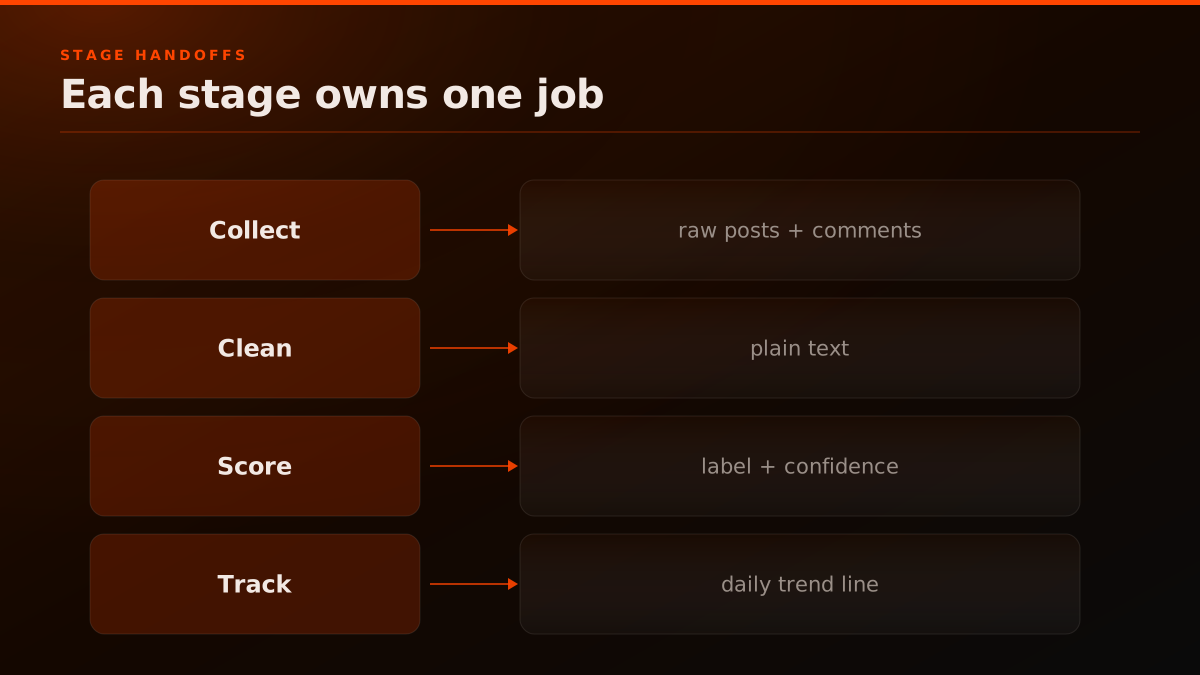 Each stage has one job and a clean handoff, so you can change the model without touching collection, and change storage without touching scoring
The stages, and what each one owns:
- Collect: pull the posts and comments that mention your keyword through a Reddit data API. This is the load-bearing stage; if it is unreliable, nothing downstream is trustworthy.
- Clean: strip markdown, quoted text, URLs, and boilerplate so the model scores the opinion, not the formatting.
- Score: run each cleaned item through a sentiment model that returns a label (positive, negative, neutral) and a confidence.
- Track: store each score with its timestamp and the item's metadata, then aggregate by day or week into a trend.
The next four sections build each stage in turn. Collection is first because it is the one that decides whether the whole pipeline is reliable.
Step 1: Pull Posts and Comments for a Keyword
The collection step makes one HTTP call per surface: a post search for titles and self-text, and a deep comment search for the actual comment bodies, both filtered to your keyword. Posts carry the headline opinion; comments carry the volume and the nuance, so a sentiment pipeline usually wants both. Here is the read against a REST endpoint, with a Bearer key:
import os, requests

API_KEY = os.environ.get("REDDIT_API_KEY", "YOUR_API_KEY")  # free key at redditapis.com/signup
BASE = "https://api.redditapis.com/api/reddit"
HEADERS = {"Authorization": f"Bearer {API_KEY}"}

def fetch_posts(keyword: str, limit: int = 50) -> list[dict]:
    """Posts whose title or body mentions the keyword."""
    r = requests.get(f"{BASE}/search",
                     headers=HEADERS,
                     params={"q": keyword, "sort": "new", "t": "week", "limit": limit},
                     timeout=20)
    r.raise_for_status()
    return [
        {"id": p["id"], "text": p["title"], "subreddit": p["subreddit"],
         "upvotes": p["upvotes"], "permalink": p["permalink"]}
        for p in r.json().get("posts", [])
    ]

def fetch_comments(keyword: str, limit: int = 20) -> list[dict]:
    """Actual comment bodies that mention the keyword (score-sorted)."""
    r = requests.get(f"{BASE}/search/comments/deep",
                     headers=HEADERS,
                     params={"q": keyword, "limit": limit},
                     timeout=30)
    r.raise_for_status()
    return [
        {"id": c["id"], "text": c["body"], "subreddit": c["subreddit"], "score": c["score"]}
        for c in r.json().get("comments", [])
    ]

if __name__ == "__main__":
    items = fetch_posts("your-brand") + fetch_comments("your-brand")
    print(f"collected {len(items)} items to score")
Two design notes matter here. First, the post search reads title, subreddit, upvotes, and permalink off each row, and the deep comment search reads the comment body and score, because those are the fields those two response shapes actually return. Second, scope the search with t=week (or day) so you score recent discussion rather than an all-time archive, and page with the after cursor when you need more than one batch. For the full read side, including advanced filters, the search API tutorial and the advanced search filters guide are the companion builds, and the Node.js guide covers the same in TypeScript.
Start building with Redditapis
Reads $0.002, votes $0.005, writes $0.012, DMs $0.025. $0.50 free credits.
Step 2: Choose a Sentiment Model
The model you pick is a trade between speed, accuracy, and cost, and there is no single right answer, only the right answer for your volume and your tolerance for error. The three practical options are a lexicon scorer, a transformer, and an LLM classifier, and Reddit text (candid, sarcastic, full of community slang) is exactly the kind of input that separates them.
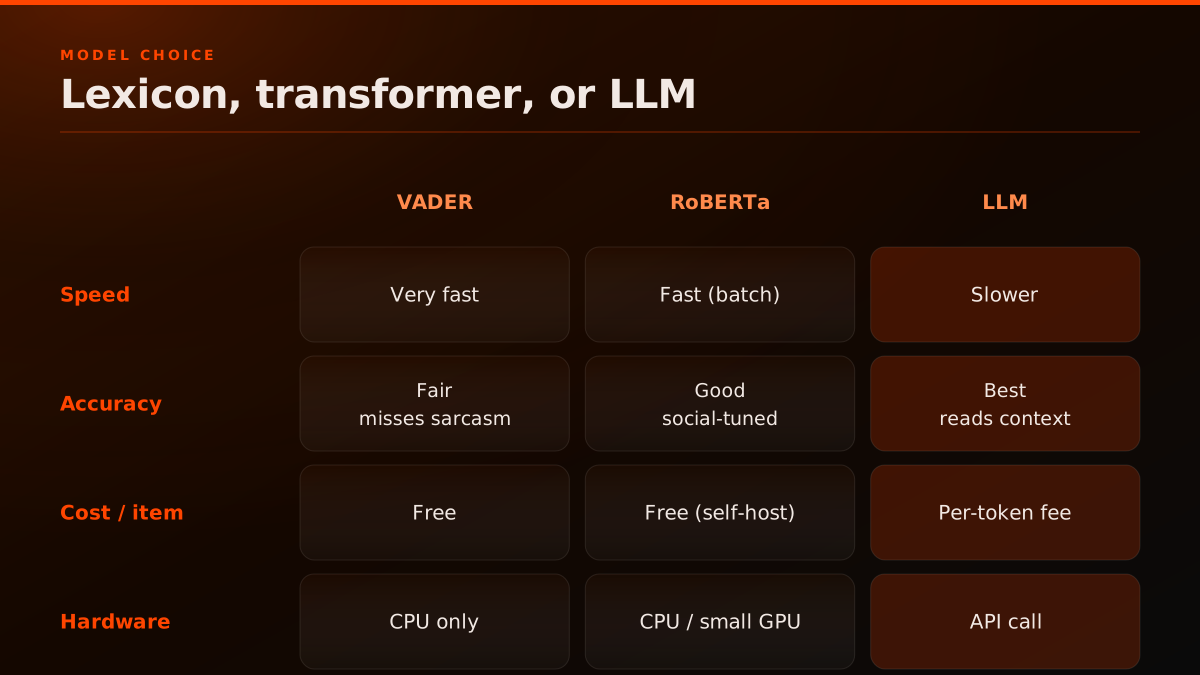 The model choice is a speed-versus-nuance trade: a lexicon for the firehose, a transformer for accuracy in batch, an LLM for the ambiguous middle
The honest read of the three:
| Model | Speed | Accuracy on Reddit text | Cost per item | Hardware |
|---|---|---|---|---|
| VADER lexicon | Very fast | Fair, misses sarcasm and slang | Free | CPU only |
| RoBERTa sentiment | Fast in batch | Good, tuned on social posts | Free (self-hosted) | CPU or small GPU |
| LLM classifier | Slower | Best, reads context and sarcasm | Per-token fee | API call |
VADER is a rule-based lexicon built for social text, so it is the fastest way to score a firehose and needs no GPU, at the cost of missing sarcasm. A transformer such as the cardiffnlp RoBERTa model is fine-tuned on social posts and is far more accurate on real Reddit phrasing while still running cheaply in batch. An LLM classifier reads context best but costs more per item, so it fits a smaller sample. A common production pattern is a transformer for the bulk and an LLM to spot-check the ambiguous middle. Whichever you pick, validate it against a hand-labeled sample of your own keyword first, because a model's accuracy on generic tweets is not its accuracy on your niche subreddit.
Step 3: Score the Text
Scoring runs each cleaned item through your chosen model and attaches a label and a confidence. With a transformer, the Hugging Face pipeline makes this a few lines: load the model once, then map it over the collected items in batches. Here is the scoring stage over the items from Step 1:
from transformers import pipeline

# Load once; reuse across the whole batch.
clf = pipeline("sentiment-analysis",
               model="cardiffnlp/twitter-roberta-base-sentiment-latest")

def score_items(items: list[dict]) -> list[dict]:
    texts = [clean(i["text"]) for i in items]
    results = clf(texts, truncation=True, batch_size=16)
    for item, res in zip(items, results):
        item["label"] = res["label"]        # positive / neutral / negative
        item["confidence"] = round(res["score"], 3)
    return items

def clean(text: str) -> str:
    """Strip URLs and collapse whitespace so the model scores the opinion."""
    import re
    text = re.sub(r"https?://\S+", "", text)
    return re.sub(r"\s+", " ", text).strip()

scored = score_items(items)
neg = [i for i in scored if i["label"] == "negative"]
print(f"{len(neg)} of {len(scored)} items negative ({100*len(neg)//max(len(scored),1)}%)")
The cleaning step matters more than it looks: Reddit text is full of URLs, quoted parent comments, and markdown that a model will happily score as if it were opinion, so stripping them before scoring is what keeps the number honest. For higher-value samples you can swap the transformer for an LLM classifier with a short prompt that asks for a label and a one-line reason, which buys you sarcasm handling and an audit trail at a higher per-item cost. Either way, the output of this stage is the same shape: every item now carries a label and a confidence, ready to store.
Step 4: Track Brand Sentiment Over Time
Tracking is what turns a batch of scores into an answer to "is sentiment about us getting better or worse." You store each scored item with its timestamp and metadata, then aggregate by day into a share-of-negative or a net-sentiment line. The storage can be a table, a time-series database, or a simple append-only file; what matters is that every score keeps its timestamp so you can group it later.
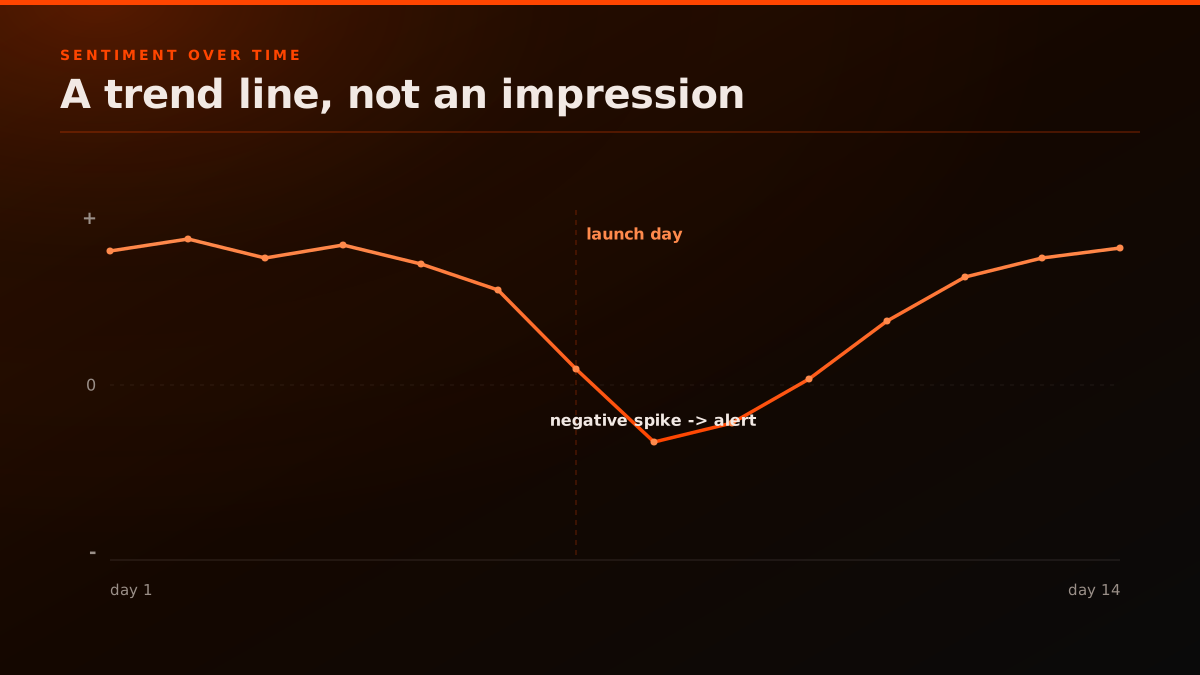 Aggregating daily scores turns scattered opinion into a trend line, so a launch dip or a reputation spike becomes visible instead of anecdotal
The aggregation is a group-by over stored rows:
from collections import defaultdict
from datetime import date

def daily_net_sentiment(rows: list[dict]) -> dict[str, float]:
    """rows carry {'day': 'YYYY-MM-DD', 'label': 'positive|neutral|negative'}."""
    by_day = defaultdict(lambda: {"pos": 0, "neg": 0, "n": 0})
    for r in rows:
        b = by_day[r["day"]]
        b["n"] += 1
        if r["label"] == "positive": b["pos"] += 1
        if r["label"] == "negative": b["neg"] += 1
    # Net sentiment = (positive - negative) / total, per day.
    return {day: round((b["pos"] - b["neg"]) / max(b["n"], 1), 3)
            for day, b in sorted(by_day.items())}
Run the collect-score-store loop on a schedule (hourly for a fast-moving brand, daily for a slow one) and the daily aggregate becomes a trend line you can chart or alert on. A useful alert is a day whose share of negative comments jumps well above the trailing average, which is the early-warning signal a launch or an incident produces first. The scheduled-collection half of this is a solved problem: the Reddit keyword monitor in Python is the on-a-schedule collector that drops straight in front of the scoring stage, and it turns this pipeline from something you run by hand into something that runs itself.
Brand Sentiment Tracking in Practice
The most common reason teams build this is brand sentiment tracking: watching what Reddit says about their product between releases and catching problems before they spread. It is a real, recurring question, and marketers ask for exactly this tool.
View on RedditThe build behind that question is the pipeline in this guide with the keyword set to a brand name and a few product terms, run daily, with an alert on negative spikes. Developers assemble the same thing from an API and a model rather than buying a black box, because it gives them the raw scores to slice by subreddit, product line, or competitor.

Dhanian 🗯️
@e_opore
𝐇𝐨𝐰 𝐭𝐨 𝐛𝐮𝐢𝐥𝐝 𝐚 𝐒𝐞𝐧𝐭𝐢𝐦𝐞𝐧𝐭 𝐀𝐧𝐚𝐥𝐲𝐬𝐢𝐬 𝐀𝐏𝐈 𝐟𝐨𝐫 𝐒𝐨𝐜𝐢𝐚𝐥 𝐌𝐞𝐝𝐢𝐚 𝐢𝐧 𝐉𝐚𝐯𝐚 Building AI-powered social media analytics? Structure matters. 𝐇𝐞𝐫𝐞 𝐢𝐬 𝐭𝐡𝐞 𝐜𝐨𝐦𝐩𝐥𝐞𝐭𝐞 𝐩𝐫𝐨𝐣𝐞𝐜𝐭 𝐚𝐫𝐜𝐡𝐢𝐭𝐞𝐜𝐭𝐮𝐫𝐞: 1. config/: Project ht… Show more

The point both make is that a sentiment API is not a mysterious product, it is a collection call plus a scoring model plus somewhere to store the result, which is exactly the four stages above. The value is in running it reliably on a schedule, not in any one clever step.
The cheapest Reddit API. Try it free.
Reads from $0.002 per call. $0.50 free credits. No credit card required.
The Data Layer Decision: What the Collection Step Calls
The single decision that determines whether a sentiment pipeline survives production is what the collection step calls underneath: Reddit's raw OAuth API, the PRAW wrapper, or a managed REST endpoint. The scoring and tracking code is identical in all three cases; only the data layer changes, and because a sentiment pipeline polls Reddit repeatedly from a server, reliability is the property that matters most.
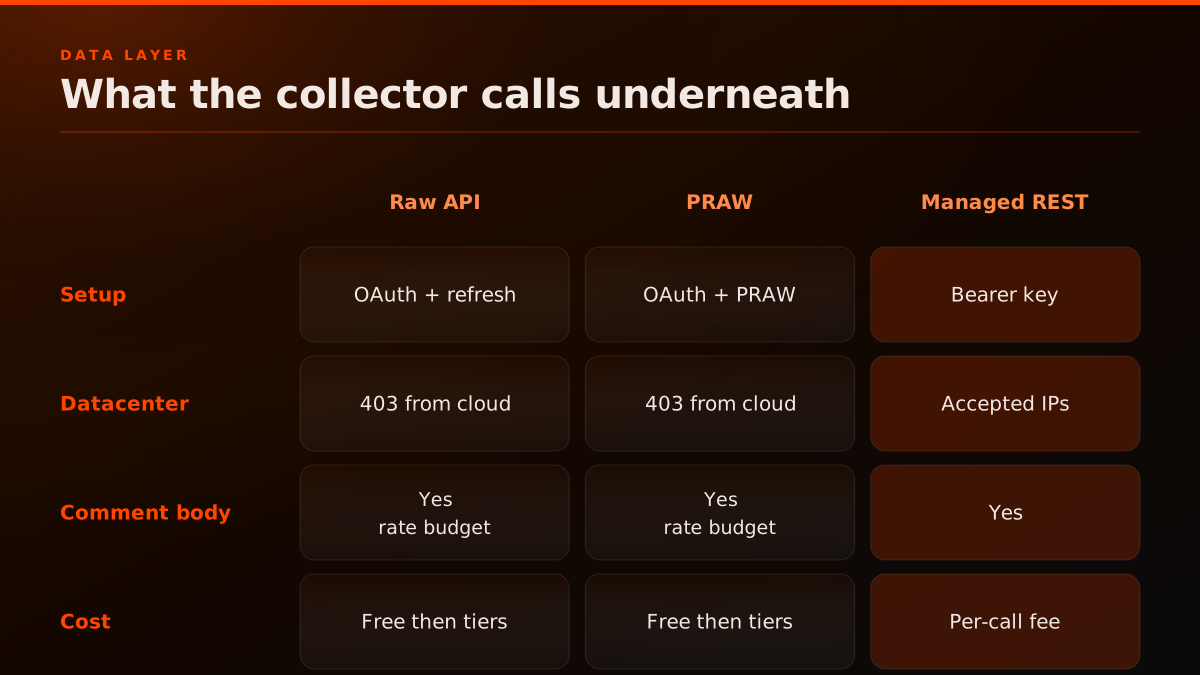 The scoring code is the same across all three data layers; a managed REST endpoint trades a small per-call fee for the datacenter reliability a scheduled pipeline needs
The honest comparison:
| Data layer | Setup | Datacenter reliability | Comment-body access | Cost model |
|---|---|---|---|---|
| Raw Reddit OAuth API | OAuth app, token refresh | Frequent 403 from cloud IPs |
Yes, with rate budget | Free tier then usage tiers |
| PRAW wrapper | OAuth app plus PRAW | Frequent 403 from cloud IPs |
Yes, with rate budget | Free tier then usage tiers |
| Managed REST endpoint | Bearer key, one header | Accepted IP pool | Yes | Per-call usage fee |
If the pipeline only ever runs on your own machine and polls lightly, the raw API or PRAW is fine. But a sentiment pipeline that runs on a schedule from a server hits the common wall: a direct call to Reddit from a datacenter IP returns 403 Forbidden regardless of correct headers, so the collector that worked in local testing silently stops returning data in the cloud, and your trend line grows holes. A managed endpoint whose IP pool Reddit accepts removes that failure mode, and the PRAW versus REST comparison lays out the trade in full. The context for why access tightened is the 2023 shift to usage-based data licensing.
What It Costs to Run a Sentiment Pipeline
Running a Reddit sentiment pipeline costs whatever the collection step charges per call, because the model side can be free. VADER and open transformer models run locally at no per-item fee, so the only variable cost is the Reddit data you pull, and that scales with how many keywords you track and how often you poll, not with a per-seat subscription.
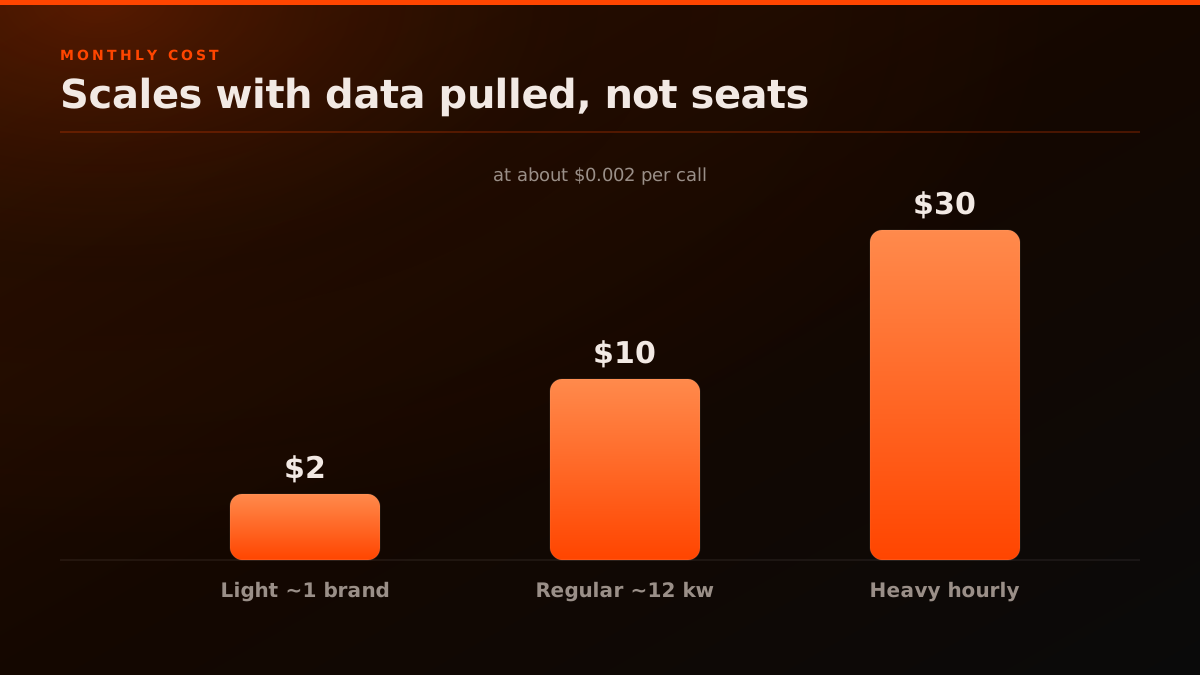 Cost scales with how much Reddit you pull, not seats, so single-brand daily tracking is a couple of dollars and a heavy hourly listening job is still modest
The rough monthly math at about $0.002 per call:
- Light (one brand, a few searches a day): roughly $2 a month
- Regular (a dozen keywords, a few polls a day): roughly $10 a month
- Heavy (hourly polling across many keywords): roughly $30 a month
The planning move is to count calls, not seats: multiply searches per poll by polls per day by days per month by the per-call price. Model your own numbers with the Reddit API cost calculator and the pricing page; the first $0.50 of credit is free at signup, which is enough to build and validate a pipeline before you spend anything. For a side-by-side of what providers charge per call, the pricing ranked comparison puts the numbers together.
Building Responsibly, and the Honest Limits
A Reddit sentiment pipeline is a read-only research tool, and the responsible way to run one is to respect the platform's rules and to be honest about what the number means. Pulling public discussion through a data API to measure aggregate sentiment is low-stakes, but a few limits are worth stating plainly so the output is not over-trusted:
- Sentiment models are imperfect on Reddit text: sarcasm, irony, and community slang all fool them, so validate against a hand-labeled sample and treat the score as signal, not truth.
- The public index is broad but not exhaustive: a search returns what Reddit surfaces, which is most of the recent conversation but not every deleted or removed comment.
- Communities can be brigaded or skewed: a spike can be a real shift or a coordinated push, so read a spike alongside the underlying posts, not on its own.
- Follow each community's rules on anything you post, and stay read-only unless you have a deliberate, human-gated reason to act.
The legal footing of pulling Reddit data through an API, which is distinct from collecting it off web pages, is covered in the is it legal to collect Reddit data guide, and Reddit's developer API terms are the reference for what programmatic access is expected to look like.
The Bottom Line
Reddit sentiment analysis is a four-stage pipeline you can build in an afternoon: collect posts and comments for your keyword through a Reddit data API, clean the text, score each item with a model, and aggregate the scores into a trend line you can track and alert on. The model choice is a speed-versus-nuance trade (a lexicon for the firehose, a transformer for accuracy, an LLM for the ambiguous middle), and the model side can be free, so the only real cost is the Reddit data at about $0.002 a call. The one decision that decides whether the pipeline survives production is the data layer underneath the collection step, because a raw call to Reddit from a server returns 403 from most datacenter IPs, so point the collector at an endpoint with an accepted IP pool and keep the reads on a schedule. If you are building the concrete pieces, the Python tutorial, the search API tutorial, and the keyword monitor are the collection half, and how to detect trending topics on Reddit is the attention-side sibling of this feeling-side guide. Grab a free key and start tracking sentiment.
Where these numbers come from.
Each row is a figure in this post and the artefact it was read from. Reddit's access rules and the third-party archives around them keep moving, so check the date on a source before you build against it.
- Reddit API documentation
- The official Reddit routes the collection step in this guide ultimately reads (search, comments, subreddit listings).
- VADER sentiment (cjhutto)
- The rule-based social-text lexicon behind the fast, no-GPU scoring option in the model comparison.
- RoBERTa sentiment model (cardiffnlp)
- A transformer fine-tuned on social posts, the accuracy option in the model comparison.
- Hugging Face Transformers pipelines
- The sentiment-analysis pipeline API the scoring code in this guide uses.
- redditapis API documentation
- Endpoint behavior, headers, and error codes for the managed data layer this guide points the pipeline at.
Frequently asked questions.
Reddit sentiment analysis is the practice of pulling posts and comments that mention a keyword, brand, or product from Reddit, then running that text through a model that labels each piece as positive, negative, or neutral so you can measure how a community feels and watch it change over time. The pipeline has four stages: collect the text through a Reddit data API such as GET https://api.redditapis.com/api/reddit/search?q=<keyword>, clean it, score each item with a sentiment model, and aggregate the scores by day or week to build a trend line. It is different from a one-off read of a thread because it is measured and repeatable: the same keyword scored every day turns scattered opinion into a number you can track. See the four-stage pipeline or grab a free key.
You collect the text, score it, and aggregate. First, call a Reddit data endpoint to pull posts and comments that match your keyword, for example GET https://api.redditapis.com/api/reddit/search?q=<keyword> for posts and GET https://api.redditapis.com/api/reddit/search/comments/deep?q=<keyword> for the actual comment bodies, both with a Bearer key. Second, run each title or comment body through a sentiment model: a lexicon scorer like VADER for speed, a transformer like a RoBERTa sentiment model for accuracy, or an LLM when you need nuance. Third, store each score with its timestamp and group by day to get a trend. The whole loop is a few dozen lines of Python, and the Python tutorial covers the read side end to end.
There is no single best; it is a speed-versus-nuance trade. VADER is a rule-based lexicon tuned for social text, so it is fast, free, and needs no GPU, but it misses sarcasm and domain slang. A transformer such as a RoBERTa model fine-tuned on social posts is far more accurate on real Reddit phrasing and still runs cheaply in batch. An LLM classifier reads context and sarcasm best but costs more per item and is slower, so it fits a smaller, high-value sample rather than a firehose. A common pattern is VADER or a transformer for the bulk and an LLM to spot-check the ambiguous middle. Reddit text is candid and sarcastic, so validate whichever model you pick against a hand-labeled sample of your own keyword before trusting the numbers.
The model side can be free (VADER and open transformer models run locally at no per-item fee); the cost is the Reddit data you pull. On a usage-priced REST endpoint at about $0.002 per call, tracking one brand with a handful of searches a day is a couple of dollars a month, and monitoring a dozen keywords with hourly polling lands in the low double digits. Cost scales with how much Reddit you read, not with a per-seat subscription, so a light brand-tracking job stays cheap and a heavy social-listening pipeline is still modest. Model your own numbers with the cost calculator and the pricing page; the first $0.50 of credit is free at signup.
Yes, and it is the main reason to build a pipeline rather than read threads by hand. You run the same keyword search on a schedule (hourly or daily), score every new post and comment, store each score with its timestamp, and plot the daily average. Over weeks that turns into a trend line that shows whether sentiment about your brand or product is rising, falling, or spiking around a launch or an incident. The key requirement is a stable, structured data source, because a trend line built on a collection step that breaks when a page layout changes is a trend line with holes in it. The keyword monitor is the on-a-schedule collection half of this.
No. PRAW is a well-maintained Python wrapper for Reddit's official OAuth API and works fine for a script on your own machine, but a sentiment pipeline that polls Reddit repeatedly from a server inherits Reddit's per-token rate budget, the OAuth setup, and a 403 from most datacenter IPs. For a collection step that has to run on a schedule and return data every time, a plain REST call to a managed endpoint is fewer moving parts. You can build the pipeline on any HTTP layer; the PRAW versus REST comparison covers the trade in full.
No, though they share the same collection step. Sentiment analysis measures how people feel about a topic (positive, negative, neutral) and tracks that feeling over time. Trend detection measures what is gaining attention right now by watching score and comment velocity, regardless of feeling. You pull Reddit the same way for both, then apply a different second stage: a sentiment model here, a velocity calculation there. If you want the attention side rather than the feeling side, see how to detect trending topics on Reddit.
Keep reading.
Continue exploring related pages.
Reddit API documentation
The complete 2026 reference: auth, all 59 endpoints, and code.
Get a Reddit API key
Instant bearer token, no waitlist and no enterprise contract.
Reddit Responsible Builder Policy
Why Reddit denies API applications, and the managed REST bypass.
Reddit API use cases
14 use cases from AI training to brand monitoring and DMs.
Reddit Search API
Search posts, comments, users, and communities over one REST endpoint.
Reddit MCP server
Wrap the REST API as MCP tools for Claude, Cursor, and any MCP client.
Reddit API for AI agents
Live Reddit context for tool calls, MCP servers, and RAG pipelines.
Redditapis pricing
Endpoint-level costs and quick monthly totals - reads from $0.002 / call.
Reddit API cost calculator
Estimate monthly spend using your request volume.
Reddit API guides and tutorials
Tutorials, walkthroughs, and API deep-dives for developers.
Reddit API alternatives
Evaluate alternatives by cost model, limits, and integration fit.
Cheap Reddit API
The cheapest way to get Reddit data: $0.002 per call, no contract, no minimum.
Official Reddit API vs Redditapis
Access, setup, rate limits, and pricing, side by side.
PRAW alternative
A hosted Reddit REST API for any language, no app registration or OAuth.
Reddapi alternative
A maintained Reddit REST API with published pricing and write endpoints.
Reddit comment scraper alternative
The raw comment API: search and filter comments, historical and live, clean JSON.
Reddit scraper API
Hosted scraper API vs building your own: managed proxies, clean JSON.
RapidAPI Reddit alternative
A direct, maintained Reddit API with published pricing and write endpoints.
Bright Data Reddit alternative
A purpose-built Reddit API vs a general scraping platform: structured JSON, plus writes.
ScraperAPI Reddit alternative
A Reddit-native API vs a generic HTML fetcher: auth and pagination handled, typed JSON.
TikHub alternative
TikHub's Reddit surface is read-only; get comment, vote, and DM endpoints too.
EnsembleData alternative
No $100/month floor: pay per call from $0.002, plus write, vote, and DM endpoints.
Scrape Creators alternative
7 read-only Reddit endpoints vs a dedicated API with real write, vote, and DM paths.
FetchLayer alternative
Posts, comments, and search only; add vote, comment, and DM over the same REST auth.
PullPush alternative
PullPush is free but volunteer-run and goes offline for reindexing; a maintained REST API that stays up.
Reddit monitoring API
Build your own keyword and brand-mention monitor: search, comment search, and subreddit streams over REST.
F5Bot vs Redditapis
F5Bot's Slack and Discord delivery needs its $49.99/mo Gold tier; Redditapis includes it from $19/mo.
Syften vs Redditapis
Syften caps you at 100 to 500 results a day; Redditapis allows 10,000 a day per monitor at the entry plan.
Octolens vs Redditapis
Octolens meters by mention with overage fees; Redditapis is flat-priced by subreddit slot from $19/mo.
Affiliate program
Earn 20% lifetime commissions - capped at $5,000/yr.
Reddit Vote API tutorial
Upvote and downvote a post programmatically via the REST API.
Reddit Data API: REST, no PRAW
REST endpoints for Reddit data with no PRAW and no OAuth dance.
Reddit scraping benchmarks
Real throughput, error rates, and cost benchmarks for Reddit scraping.
Reddit API answers
Direct answers on cost, access, rate limits, endpoints, and auth.
How much the Reddit API costs
Per-call pricing from $0.002 a read, with $0.50 in free credits.
Reddit API in Python
One requests call with a bearer token, no PRAW and no OAuth flow.
Reddit shadowban checker
Check if a Reddit account is shadowbanned in seconds, free and no login.
Subreddit stats checker
See any subreddit's live subscriber count, active users, and age, free and no login.
Similar reads.
More guides on the Reddit API, scraping, pricing, and MCP servers.
How to Detect Trending Topics on Reddit With an API
Detect trending topics on Reddit with an API: snapshot hot and top listings, compute score and comment velocity, and surface rising posts, subreddits, and topics.
Reddit Monitoring in 2026: How Alerts Actually Work, What They Miss, and How to Cut the Noise
Reddit has no push, so every Reddit alert is somebody's polling loop. What that means for speed, what monitoring silently misses, and how to make the output usable.

Most Popular Subreddits via the Reddit API: Trending and Hot Communities in 2026
How to pull the most popular, trending, and hot subreddits programmatically: the popular and community-search endpoints, why popular is not the subscriber ranking, with runnable code.

Advanced Reddit Search Filters API (2026)
Filter Reddit search by score, comment count, media type, and NSFW over one authenticated GET. Every filter parameter, the response meta, and real Python.

Reddit Bulk Fetch by ID: Hydrate Posts in One API Call
Fetch many Reddit posts in one call with the by_id API. Hydrate t3_ fullnames from a stream, backfill archives, and dedup at scale, with copy-paste Python for 2026.

Reddit Subreddit Rules API: Pull Posting Rules as JSON
Pull any subreddit's posting rules as structured JSON with the rules API. Build pre-submit validation, compliance checks, and automod-aware bots, with copy-paste Python for 2026.

Reddit User API: Fetch Profile, Karma, and History
Fetch a Reddit user's profile, karma, and full comment plus submission history from one API. Real request and response JSON, copy-paste Python, and pagination for 2026.

How to Get Reddit Comments via the API: Fetch the Full Comment Tree (2026)
Fetch Reddit comments by permalink, walk the nested tree, expand the more / morechildren nodes, and flatten replies in Python. Copy-paste code and first-party numbers, 2026.