
How to Detect Trending Topics on Reddit With an API
Detect trending topics on Reddit with an API: snapshot hot and top listings, compute score and comment velocity, and surface rising posts, subreddits, and topics.
Detecting trending topics on Reddit means snapshotting the platform's ranked listings on a schedule and measuring what is accelerating: not what has the highest score, but what is gaining score and comments the fastest right now. It is a velocity calculation on top of a collection step. You poll GET https://api.redditapis.com/api/reddit/posts?subreddit=<name>&sort=hot and sort=rising at a fixed interval, store each post's engagement with a timestamp, and compare the new snapshot against the previous one to find the steepest climbers. This guide builds the whole thing with copy-paste Python: the snapshot call, the velocity math, the ranking that surfaces trending posts, the same idea applied to trending subreddits and emerging keyword topics, and the one data-layer decision that determines whether the poller keeps running in production.
Not affiliated with Reddit Inc. redditapis.com is an independent third-party REST API for Reddit data. This guide is vendor-neutral: it shows the snapshot, velocity, and ranking steps honestly, names the official Reddit API and open-source tooling where they fit, and points at the ranking math so you can build the pieces that suit your situation.
TL;DR: Trending is a rate of change, so you snapshot and compare. (1) Poll
GET https://api.redditapis.com/api/reddit/posts?subreddit=<name>&sort=hotandsort=risingon a fixed interval with aBearerkey. (2) Store each post'supvotesand comment count with a timestamp. (3) Compute velocity:(upvotes_now - upvotes_before) / minutes_elapsedfor score and comments. (4) Rank by velocity, not absolute score, to surface what is accelerating; normalize with a z-score to compare across subreddits of different sizes. The same snapshot-and-compare finds trending subreddits (viasub/<name>/about) and emerging topics (via keyword search sorted bynew). Cost scales with polling frequency at about $0.002 a call. The one decision that decides whether it survives production is the data layer, because a raw call to Reddit from a server returns403from most datacenter IPs. The first $0.50 is free at /signup.
What this guide covers:
- What trend detection on Reddit is, and why the API beats watching the homepage
- The three trend signals: score velocity, comment velocity, and new-post volume
- Step 1: snapshotting hot, rising, and top, with working Python
- Step 2: computing velocity between snapshots, and Step 3: ranking and surfacing
- Detecting trending subreddits and emerging keyword topics
- The data-layer decision, the cost math, and the honest limitations
What Is Trend Detection on Reddit?
Trend detection on Reddit is finding what is gaining attention fastest right now by measuring the rate of change of engagement, not its absolute level. A post with 5,000 upvotes accumulated over a day is popular; a post gaining 300 upvotes in the last ten minutes is trending, and trend detection is the machinery that tells the two apart. The output is a ranked list of accelerating posts, subreddits, or topics, updated every time you poll.
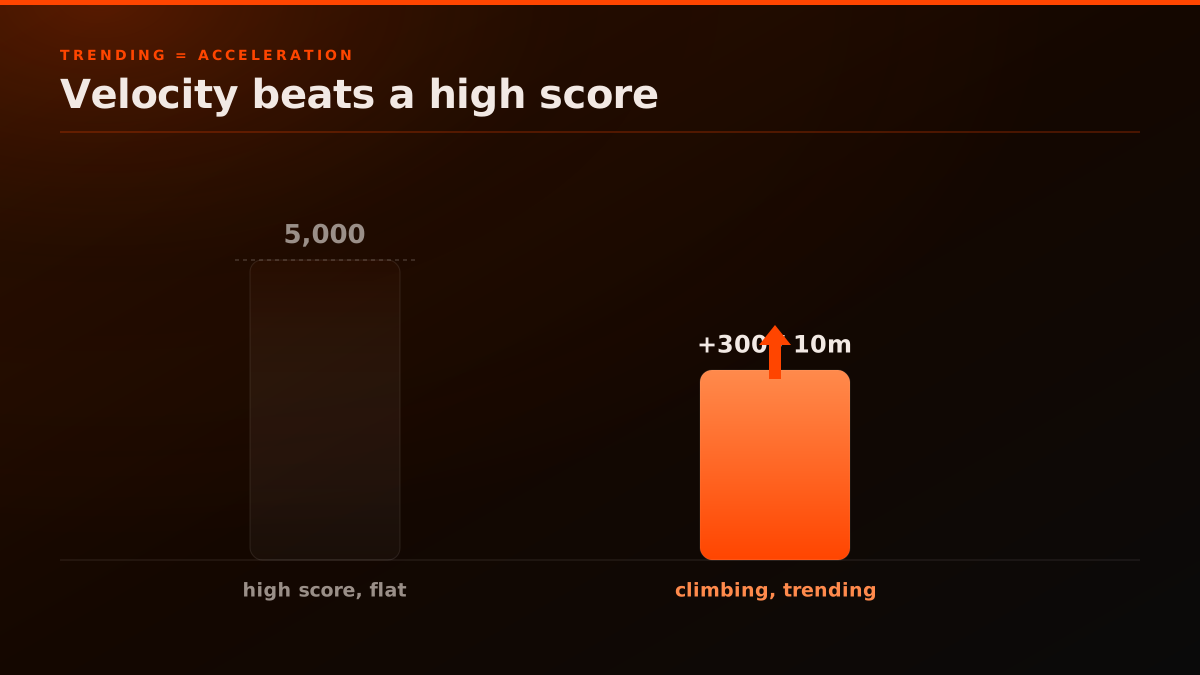 Trending is about acceleration, not altitude: a post gaining fast beats a higher-scoring post that has stalled, which is why velocity is the signal
People build this for launch monitoring, catching a breaking story in a niche before it hits the front page, spotting a competitor's post gaining traction, or feeding a content or trading pipeline that reacts to what a community is talking about. All of them are the same calculation pointed at different listings, and all of them need the same thing the Reddit homepage cannot give you: a stored history to measure change against.
Why the API, Not the Homepage
You detect trends through the API rather than by watching the homepage because trending is a rate of change, and a rate of change needs a stored history that a web page does not keep. Reddit's hot and rising tabs show you a single moment; to know that a post is accelerating you have to compare this moment against the last one, which means capturing structured snapshots on a schedule and diffing them. That is exactly what an API gives you and a browser does not.
The demand for this is real, developers keep building trend trackers on top of Reddit because the signal is genuinely useful.
I built a free tool that tracks stats and monthly trends across 100,000+ subreddits
[removed]
That project tracks stats and monthly trends across 100,000 subreddits, which is snapshot-and-compare at scale. An API-driven approach buys three things the homepage cannot:
- History: stored snapshots you can diff, which is the only way to compute velocity
- Breadth: many subreddits and searches polled in parallel, not one page at a time
- Structure: clean numeric fields (
upvotes, comment counts) you can do math on directly
The rest of this guide is the concrete build: what to snapshot, how to turn two snapshots into a velocity, and how to rank the result so the genuinely trending items rise to the top.
The Signals: Score Velocity, Comment Velocity, and Volume
Three signals tell you something is trending, and the strongest detectors combine them: score velocity, comment velocity, and new-post volume. Each catches a different shape of trend, and using them together filters out the false positives that any one alone would surface.
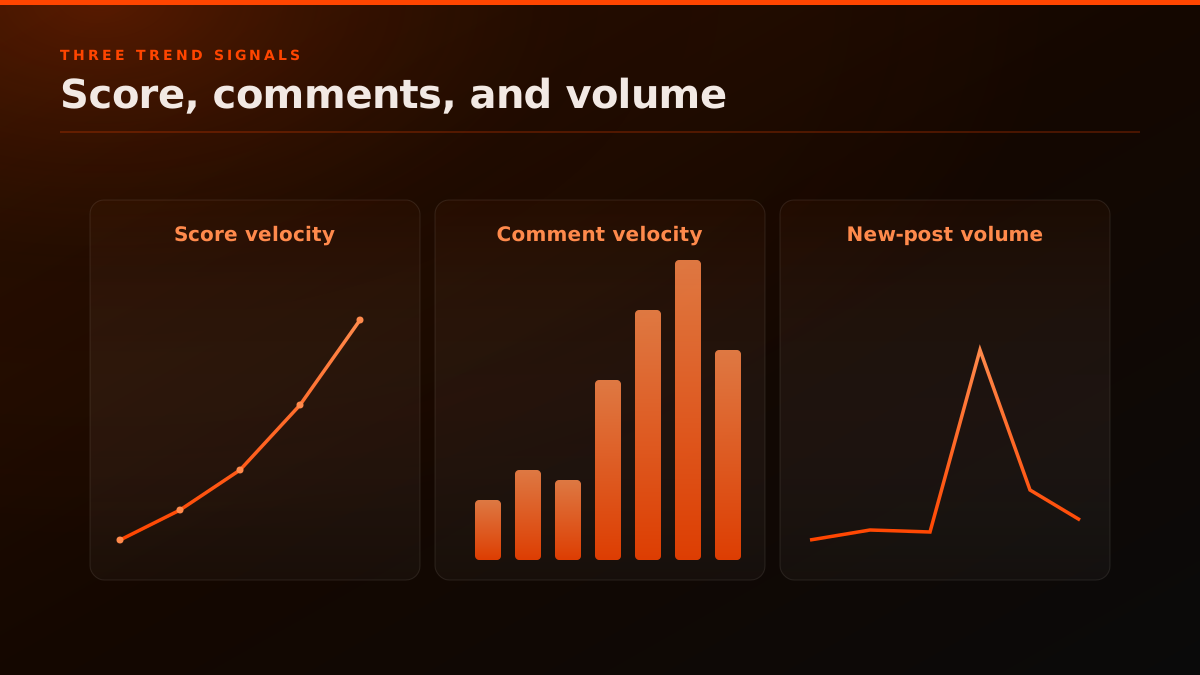 Three signals, three shapes of trend: a post accelerating in score, a thread exploding in comments, and a topic spiking in fresh-post volume across the platform
What each signal catches:
- Score velocity: how fast a post's
upvotesare climbing. Catches a single post breaking out. - Comment velocity: how fast a thread's comment count is climbing. Catches a controversy or a discussion catching fire, which sometimes moves before score does.
- New-post volume: how many fresh posts mention a keyword in a short window versus the baseline. Catches a topic trending across the platform rather than one post trending within a subreddit.
The first two are per-post and come from snapshotting listings; the third is per-topic and comes from keyword search sorted by new. The next sections build the per-post velocity first, because it is the core calculation everything else reuses.
Step 1: Snapshot Hot, Rising, and Top
The snapshot step captures the current state of a subreddit's listings so you have something to compare against next time. You poll hot and rising for the live picture and top?t=day for a baseline, reading each post's upvotes, comment count, and id. Here is the snapshot against a REST endpoint with a Bearer key:
import os, time, requests

API_KEY = os.environ.get("REDDIT_API_KEY", "YOUR_API_KEY")  # free key at redditapis.com/signup
BASE = "https://api.redditapis.com/api/reddit"
HEADERS = {"Authorization": f"Bearer {API_KEY}"}

def snapshot(subreddit: str, sort: str = "hot", limit: int = 50) -> dict[str, dict]:
    """Current listing keyed by post id, with the fields velocity needs."""
    r = requests.get(f"{BASE}/posts",
                     headers=HEADERS,
                     params={"subreddit": subreddit, "sort": sort, "limit": limit},
                     timeout=20)
    r.raise_for_status()
    now = time.time()
    return {
        p["id"]: {
            "title": p["title"], "subreddit": p["subreddit"],
            "upvotes": p["upvotes"], "num_comments": p["num_comments"],
            "permalink": p["permalink"], "t": now,
        }
        for p in r.json().get("posts", [])
    }

if __name__ == "__main__":
    snap = snapshot("technology", sort="rising")
    print(f"captured {len(snap)} posts at one instant")
The sort values hot, rising, top, and new are all supported on GET /api/reddit/posts, and top accepts a t window (hour, day, week, and so on). Read upvotes and num_comments off each row because those are the numeric fields the posts response carries, and keep the poll limit modest so a snapshot is one cheap call. For the listing sorts and their parameters in full, the subreddit analytics comparison and the data API overview cover the surface, and the Node.js guide shows the same in TypeScript.
Start building with Redditapis
Reads $0.002, votes $0.005, writes $0.012, DMs $0.025. $0.50 free credits.
Step 2: Compute Velocity Between Snapshots
Velocity is the change in engagement between two snapshots divided by the time elapsed, and it is the calculation that turns two flat listings into a trend signal. You keep the previous snapshot, and on the next poll you match posts by id and compute the per-minute rate of change for score and comments. Here is the diff:
def velocity(prev: dict[str, dict], curr: dict[str, dict]) -> list[dict]:
    """Per-post score and comment velocity between two snapshots."""
    out = []
    for pid, now in curr.items():
        before = prev.get(pid)
        if not before:
            continue  # new since last poll; needs one more snapshot to rate
        minutes = max((now["t"] - before["t"]) / 60.0, 1e-6)
        out.append({
            "id": pid,
            "title": now["title"],
            "subreddit": now["subreddit"],
            "permalink": now["permalink"],
            "score_velocity": (now["upvotes"] - before["upvotes"]) / minutes,
            "comment_velocity": (now["num_comments"] - before["num_comments"]) / minutes,
        })
    return out
The match-by-id step is what makes this correct: the same post appears in both snapshots, so subtracting its old score from its new one gives the true gain, and dividing by the elapsed minutes normalizes for an uneven polling interval. A post that is new since the last poll has no prior to rate against, so it waits one more cycle rather than being scored off a single point. Run snapshot on a schedule, keep the last result, and feed both into velocity each cycle. The scheduled-polling loop and its storage are the same machinery as a Reddit keyword monitor, with this velocity step added on top.
Step 3: Rank and Surface Trending Posts
Ranking turns per-post velocities into the short list you actually surface, and the one correction that matters is normalizing across subreddits of different sizes. A raw score velocity favors big subreddits where everything moves fast, so a genuinely trending post in a small community gets buried. Normalizing each post's velocity against its subreddit's typical rate, for example as a z-score, fixes that: it measures how unusual this post's acceleration is for its own community.
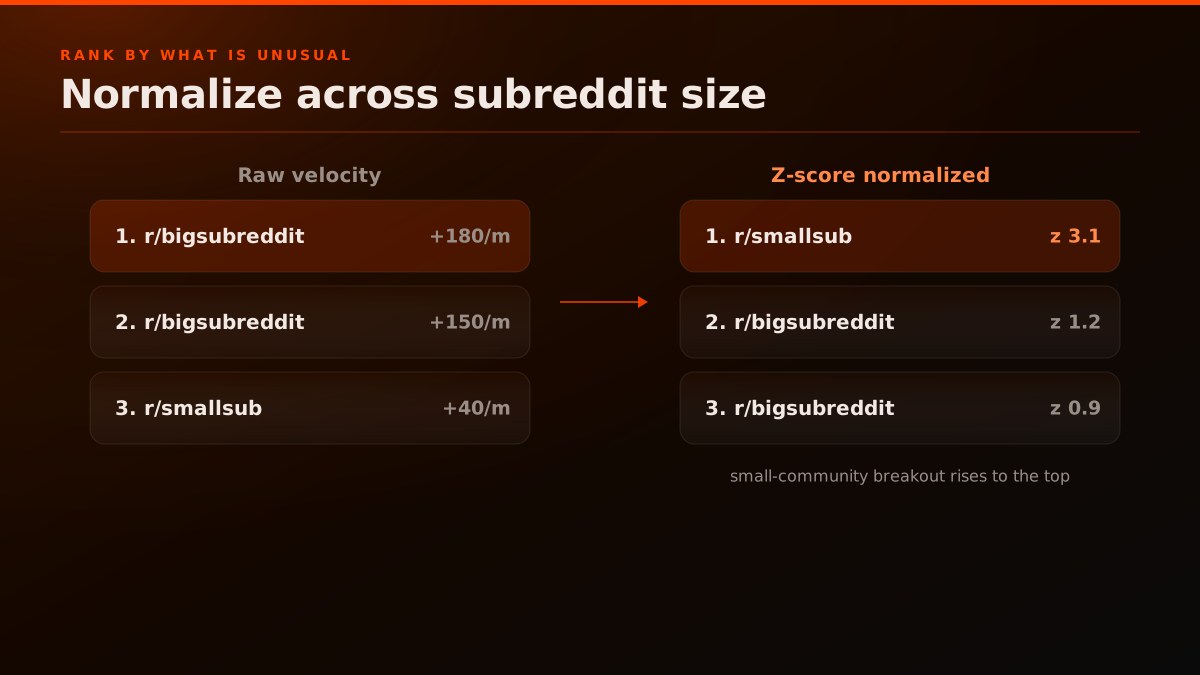 Normalizing velocity by each subreddit's typical rate is what lets a breakout in a small community outrank routine motion in a big one
The ranking is a sort on the normalized velocity:
import statistics

def rank_trending(rows: list[dict], baseline: dict[str, list[float]], top_n: int = 10):
    """Rank by how unusual each post's score velocity is for its subreddit."""
    scored = []
    for r in rows:
        hist = baseline.get(r["subreddit"], [])
        if len(hist) >= 5:
            mean = statistics.mean(hist)
            sd = statistics.pstdev(hist) or 1.0
            r["z"] = (r["score_velocity"] - mean) / sd   # standard score
        else:
            r["z"] = r["score_velocity"]                 # not enough history yet
        scored.append(r)
    return sorted(scored, key=lambda x: x["z"], reverse=True)[:top_n]
The baseline is a rolling history of recent velocities per subreddit that you accumulate as you poll, so the z-score gets more accurate the longer the tracker runs. The output is a ranked list where the top entries are the posts accelerating most unusually for their community, which is the definition of trending you actually want. Developers build exactly this kind of ranked, momentum-based Reddit view.
I built a Reddit-powered “Bloomberg terminal” to track ticker trends and identify bull/bear cases
​ [Quick demo](https://reddit.com/link/n4pagm/video/587cqrz434x61/player) Hey everyone! I built a site that tracks all types of trends across reddit (mentions, comment volume, bullish sentiment, etc.). I know…
That project ranks tickers by Reddit momentum, which is this same velocity-and-rank pipeline pointed at a set of keywords instead of a set of subreddits.
Detecting Trending Subreddits, Not Just Posts
The same snapshot-and-compare approach finds trending communities, not just trending posts, by watching each subreddit's own activity over time. You poll GET /api/reddit/sub/<name>/about for the communities you track and store subscribers and active_user_count with a timestamp; a subreddit whose active-user count or subscriber growth accelerates is a community trending as a whole. To discover which communities to watch in the first place, a community search returns subreddits matching a topic with their sizes.
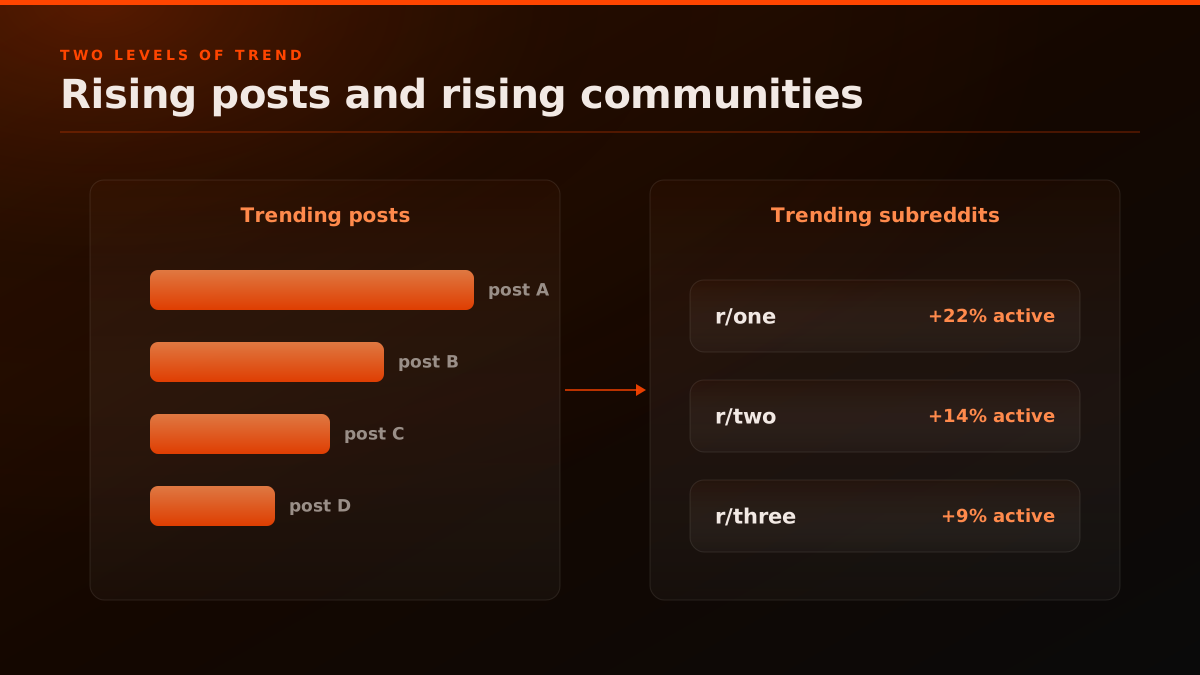 Two levels of trend: posts accelerating inside a community, and the community itself accelerating, and watching both catches a topic and the crowd forming around it
The subreddit-level snapshot mirrors the post-level one:
def community_snapshot(name: str) -> dict:
    r = requests.get(f"{BASE}/sub/{name}/about", headers=HEADERS, timeout=20)
    r.raise_for_status()
    d = r.json()
    return {"name": d["name"], "subscribers": d["subscribers"],
            "active": d.get("active_user_count"), "t": time.time()}

def discover(topic: str, limit: int = 25) -> list[dict]:
    r = requests.get(f"{BASE}/search/communities",
                     headers=HEADERS, params={"q": topic, "limit": limit}, timeout=20)
    r.raise_for_status()
    return [{"name": c["name"], "title": c["title"], "subscribers": c["subscribers"]}
            for c in r.json().get("communities", [])]
Combining rising post velocity inside a subreddit with rising activity of the subreddit itself gives a two-level picture: the topic that is heating up and the community forming around it. Discovering the right communities to watch is its own task, and the how to find subreddits guide covers the discovery side in depth.
Emerging Topics: New-Post Volume Across the Platform
The third signal catches a topic trending across Reddit rather than one post trending within a subreddit, and it comes from watching how many fresh posts mention a keyword in a short window versus the baseline. You search for the keyword sorted by new, count the posts in the last window, and compare that count against the recent average; a window that is well above the baseline is an emerging topic. This is the same z-score idea applied to post counts instead of scores.
def new_post_volume(keyword: str, window_min: int = 60) -> int:
    """Count fresh posts mentioning a keyword in the recent window."""
    r = requests.get(f"{BASE}/search",
                     headers=HEADERS,
                     params={"q": keyword, "sort": "new", "t": "day", "limit": 100},
                     timeout=20)
    r.raise_for_status()
    cutoff = time.time() - window_min * 60
    posts = r.json().get("posts", [])
    return sum(1 for p in posts if p.get("created_utc", 0) >= cutoff)
Store the per-window count each poll, keep a rolling baseline, and flag a window whose count exceeds the mean by a couple of standard deviations. This is the signal that catches a breaking story or a viral product moment while it is still small, before any single post has accumulated enough score to reach hot. Reddit's own listing sorts are a single moment; building your own volume baseline is what turns that moment into a rate. Developers keep asking for exactly this kind of real-time, engagement-filtered Reddit access.

Om Patel
@om_patel5
REDDIT API IS BACK. I just launched a Reddit MCP tool that lets you search Reddit in real time from any AI client. > search posts across any subreddit by keyword, time, and engagement > pull full comment threads from any post > fetch top posts from any subreddit with f… Show more

The pattern in that post, searching Reddit in real time and filtering by engagement across subreddits, is the collection layer every signal in this guide sits on top of.
The cheapest Reddit API. Try it free.
Reads from $0.002 per call. $0.50 free credits. No credit card required.
The Data Layer Decision: What the Poller Calls
The single decision that determines whether a trend detector survives production is what the poller calls underneath: Reddit's raw OAuth API, the PRAW wrapper, or a managed REST endpoint. The velocity and ranking code is identical in all three cases; only the data layer changes, and because trend detection is defined by tight, frequent polling, the rate budget and the datacenter block bite harder here than in almost any other Reddit workload.
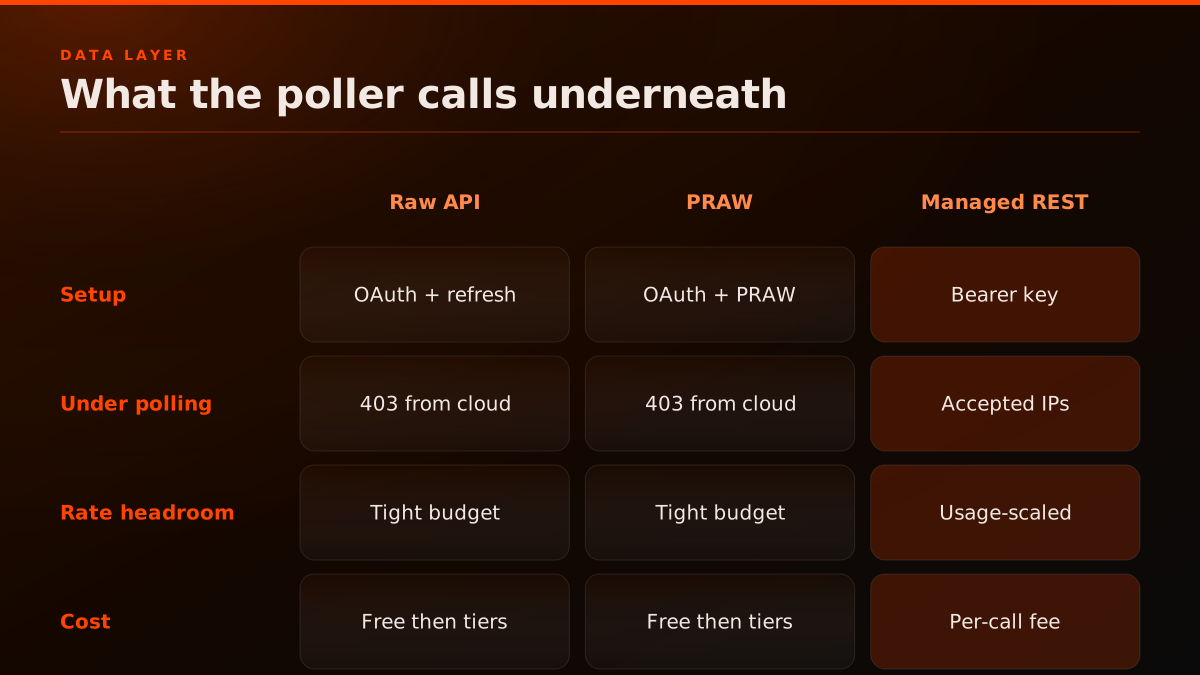 The velocity code is the same across all three data layers; a managed REST endpoint trades a small per-call fee for the datacenter reliability and rate headroom tight polling needs
The honest comparison:
| Data layer | Setup | Reliability under frequent polling | Rate headroom | Cost model |
|---|---|---|---|---|
| Raw Reddit OAuth API | OAuth app, token refresh | Frequent 403 from cloud IPs |
Per-token budget, tight | Free tier then usage tiers |
| PRAW wrapper | OAuth app plus PRAW | Frequent 403 from cloud IPs |
Per-token budget, tight | Free tier then usage tiers |
| Managed REST endpoint | Bearer key, one header | Accepted IP pool | Usage-scaled | Per-call usage fee |
If the tracker only ever runs on your own machine and polls a couple of subreddits slowly, the raw API or PRAW is fine. But a trend detector by definition polls often, from a server, across many listings, and that is exactly where a direct call to Reddit returns 403 Forbidden from most datacenter IPs and where a per-token rate budget runs out fastest. A managed endpoint whose IP pool Reddit accepts removes both failure modes, and the rate limits guide and the PRAW versus REST comparison lay out the trade. Full endpoint behavior, headers, and error codes are in the API documentation.
What It Costs to Run a Trend Detector
Running a Reddit trend detector costs whatever the poller charges per call, and the polling interval is the main lever. Trend detection is snapshot-and-compare, so cost scales with how many listings you snapshot and how often, not with a per-seat subscription: tighter intervals catch faster trends but spend more calls.
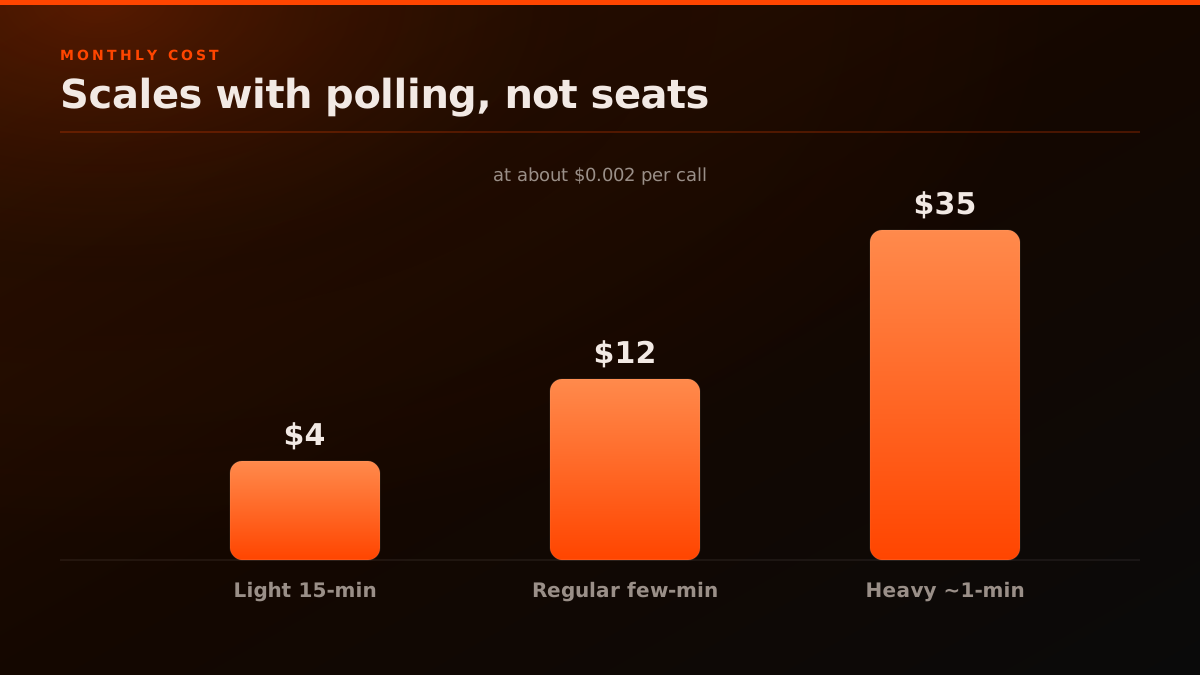 Cost scales with polling frequency and breadth, not seats, so a few subreddits every fifteen minutes is a few dollars and a broad fast poller is still modest
The rough monthly math at about $0.002 per call:
- Light (a few subreddits every fifteen minutes): roughly $4 a month
- Regular (a dozen subreddits and searches every few minutes): roughly $12 a month
- Heavy (dozens of listings polled every minute or two): roughly $35 a month
The planning move is to count calls: multiply listings per poll by polls per hour by hours per month by the per-call price, then pick the loosest interval that still catches the trends you care about. Model your own numbers with the Reddit API cost calculator and the pricing page; the first $0.50 of credit is free at signup. For a side-by-side of what providers charge per call, the pricing ranked comparison puts the numbers together.
Building Responsibly, and the Honest Limits
A Reddit trend detector is a read-only polling tool, and running one responsibly means respecting the platform's rate expectations and being honest about what a spike means. Polling public listings to measure velocity is low-stakes, but a few limits are worth stating plainly:
- Poll at a sane interval: tighter is not always better, and hammering an endpoint is both wasteful and rude to any data layer; pick the loosest interval that catches your trends.
- A spike can be manufactured: brigading and coordinated pushes produce the same velocity signature as organic momentum, so read a trending item alongside its actual posts before acting on it.
- The public index is broad but not exhaustive: a listing returns what Reddit surfaces, which is most of the live picture but not every removed or filtered post.
- Velocity is noisy at the edges: a post with tiny absolute numbers can show a huge percentage velocity, so apply a minimum-engagement floor before ranking.
The legal footing of pulling Reddit data through an API, distinct from collecting it off web pages, is covered in the is it legal to collect Reddit data guide, and Reddit's developer API terms are the reference for what programmatic access is expected to look like.
The Bottom Line
Detecting trending topics on Reddit is snapshot-and-compare: poll hot, rising, and top on a schedule, store each post's upvotes and comment count with a timestamp, compute velocity as the change divided by the elapsed time, and rank by that velocity rather than by absolute score. Normalize with a z-score so a breakout in a small community is not buried by routine motion in a big one, and apply the same snapshot-and-compare to subreddit activity and to keyword post-volume to catch trending communities and emerging topics. Cost scales with your polling interval at about $0.002 a call, so a focused tracker is a few dollars a month. The one decision that decides whether it survives production is the data layer underneath the poller, because a raw call to Reddit from a server returns 403 from most datacenter IPs and a per-token budget runs out fast under tight polling, so point the poller at an endpoint with an accepted IP pool. If you are building the pieces, the subreddit analytics comparison, the keyword monitor, and the how to find subreddits guide are the neighbors, and how to do Reddit sentiment analysis is the feeling-side sibling of this attention-side guide. Grab a free key and start detecting trends.
Where these numbers come from.
Each row is a figure in this post and the artefact it was read from. Reddit's access rules and the third-party archives around them keep moving, so check the date on a source before you build against it.
- Reddit API documentation
- The official Reddit listing routes this guide snapshots (hot, top, rising, subreddit about, search).
- How Reddit ranking algorithms work
- The write-up of Reddit's hot and best ranking math, background for why the built-in sorts are a moment and not a rate.
- Standard score (z-score)
- The statistical basis for normalizing velocity across subreddits of different sizes in this guide.
- PRAW documentation
- The official Python wrapper referenced in the data-layer comparison.
- redditapis API documentation
- Endpoint behavior, listing sorts, headers, and error codes for the managed data layer this guide points the poller at.
Frequently asked questions.
You snapshot Reddit's ranked listings on a schedule and measure change. Poll GET https://api.redditapis.com/api/reddit/posts?subreddit=<name>&sort=hot and sort=rising at a fixed interval, store each post's upvotes and comment count with a timestamp, then compare the new snapshot against the previous one to compute velocity: how fast a post's score and comments are climbing. Posts with the steepest velocity are trending right now, regardless of their absolute score. The same idea across many subreddits, or across keyword searches sorted by new, surfaces emerging topics before they reach the front page. Trend detection is a velocity calculation on top of a collection step, not a single endpoint. See the trend signals or grab a free key.
They are three different sorts of the same listing, and each answers a different question. hot is Reddit's default ranking that blends score with recency, so it shows what is popular right now. top ranks by raw score within a time window (t=hour, day, week, and so on), so it shows what performed best over that period. rising shows posts gaining engagement unusually fast for their age, which is the closest built-in signal to trending. For trend detection you poll hot and rising for the live picture and top?t=day for a baseline, then compute your own velocity across snapshots because the built-in sorts are a single moment, not a rate of change. All three are sort values on GET https://api.redditapis.com/api/reddit/posts.
Velocity is the change in a post's engagement divided by the time between two snapshots. Store each post's upvotes and comment count with the poll timestamp, then on the next poll compute (upvotes_now - upvotes_before) / minutes_elapsed for score velocity and the same for comments. A post gaining 200 upvotes in ten minutes is trending harder than one that reached a higher total over a day, and velocity is what separates the two. Rank posts by velocity rather than absolute score to surface what is accelerating. To compare across subreddits of different sizes, normalize the velocity against each subreddit's typical rate, for example as a z-score, so a fast post in a small community is not drowned out by a large one.
Yes, with the same snapshot-and-compare approach applied to communities instead of posts. Poll GET https://api.redditapis.com/api/reddit/sub/<name>/about for each subreddit you watch and store its subscribers and active_user_count over time; a community whose active-user count or subscriber growth accelerates is trending. To discover new communities to watch in the first place, GET https://api.redditapis.com/api/reddit/search/communities?q=<topic> returns subreddits matching a topic with their subscriber counts. Combining rising post velocity inside a subreddit with rising activity of the subreddit itself gives a two-level trend picture, the topic and the community around it. See detecting trending subreddits.
Trend detection is polling, so cost scales with how many listings you snapshot and how often. On a usage-priced REST endpoint at about $0.002 per call, watching a handful of subreddits every fifteen minutes is a few dollars a month, and a broad tracker polling dozens of subreddits and searches every few minutes lands in the low double digits. Because the whole method is comparing snapshots, the polling interval is the main cost lever: tighter intervals catch faster trends but cost more calls. Model your own numbers with the cost calculator and the pricing page; the first $0.50 of credit is free at signup, which is enough to build and tune a tracker before spending anything.
Yes, because trending is a rate of change and a rate of change needs at least two points in time. A single call to hot tells you what is popular at this instant but not what is accelerating, so you store each poll's results (post id, score, comment count, timestamp) and compute the delta against the previous poll. The storage can be as simple as an append-only file or a small table keyed by post id; the only requirement is that you keep the previous snapshot to diff against. The scheduled-polling and storage machinery is the same as a Reddit keyword monitor, with a velocity calculation added on top.
No, though they share the same collection step. Trend detection measures what is gaining attention right now by watching score and comment velocity, regardless of how people feel about it. Sentiment analysis measures how people feel (positive, negative, neutral) and tracks that feeling over time. You pull Reddit the same way for both, then apply a different second stage: a velocity calculation here, a sentiment model there. If you want the feeling side rather than the attention side, see how to do Reddit sentiment analysis.
No. PRAW is a well-maintained Python wrapper for Reddit's official OAuth API and works fine for a script on your own machine, but a trend detector polls Reddit frequently from a server, so it inherits Reddit's per-token rate budget, the OAuth setup, and a 403 from most datacenter IPs. Because trend detection is defined by tight polling, the rate budget and the datacenter block bite fast. You can build the poller on any HTTP layer; a managed REST endpoint removes the 403 failure mode and the per-token throttle, and the PRAW versus REST comparison covers the trade in full.
Keep reading.
Continue exploring related pages.
Reddit API documentation
The complete 2026 reference: auth, all 59 endpoints, and code.
Get a Reddit API key
Instant bearer token, no waitlist and no enterprise contract.
Reddit Responsible Builder Policy
Why Reddit denies API applications, and the managed REST bypass.
Reddit API use cases
14 use cases from AI training to brand monitoring and DMs.
Reddit Search API
Search posts, comments, users, and communities over one REST endpoint.
Reddit MCP server
Wrap the REST API as MCP tools for Claude, Cursor, and any MCP client.
Reddit API for AI agents
Live Reddit context for tool calls, MCP servers, and RAG pipelines.
Redditapis pricing
Endpoint-level costs and quick monthly totals - reads from $0.002 / call.
Reddit API cost calculator
Estimate monthly spend using your request volume.
Reddit API guides and tutorials
Tutorials, walkthroughs, and API deep-dives for developers.
Reddit API alternatives
Evaluate alternatives by cost model, limits, and integration fit.
Cheap Reddit API
The cheapest way to get Reddit data: $0.002 per call, no contract, no minimum.
Official Reddit API vs Redditapis
Access, setup, rate limits, and pricing, side by side.
PRAW alternative
A hosted Reddit REST API for any language, no app registration or OAuth.
Reddapi alternative
A maintained Reddit REST API with published pricing and write endpoints.
Reddit comment scraper alternative
The raw comment API: search and filter comments, historical and live, clean JSON.
Reddit scraper API
Hosted scraper API vs building your own: managed proxies, clean JSON.
RapidAPI Reddit alternative
A direct, maintained Reddit API with published pricing and write endpoints.
Bright Data Reddit alternative
A purpose-built Reddit API vs a general scraping platform: structured JSON, plus writes.
ScraperAPI Reddit alternative
A Reddit-native API vs a generic HTML fetcher: auth and pagination handled, typed JSON.
TikHub alternative
TikHub's Reddit surface is read-only; get comment, vote, and DM endpoints too.
EnsembleData alternative
No $100/month floor: pay per call from $0.002, plus write, vote, and DM endpoints.
Scrape Creators alternative
7 read-only Reddit endpoints vs a dedicated API with real write, vote, and DM paths.
FetchLayer alternative
Posts, comments, and search only; add vote, comment, and DM over the same REST auth.
PullPush alternative
PullPush is free but volunteer-run and goes offline for reindexing; a maintained REST API that stays up.
Reddit monitoring API
Build your own keyword and brand-mention monitor: search, comment search, and subreddit streams over REST.
F5Bot vs Redditapis
F5Bot's Slack and Discord delivery needs its $49.99/mo Gold tier; Redditapis includes it from $19/mo.
Syften vs Redditapis
Syften caps you at 100 to 500 results a day; Redditapis allows 10,000 a day per monitor at the entry plan.
Octolens vs Redditapis
Octolens meters by mention with overage fees; Redditapis is flat-priced by subreddit slot from $19/mo.
Affiliate program
Earn 20% lifetime commissions - capped at $5,000/yr.
Reddit Vote API tutorial
Upvote and downvote a post programmatically via the REST API.
Reddit Data API: REST, no PRAW
REST endpoints for Reddit data with no PRAW and no OAuth dance.
Reddit scraping benchmarks
Real throughput, error rates, and cost benchmarks for Reddit scraping.
Reddit API answers
Direct answers on cost, access, rate limits, endpoints, and auth.
How much the Reddit API costs
Per-call pricing from $0.002 a read, with $0.50 in free credits.
Reddit API in Python
One requests call with a bearer token, no PRAW and no OAuth flow.
Reddit shadowban checker
Check if a Reddit account is shadowbanned in seconds, free and no login.
Subreddit stats checker
See any subreddit's live subscriber count, active users, and age, free and no login.
Similar reads.
More guides on the Reddit API, scraping, pricing, and MCP servers.
Reddit Sentiment Analysis With an API: A 2026 Guide
Build a Reddit sentiment analysis pipeline: pull posts and comments for a keyword through an API, score them with a model, and track brand sentiment over time.
Reddit Monitoring in 2026: How Alerts Actually Work, What They Miss, and How to Cut the Noise
Reddit has no push, so every Reddit alert is somebody's polling loop. What that means for speed, what monitoring silently misses, and how to make the output usable.

Most Popular Subreddits via the Reddit API: Trending and Hot Communities in 2026
How to pull the most popular, trending, and hot subreddits programmatically: the popular and community-search endpoints, why popular is not the subscriber ranking, with runnable code.

Advanced Reddit Search Filters API (2026)
Filter Reddit search by score, comment count, media type, and NSFW over one authenticated GET. Every filter parameter, the response meta, and real Python.

Reddit Bulk Fetch by ID: Hydrate Posts in One API Call
Fetch many Reddit posts in one call with the by_id API. Hydrate t3_ fullnames from a stream, backfill archives, and dedup at scale, with copy-paste Python for 2026.

Reddit Subreddit Rules API: Pull Posting Rules as JSON
Pull any subreddit's posting rules as structured JSON with the rules API. Build pre-submit validation, compliance checks, and automod-aware bots, with copy-paste Python for 2026.

Reddit User API: Fetch Profile, Karma, and History
Fetch a Reddit user's profile, karma, and full comment plus submission history from one API. Real request and response JSON, copy-paste Python, and pagination for 2026.

How to Get Reddit Comments via the API: Fetch the Full Comment Tree (2026)
Fetch Reddit comments by permalink, walk the nested tree, expand the more / morechildren nodes, and flatten replies in Python. Copy-paste code and first-party numbers, 2026.