
PRAW vs Reddit REST API in 2026: When to Switch
A decision matrix for moving off PRAW to a REST plus bearer-token model. Feature parity, a field-name map, a one-hour migration plan, and what the official commercial path really costs.

PRAW is a Python client library that wraps Reddit's official OAuth API. It carries every constraint of that surface: OAuth registration, tier approval, and the same commercial data terms. A third-party REST adapter exposes the same Reddit content over plain HTTP with a bearer token, no OAuth flow required.
Not affiliated with Reddit Inc. redditapis.com is an independent third-party REST proxy for Reddit's API. PRAW is an open-source project maintained by the praw-dev community.
TL;DR: PRAW is a Python wrapper around Reddit's OAuth API, so it carries every constraint that the official path carries. Switch to a REST plus bearer-token model when you hit commercial volume, get blocked on tier approval, or work outside Python. The migration is a base-URL swap plus a field-name rename and finishes in about an hour. Below roughly 500,000 reads per month the REST adapter is far cheaper; above that, a negotiated Standard contract starts to win. Stay on PRAW for hobby, read-only, low-volume work with an approved app.
What you will have after reading:
- A clear three-signal test for whether to leave PRAW
- A feature-parity view of PRAW versus a REST adapter
- A field-name map and a one-hour migration plan
- What the official commercial path costs, and what it costs you to get in
Cost: $0.0015 per GET read on the REST path. Free credit at /signup. No card required.
The PRAW Decision in 2026, at a Glance
PRAW is the default way to talk to Reddit from Python, and for a large set of jobs it should stay the default. The question this post answers is narrower: at what point does the Python wrapper stop being the right tool, and what does the move look like when it does.
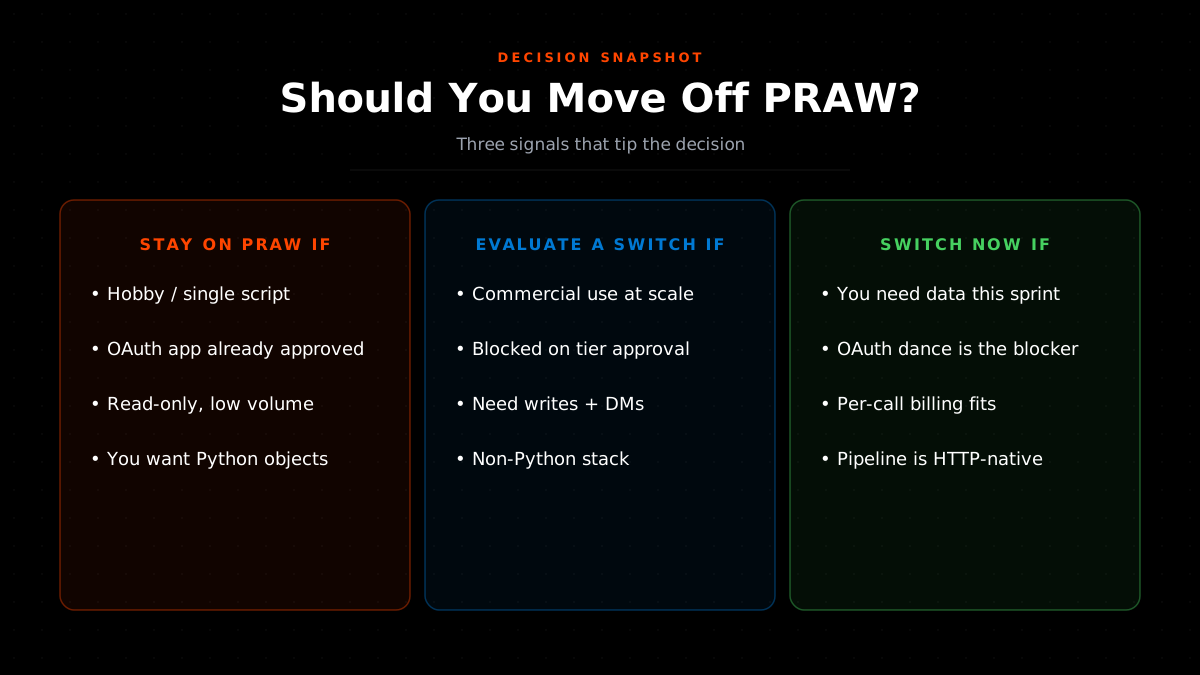
There are three honest answers, and which one applies to you depends entirely on volume, commercial posture, and language. The snapshot above splits them into stay, evaluate, and switch-now columns:
- Stay on PRAW when you run a hobby or single script, your developer app is already approved, your work is read-only at low volume, and you actively want Python objects.
- Evaluate a switch when you have moved into commercial use at scale, you are blocked on tier approval, you need writes and DMs, or your stack is not Python.
- Switch now when you need data this sprint, the OAuth dance is the only blocker, per-call billing fits your budget, and your pipeline is already HTTP-native.
Most teams reading a post titled like this one already feel the pull of the third column, but the goal here is to make the call on evidence rather than frustration. The rest of this guide walks each axis in turn so the decision is defensible to a teammate or a finance reviewer. Each axis stands on its own, so you can short-circuit the moment one of them clearly applies to your situation. A useful habit is to write down your answer to all three before you read further, then check it against the cost crossover later in this guide.
What PRAW Actually Is
A surprising amount of confusion about PRAW comes from treating it as an API. It is not. PRAW is a client library that wraps Reddit's official OAuth API. It is published on PyPI and developed in the open on GitHub. Every convenience it offers sits on top of the same authentication, the same rate limits, and the same commercial terms that govern the raw API underneath.
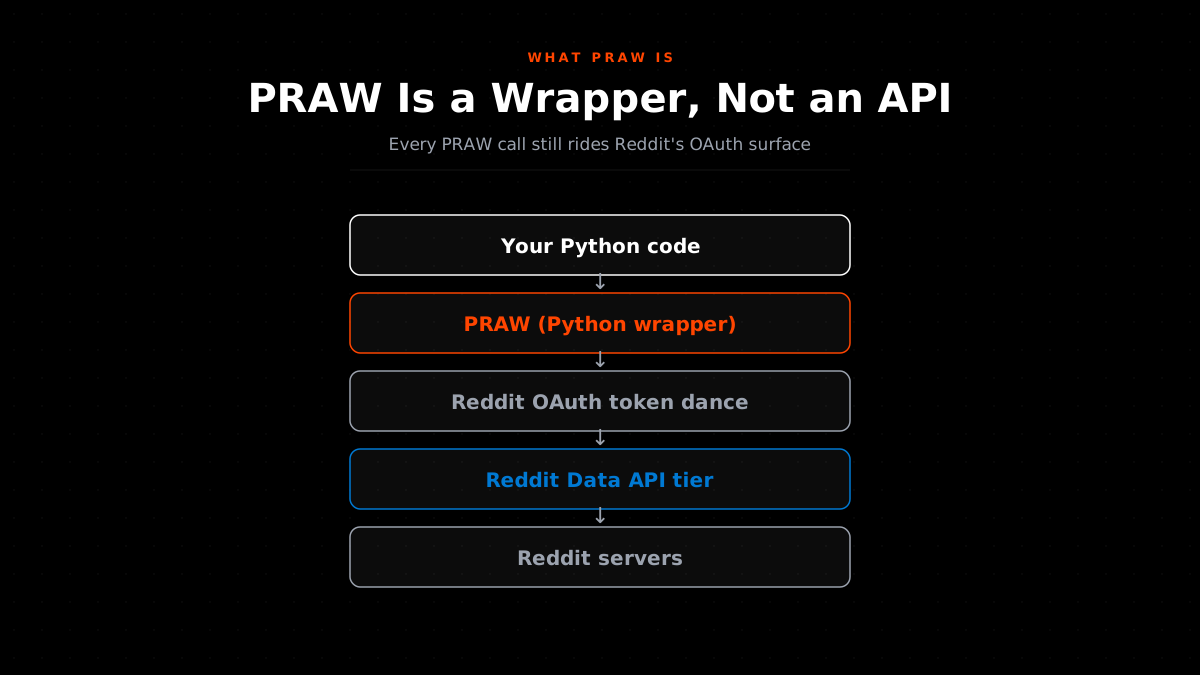
That layering matters for the decision because it tells you what you can and cannot escape by changing tools:
- Swapping PRAW for another Python OAuth library changes only the syntax. You land on the same auth, the same limits, and the same terms.
- Swapping the surface itself, from
reddit.com/apibehind OAuth to a third-party REST adapter behind a bearer token, changes the constraints.
You cannot escape Reddit's terms by switching Python libraries, because every library lands on the same surface. You can change which surface you call. A third-party REST adapter is a genuinely different surface: it maintains its own Reddit session, exposes its own bearer-token auth, and bills on its own per-call model. That distinction is the entire reason this comparison is worth writing down. A library swap is a refactor; a surface swap is an architecture decision with real cost and compliance consequences. That is the move this post is about, and it is the only move that changes the constraints rather than just the syntax. Keep that framing in mind for every section that follows, because it is the difference between treating the choice as cosmetic and treating it as structural.
The Setup Cost: Nine Steps Versus One
The fastest way to feel the difference between the two paths is to count the steps to your first successful call. PRAW inherits the full OAuth setup, while a REST adapter collapses it to a single credential.
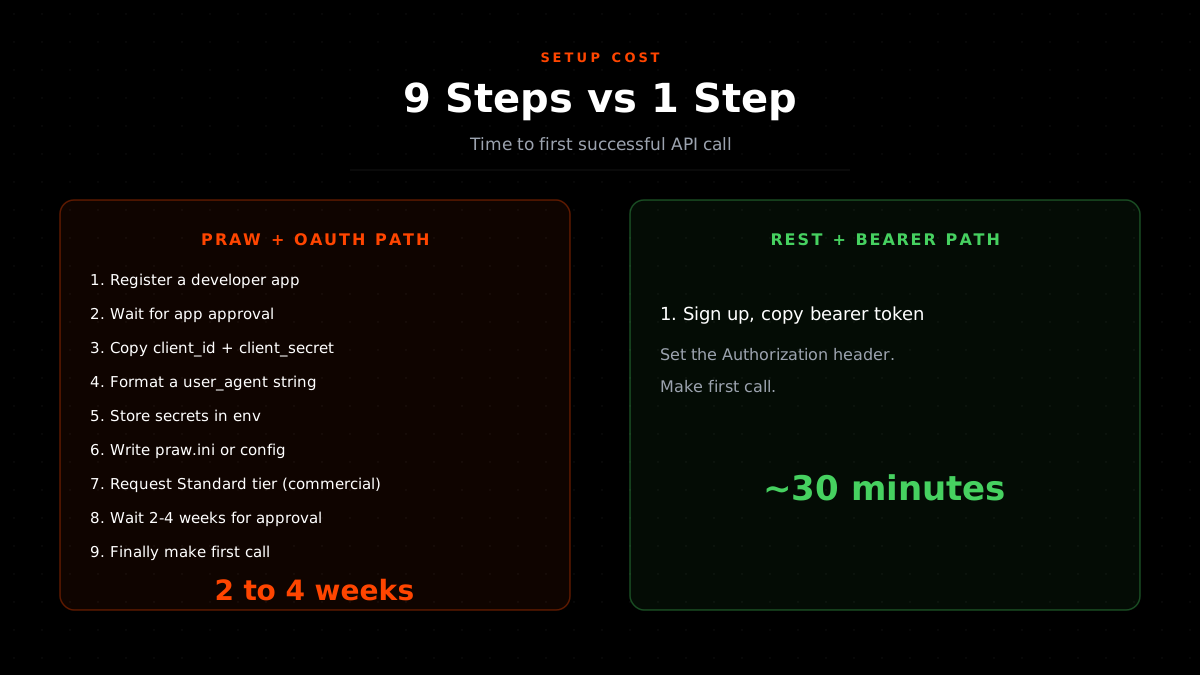
On the PRAW side the path runs through several gated steps:
- Register a developer app at
reddit.com/prefs/appsand wait for approval. - Copy a
client_idandclient_secretand store them safely. - Format a
user_agentstring that matches Reddit's expected shape exactly. - Request a commercial agreement for commercial volume and wait for the app review.
None of these steps are hard in isolation, but together they are the reason a "quick Reddit integration" so often turns into a multi-week procurement story. The waiting is the expensive part, because it is unbounded from your side: you cannot accelerate an approval queue, and a blocked integration stalls everything downstream of it. That is precisely the failure mode the single-credential path removes.
The REST adapter path is a single credential. You sign up, copy a bearer token, set the Authorization header, and you are calling endpoints. The setup time difference is not a rounding error; it is the difference between shipping this sprint and shipping next quarter. For a team under deadline, that gap alone often decides the matter.
Feature Parity: Where the Two Paths Match and Differ
Speed of setup is one axis. Capability is another, and it deserves an honest side-by-side rather than a sales pitch. The single table below is the feature-parity view; everything else in this post is prose and diagrams by design, so this table carries the structured comparison.
| Capability | PRAW (OAuth wrapper) | REST plus bearer token |
|---|---|---|
| Auth model | OAuth client ID plus secret, token refresh | Single bearer token in a header |
| Language fit | Python only | Any HTTP client, any language |
| Setup time | Hours to weeks (tier approval) | About thirty minutes |
| Billing | Reddit tier rules apply | Per call, pay as you use |
| Read endpoints | Full | Posts, search, top, comments |
| Writes and DMs | Full (with scopes) | Supported on the write endpoints |
| Return type | Python objects | JSON dicts |
| Comment trees | Lazy MoreComments helper | Manual pagination |
| Streaming helpers | Built in | Write your own poll loop |
The table makes the shape of the tradeoff clear. PRAW wins on ergonomics inside Python: objects, lazy trees, and stream helpers are genuinely pleasant. The REST path wins on access, language portability, billing transparency, and setup speed. Neither is universally better. The right answer is a function of your constraints, which is exactly why the decision tree below exists.
The Migration Decision Tree
If the parity table tells you what differs, the decision tree tells you what to do about it. Four questions route almost every team to the correct path without hand-wringing.
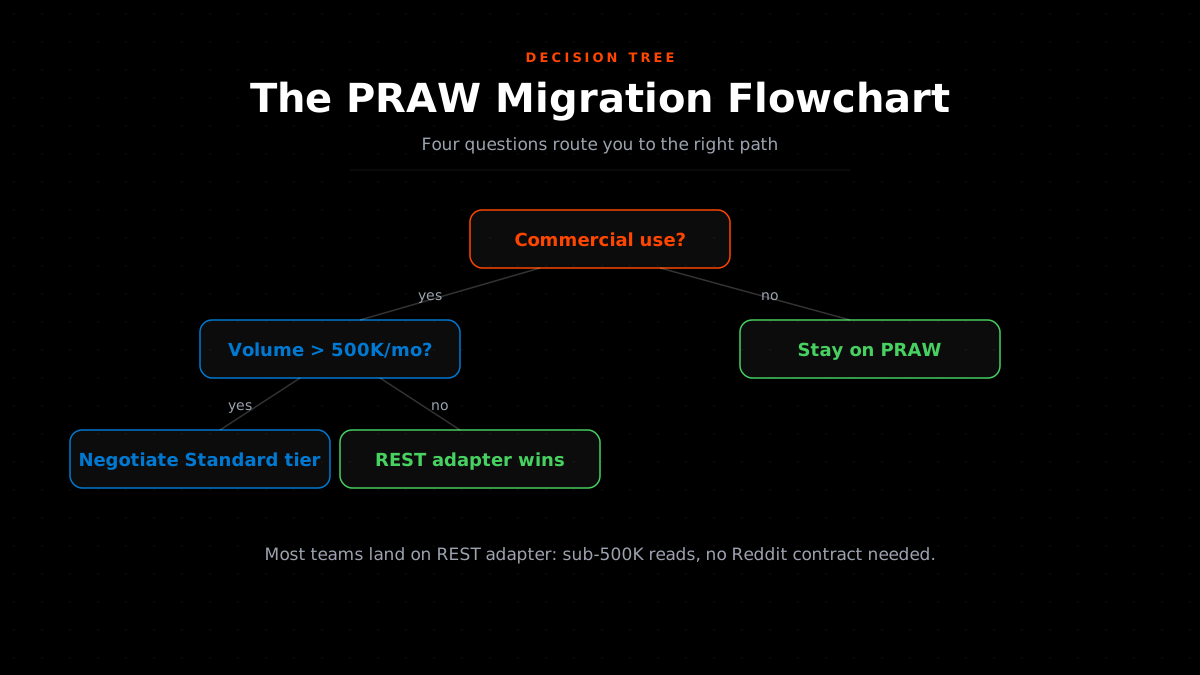
Walk the tree in order:
- Commercial use? If no, and you are within free-tier expectations, PRAW is fine and you can stop here.
- Can you wait on an app review with no published timeline? If yes, the official commercial path is worth negotiating, because its per-call rate is lower than any third-party adapter.
- Below that volume? The per-call REST model is dramatically cheaper, which is where the large majority of teams actually sit.
The tree is deliberately small because most real decisions are: the hard part is being honest about which leaf you land on. Teams get this wrong in two directions. Some over-provision, signing an annual contract for a workload that would cost a tenth as much per call. Others under-plan, building on the free tier until a launch spikes their volume and the limits bite at the worst possible moment. The tree exists to force the volume question early, while it is still cheap to answer.
Start building with Redditapis
Reads $0.0015, votes $0.005, writes $0.012, DMs $0.025. $0.50 free credits.
The Field-Name Map: The Whole Migration Is a Rename
Teams often imagine a PRAW migration as a full rewrite. In practice the bulk of the work is renaming attributes to dict keys, and that mapping is stable, short, and consistent. The underlying field names trace back to Reddit's own API wiki, so the REST JSON keys line up with the same data model PRAW exposes as attributes.
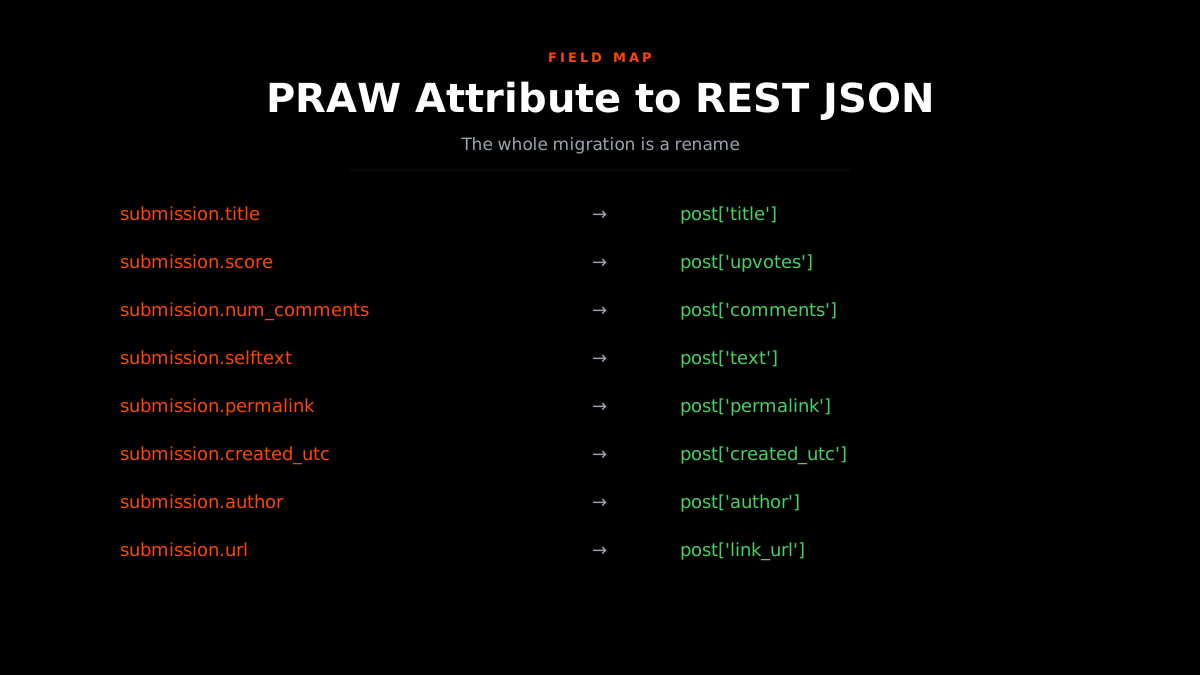
The diagram above is the cheat sheet you will paste next to your editor during the cutover. In code, the before and after look like this:
#: BEFORE -- PRAW plus OAuth plus a registered developer app
import praw

reddit = praw.Reddit(
    client_id="YOUR_CLIENT_ID",
    client_secret="YOUR_CLIENT_SECRET",
    user_agent="my-app/1.0 (by u/youruser)",
)
for submission in reddit.subreddit("python").new(limit=25):
    print(submission.title, submission.score)

#: AFTER -- REST plus bearer token, pay per call
import os, requests

resp = requests.get(
    "https://api.redditapis.com/api/reddit/posts",
    headers={"Authorization": f"Bearer {os.environ['REDDITAPIS_KEY']}"},
    params={"subreddit": "python", "sort": "new", "limit": 25},
)
for post in resp.json()["posts"]:
    print(post["title"], post["upvotes"])
The attribute renames cover the common surface: submission.title becomes post['title'], submission.score becomes post['upvotes'], submission.num_comments becomes post['comments'], and submission.selftext becomes post['text']. The PRAW attribute documentation lists the full submission surface if you use less-common fields. For the complete REST client with retry and pagination, see /blogs/reddit-data-api-rest-vs-praw-2026.
Keeping Your Ergonomics: A Thin Wrapper
If your downstream code reads submission.title in two hundred places, you do not have to touch all of them. A small adapter class restores attribute access over the JSON dict, so the rest of your codebase stays unchanged. If you specifically need PRAW's async ergonomics, Async PRAW mirrors the same interface, but the thin wrapper below keeps you on plain requests with no OAuth flow to maintain.
class Post:
    """Attribute-style access over a REST post dict, PRAW-like ergonomics."""
    def __init__(self, data: dict):
        self._d = data

    @property
    def title(self) -> str:
        return self._d.get("title", "")

    @property
    def score(self) -> int:
        return self._d.get("upvotes", 0)

    @property
    def num_comments(self) -> int:
        return self._d.get("comments", 0)

    @property
    def selftext(self) -> str:
        return self._d.get("text", "")

#: Usage looks almost exactly like PRAW
posts = [Post(p) for p in resp.json()["posts"]]
for post in posts:
    print(post.title, post.score)
That is roughly twenty lines and it absorbs the single biggest source of migration friction. With the wrapper in place, the diff to your business logic is close to zero, and you can delete the wrapper later if you decide to embrace dict access fully. This pattern is why most read-pipeline migrations finish in well under an hour.
What You Give Up Leaving PRAW
A fair comparison names the losses, not just the wins. There are three real conveniences you trade away when leaving PRAW, and each has a concrete workaround rather than a hard wall.
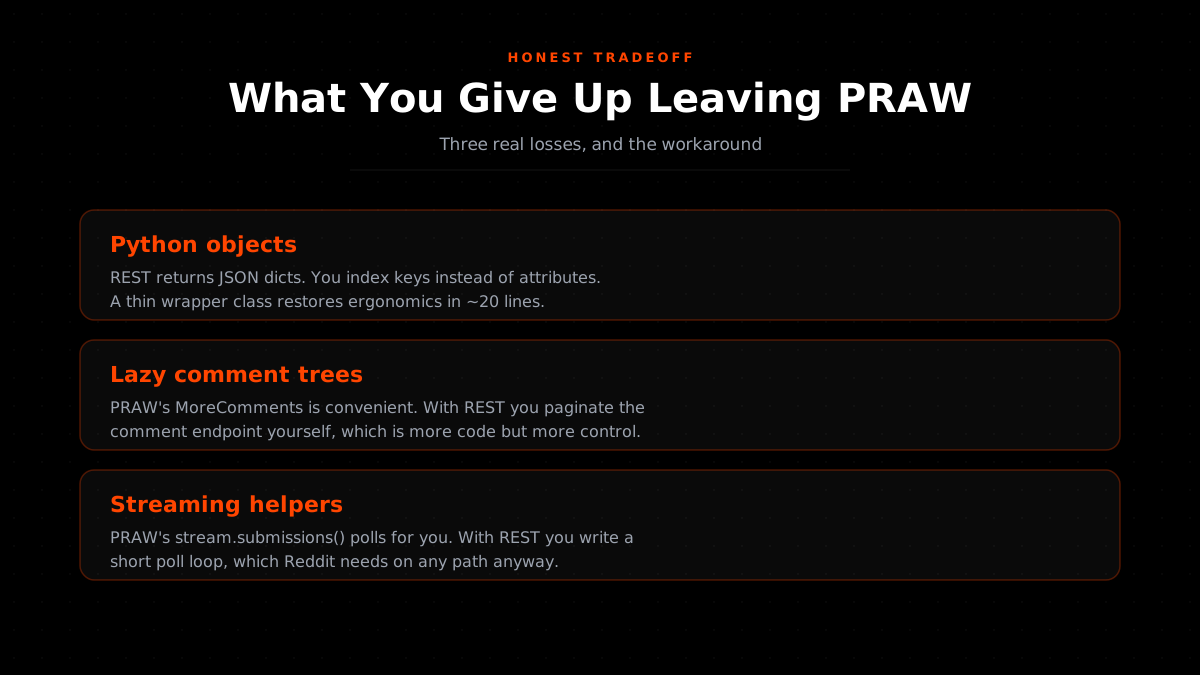
The three losses, and their workarounds, are:
- Native objects. The thin
Postwrapper above restores attribute access in about twenty lines. - Lazy comment trees. PRAW's
MoreCommentshandles deep threads for you; on REST you paginate the comment endpoint explicitly, which costs more code but gives you direct control over depth and cost. - Streaming helpers. PRAW's
streamhelpers poll on your behalf; on REST you write a short poll loop yourself.
The comment-tree point matters most when a single AMA thread can balloon your call count, because explicit pagination lets you cap depth deliberately rather than letting a helper fetch everything. On streaming, Reddit has no public streaming socket, so polling is the reality on every path regardless of tool. None of the three is a dealbreaker, but you should know them going in, and you should price the extra code into your migration estimate honestly.
Why REST Wins in the Age of AI Search 2026
The migration math changed in 2025 and 2026 because the dominant Reddit-data workload changed. The old workload was a standing app polling a few subreddits. The new workload is agents, retrieval pipelines, and training jobs that pull fresh Reddit context on demand.
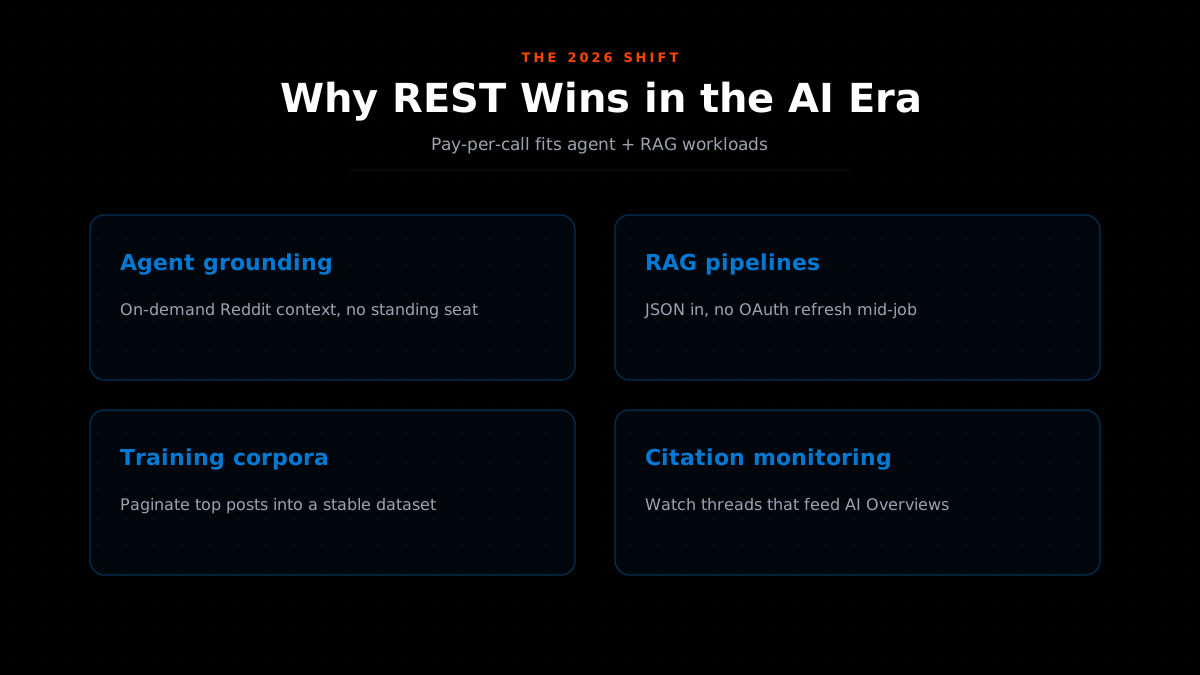
Pay-per-call billing fits these workloads in a way that a per-seat or annual-floor model does not:
- Agent grounding. An agent that grounds an answer in twenty Reddit posts should pay for twenty reads, not a subscription.
- Retrieval pipelines. A RAG job wants JSON in and no token refresh mid-job.
- Training corpora. A training run wants to paginate the top of a subreddit into a stable dataset and stop.
- Citation monitoring. Teams watching whether their brand surfaces in Reddit threads, which increasingly feed Google's AI Overviews, want cheap, frequent, scriptable checks.
The REST adapter path serves all four because it is HTTP-native and billed by usage. The structural reason is that these workloads are bursty and unattended: they spike when an agent is reasoning or a training run kicks off, then drop to nothing. A billing model that charges for capacity you are not using is a poor fit, while a per-call model maps spend directly onto work done. Reddit's role as a citation source in AI search is widely discussed by builders, including this thread on the 2023 changes that reshaped the landscape:
View on RedditThe 2023 pricing reset is still the reason most "should I move off PRAW" questions exist in 2026. The community has been working through the implications ever since, and the practical answer for most builders has converged on a REST plus bearer-token path for anything beyond hobby scale.
The Cost Picture: Reddit Is Cheaper Per Call, If You Can Get In
Cost is usually the deciding axis, and the honest version does not favor us. Reddit's own reported commercial rate is lower per call than the REST adapter at every volume. The adapter wins on time to first call, not on unit price.
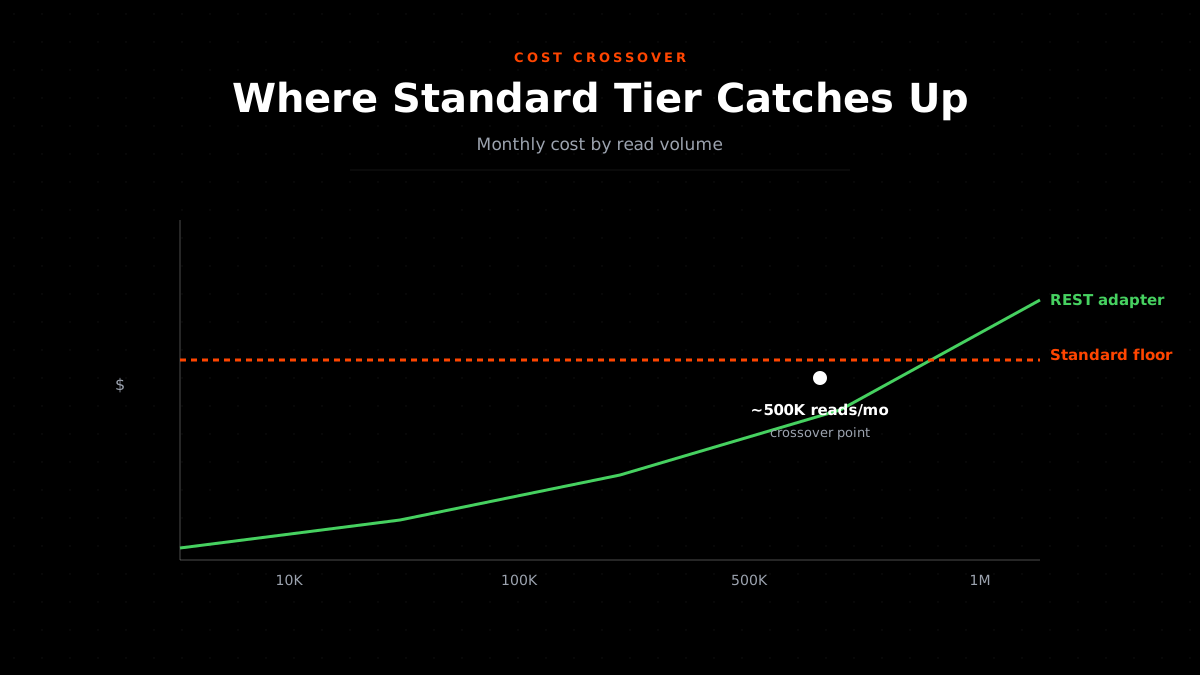
The shape of the comparison is the whole story:
- REST adapter: $0.0015 per read, rising linearly, available the moment you sign up.
- Official commercial path: a reported rate of about $12,000 per 50 million requests, roughly $0.24 per 1,000 calls (The Verge, May 2023), which is $0.00024 per read, available only after an app review and a negotiated agreement.
- No crossover: the official rate is lower at every volume. The gap you are paying to close is time and access, not price.
Reddit publishes no annual minimum, and the $12,000 figure that circulates (The Verge, May 2023) is simply that same per-call rate at 50 million requests, reported by Apollo's developer in 2023 after a call with Reddit. The official commercial terms are published in Reddit's Data API terms, and they are worth reading before any commercial commitment. Use the /reddit-api-cost-calculator to model your own volume and the /pricing page for the current per-endpoint rates.
The cheapest Reddit API. Try it free.
Reads from $0.0015 per call. $0.50 free credits. No credit card required.
Cost at 100K Reads: The Common Case
Rates in the abstract are useful, but most teams need a concrete dollar figure for a realistic monthly volume. At 100,000 reads per month, the three common paths land far apart in cost.
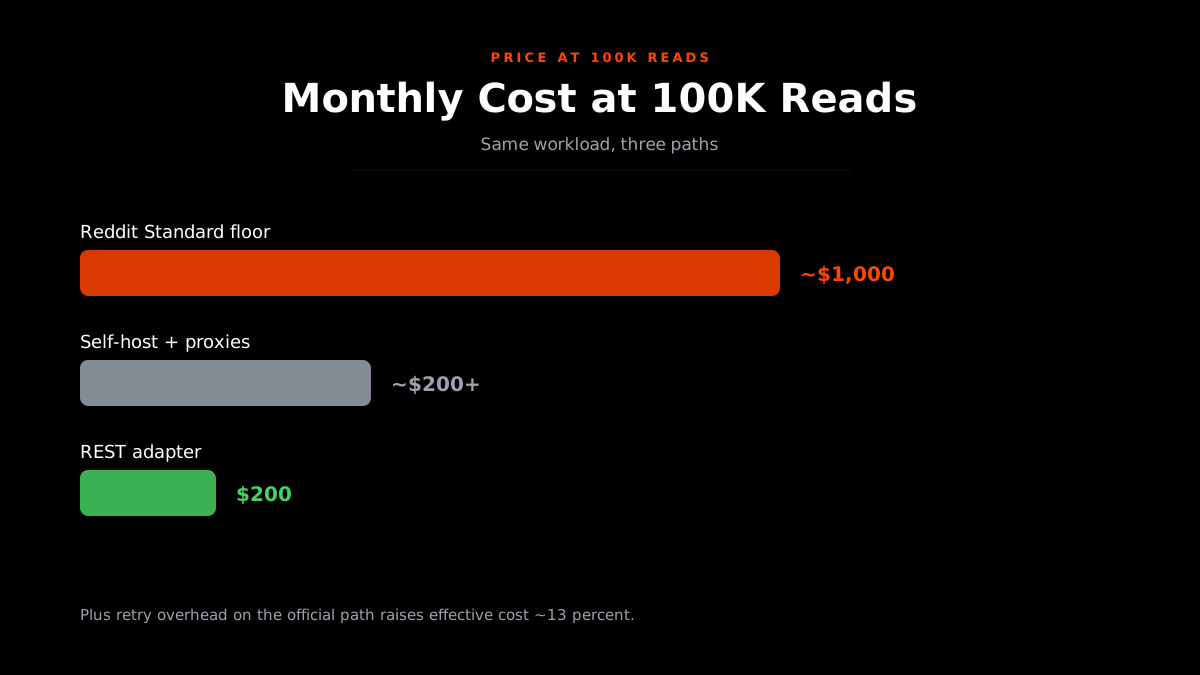
At 100,000 reads per month the three paths land far apart:
- Reddit's own commercial rate: about $24 per month (100,000 x $0.00024), the cheapest of the three, but only once you hold a negotiated agreement.
- Self-hosted with proxies: an estimated $200-plus per month for infrastructure, plus meaningful engineering time to build and maintain the pacing layer.
- REST adapter: a flat $150 at 100,000 reads (pricing).
There is also a quiet surcharge on the official path: at its measured non-2xx rate, retry overhead raises the effective cost by roughly thirteen percent, a number that almost never appears in the headline pricing. The self-hosted option looks cheap on infrastructure alone, but the engineering time to keep proxies rotating and backoff tuned is the real expense, and it never shows up on the invoice. Developers who have run pipelines at scale know this gap well:

Anakin
@anakinHQ
Reddit's 2023 API pricing killed Apollo and the rest of the third-party clients. What's left is rate-limited enough that anything at scale needs auth rotation and backoff. So we maintain an endpoint for it! Wire's Reddit APIs let you pull a subreddit's posts, a full comment htt… Show more


The point about needing auth rotation and backoff at scale is exactly the maintenance burden that a managed REST layer absorbs for you. You are either building that pacing layer yourself or paying a service to keep it healthy.
The 2023 pricing change that triggered all of this is still fresh in the memory of anyone who built on the old client ecosystem, and the sentiment shows up constantly when developers talk about why their tooling had to change:

Barely Thinking
@BarelyThinking_
I did not understand why Reddit shut down their API access a few years ago, killing several third party apps, like Apollo. Turns out that it was just one of many decisions. Likr close sourcing their software, sold their data to train AI etc. Video https://t.co/m8PGk964nU
That late realization is exactly the one that drives the PRAW decision: the access model changed, the cost model changed, and the tooling that survives is the tooling that fits the new economics. For most pipelines that means a per-call REST path rather than a standing OAuth integration.
The Rate-Limit Reality That Pushes Teams Off PRAW
The single most common reason a PRAW pipeline starts to hurt is rate limiting that arrives earlier and harder than expected. PRAW's own rate-limit documentation explains how its built-in limiter reads Reddit's response headers, but builders routinely hit limits well below the documented ceiling, usually for one of a few reasons:
- Shared OAuth credentials reused across many threads or processes.
- Polling loops with no backoff, or hard-coded sleeps that overshoot the safe interval.
- Stale advice from 2021 and 2022 that no longer matches Reddit's current behavior.
Each of these shows up the same way from the outside: a flood of 429 responses that feels far too early for the documented budget.
The thread above captures the surprise perfectly. The fix on raw OAuth is exponential backoff with jitter that respects the Retry-After header, plus proactive throttling before you exhaust your budget. A managed REST layer maintains a server-side queue that paces requests before they reach Reddit, which is why production pipelines so often migrate past a certain volume. The full backoff playbook lives at /blogs/reddit-api-rate-limits-2026, and the throughput numbers behind it are in /blogs/reddit-scraping-benchmarks-throughput-error-rates-2026.
For a deeper look at how Reddit's server-side handling has shifted over time, this discussion is a useful primer for anyone debugging unexpected throttling:
View on RedditThe recurring theme across these threads is that the operational cost of staying on raw OAuth grows with scale, which is the same force that makes the REST path attractive once you cross out of hobby territory.
A Short Video Primer for Visual Learners
If you prefer to see the API landscape walked through rather than read it, this overview covers the moving pieces that inform the PRAW versus REST decision. As you watch, keep three questions in mind:
- Which auth model does each path demand, and what does it cost you in setup time?
- Can you wait out an app review and a contract negotiation before your first call?
- Is your stack Python, or would a language-agnostic surface help you more?
Video is a good way to build intuition, but the decision itself still comes down to those three axes: commercial posture, volume, and language. With those in hand, the cutover is mechanical, and the rest of this guide turns it into a timed checklist.
The One-Hour PRAW Cutover Plan
When you have decided to switch, the migration is a tight, timed sequence rather than an open-ended project. Five moves take a read pipeline from PRAW to REST in about an hour.
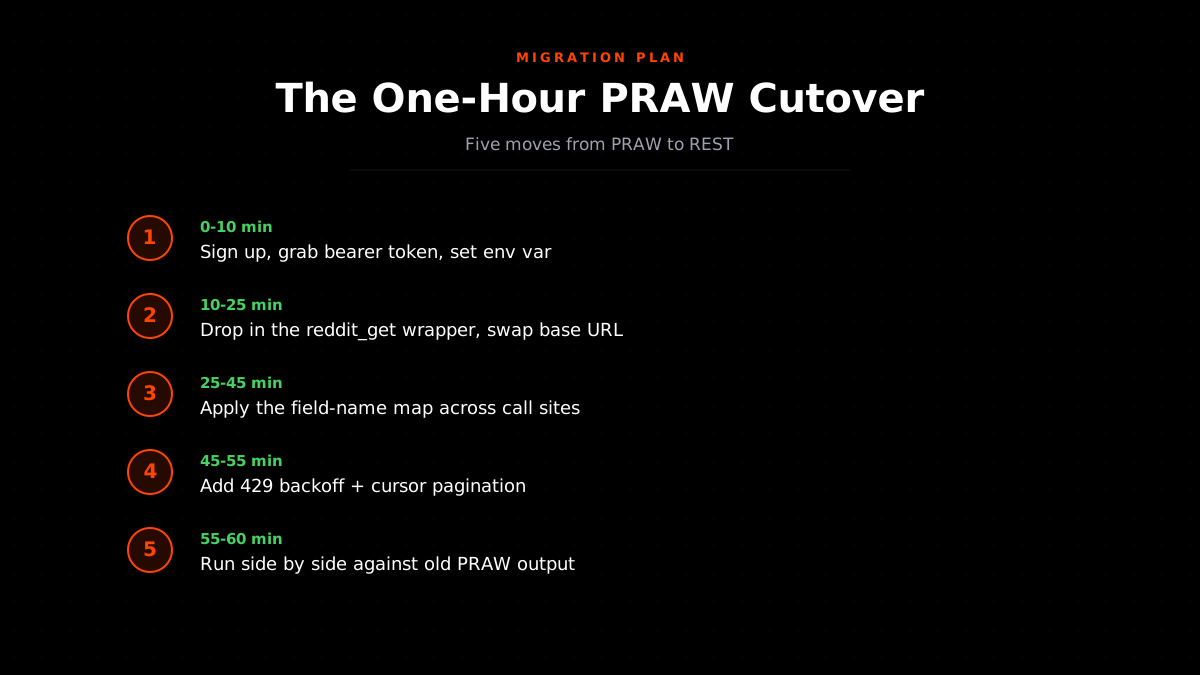
The five moves, with rough timings:
- 0 to 10 min: sign up at /signup, copy the bearer token, set the
REDDITAPIS_KEYenvironment variable. - 10 to 25 min: swap the base URL and drop in a generic request wrapper that sets the Authorization header.
- 25 to 45 min: apply the field-name map across your call sites, optionally behind the thin
Postwrapper. - 45 to 55 min: add 429 backoff and cursor pagination.
- 55 to 60 min: run the new client side by side against your existing PRAW output and diff.
The first ten minutes are administrative: sign up at /signup, copy the bearer token, and set it as an environment variable. The next fifteen swap the base URL and drop in a generic request wrapper that handles the Authorization header. The middle twenty apply the field-name map across your call sites, optionally behind the thin wrapper class. The next ten add 429 backoff and cursor pagination, which you want on any path. The last five run the new client side by side against your existing PRAW output and diff the results. When the diff is clean, you flip the default. Because you migrated behind a wrapper and validated in parallel, the cutover carries almost no risk, and your downstream consumers never see the seam. The complete production client, including the retry and pagination code referenced here, is documented at /blogs/reddit-data-api-rest-vs-praw-2026.
Choosing Your Path: A Final Framework
The PRAW versus REST decision compresses to three questions you can answer honestly in about a minute. Commercial posture, monthly read volume, and programming language are the only variables that matter. Answer all three and the correct path is clear.
- Commercial and able to wait for approval? Price a negotiated commercial contract; its per-call rate is lower than ours.
- Need data this sprint with OAuth as the blocker? The REST adapter ships in about thirty minutes.
- Stack outside Python? The language-agnostic REST path removes PRAW's only structural advantage for you.
For most teams the honest answer to all three lands on the same path: you cannot wait out the review, you need to move quickly, and you would rather not maintain a pacing layer. That is the REST plus bearer-token route, and it is why this comparison exists. If you are a hobby developer with an approved app doing read-only work at low volume, PRAW remains the right tool and you should keep it. The independent, third-party nature of a REST adapter is a feature for the first group and irrelevant to the second.
To start, sign up at /signup for free credit, keep the field-name map from this post next to your editor, and run the new path beside your existing PRAW code. The full endpoint catalog is at docs.redditapis.com, the read walkthrough is at /blogs/reddit-data-api-rest-vs-praw-2026, and the rate-limit playbook is at /blogs/reddit-api-rate-limits-2026. For broader context on access paths, see /reddit-api-alternatives and /reddit-api-usecases.
Where these numbers come from.
Each row is a figure in this post and the artefact it was read from. Reddit's access rules and the third-party archives around them keep moving, so check the date on a source before you build against it.
- PRAW documentation
- The official PRAW docs for the Python wrapper this comparison is built around.
- PRAW on PyPI
- The published package, cited for PRAW's distribution and version posture.
- PRAW source on GitHub
- The open-source PRAW repository, the maintenance signal referenced in the guide.
- Reddit API documentation
- The OAuth API PRAW wraps, so it inherits its auth, limits, and terms.
- Reddit Data API Terms
- The commercial terms any Reddit-official path carries, central to the switch decision.
Frequently asked questions.
PRAW is a Python wrapper around Reddit's official OAuth API, so every PRAW call still rides the OAuth surface. A third-party REST adapter exposes the same public Reddit content over plain HTTP with a bearer token instead. You set one Authorization header and call endpoints directly, with no client ID and secret pair and no callback URL. The response shapes are documented and stable, so the swap is mostly mechanical. Start at /signup for free credit, or read the full read-endpoint walkthrough at /blogs/reddit-data-api-rest-vs-praw-2026.
Switch when one of three signals fires: you have crossed into commercial use and the official tier minimum is out of budget, you are blocked waiting on tier approval and need data this sprint, or your stack is not Python and PRAW gives you no leverage. If you are a hobby script doing read-only work at low volume with an approved app, staying on PRAW is the right call. The decision matrix in this post maps each case. See /pricing for the cost side of the decision.
PRAW itself is open source under a permissive license, but PRAW does not grant you data rights. PRAW calls Reddit's API, and commercial use of that API falls under Reddit's Data API terms, which gate higher volume behind the Standard commercial tier. So the license question is really a Reddit terms question, not a PRAW question. A third-party REST adapter like redditapis.com is an independent service that bills per call. Review /pricing and your own compliance posture before you commit either way.
For a typical read pipeline, under an hour. The work is a base-URL swap, a generic request wrapper with retry and backoff, and a field-name rename across your call sites (submission.title becomes post['title'], submission.score becomes post['upvotes']). Write-heavy or comment-tree-heavy code takes longer because you replace PRAW helper methods with explicit pagination. The one-hour plan in this post breaks the cutover into five timed steps. The companion read walkthrough at /blogs/reddit-data-api-rest-vs-praw-2026 has the full client code.
You keep your business logic and rewrite only the data-access layer. PRAW returns objects with attributes; a REST adapter returns JSON dicts with keys. A thin wrapper class of about twenty lines restores attribute-style ergonomics if your downstream code expects them, so the diff stays small. The field-name map in this post covers the common attributes. Sign up at /signup to run the new path side by side against your existing PRAW output before you cut over.
No, and it is worth being straight about it. Reddit's reported commercial rate works out to about $0.24 per 1,000 calls, derived in this post from the roughly $12,000 per 50 million requests The Verge reported in 2023, which is $0.00024 a call, against $0.0015 on the REST adapter. Reddit is cheaper per call at every volume, and there is no crossover. What the REST adapter buys is access: no negotiated agreement, no app review, and no non-commercial restriction. Model your exact volume with the /reddit-api-cost-calculator and check the current rate card at /pricing.
Three conveniences: native Python objects instead of dicts, lazy comment-tree expansion through MoreComments, and built-in streaming helpers. Each has a short workaround on the REST side. You add a small wrapper class for objects, you paginate the comment endpoint yourself for trees, and you write a poll loop for near-real-time, which Reddit requires on any path because there is no public streaming socket. The honest-tradeoff section in this post covers all three. More patterns live at /reddit-api-usecases.
Not if you migrate behind a wrapper and run both paths in parallel first. The safe cutover is to add the REST client alongside PRAW, point a copy of your pipeline at it, diff the output for a day, then flip the default. Because the REST response shape maps cleanly onto PRAW attributes, downstream consumers rarely notice. The production patterns for retry, backoff, and pagination are in /blogs/reddit-api-rate-limits-2026.
Keep reading.
Continue exploring related pages.
Reddit API documentation
The complete 2026 reference: auth, all 73 endpoints, and code.
Get a Reddit API key
Instant bearer token, no waitlist and no enterprise contract.
Reddit Responsible Builder Policy
Why Reddit denies API applications, and the managed REST bypass.
Reddit API use cases
14 use cases from AI training to brand monitoring and DMs.
Reddit Search API
Search posts, comments, users, and communities over one REST endpoint.
Reddit MCP server
Wrap the REST API as MCP tools for Claude, Cursor, and any MCP client.
Reddit MCP hub
Install tabs for every client, the full tool table, pricing and fixes.
Reddit API for AI agents
Live Reddit context for tool calls, MCP servers, and RAG pipelines.
Redditapis pricing
Endpoint-level costs and quick monthly totals - reads from $0.0015 / call.
Reddit API cost calculator
Estimate monthly spend using your request volume.
Reddit API guides and tutorials
Tutorials, walkthroughs, and API deep-dives for developers.
Reddit API alternatives
Evaluate alternatives by cost model, limits, and integration fit.
Cheap Reddit API
The cheapest way to get Reddit data: $0.0015 per call, no contract, no minimum.
Official Reddit API vs Redditapis
Access, setup, rate limits, and pricing, side by side.
PRAW alternative
A hosted Reddit REST API for any language, no app registration or OAuth.
Reddapi alternative
A maintained Reddit REST API with published pricing and write endpoints.
Reddit comment scraper alternative
The raw comment API: search and filter comments, historical and live, clean JSON.
Reddit scraper API
Hosted scraper API vs building your own: no proxies to manage, clean JSON.
RapidAPI Reddit alternative
A direct, maintained Reddit API with published pricing and write endpoints.
Bright Data Reddit alternative
A purpose-built Reddit API vs a general scraping platform: structured JSON, plus writes.
ScraperAPI Reddit alternative
A Reddit-native API vs a generic HTML fetcher: auth and pagination handled, typed JSON.
TikHub alternative
TikHub's Reddit surface is read-only; get comment, vote, and DM endpoints too.
EnsembleData alternative
No $100/month floor: pay per call from $0.0015, plus write, vote, and DM endpoints.
Scrape Creators alternative
7 read-only Reddit endpoints vs a dedicated API with real write, vote, and DM paths.
FetchLayer alternative
Posts, comments, and search only; add vote, comment, and DM over the same REST auth.
PullPush alternative
PullPush is free but volunteer-run and goes offline for reindexing; a maintained REST API that stays up.
Reddit monitoring API
Build your own keyword and brand-mention monitor: search, comment search, and subreddit streams over REST.
F5Bot vs Redditapis
F5Bot's Slack and Discord delivery needs its $49.99/mo Gold tier; Redditapis includes it from $19/mo.
Syften vs Redditapis
Syften caps you at 100 to 500 results a day; Redditapis allows 10,000 a day per monitor at the entry plan.
Octolens vs Redditapis
Octolens meters by mention with overage fees; Redditapis is flat-priced by subreddit slot from $19/mo.
Affiliate program
Earn 20% lifetime commissions - capped at $5,000/yr.
Reddit Vote API tutorial
Upvote and downvote a post programmatically via the REST API.
Reddit Data API: REST, no PRAW
REST endpoints for Reddit data with no PRAW and no OAuth dance.
Reddit scraping benchmarks
Real throughput, error rates, and cost benchmarks for Reddit scraping.
Reddit API answers
Direct answers on cost, access, rate limits, endpoints, and auth.
How much the Reddit API costs
Per-call pricing from $0.0015 a read, with $0.50 in free credits.
Reddit API in Python
One requests call with a bearer token, no PRAW and no OAuth flow.
Reddit shadowban checker
Check if a Reddit account is shadowbanned in seconds, free and no login.
Subreddit stats checker
See any subreddit's live subscriber count, active users, and age, free and no login.
Similar reads.
More guides on the Reddit API, scraping, pricing, and MCP servers.
Does the Reddit Search API Support Boolean Queries? Every Operator, Tested
AND, OR, and NOT don't work like SQL against Reddit's search backend. Here's what actually works (subreddit:, author:, exact phrases, exclusion), tested live against the production API, plus why the boolean confusion exists in the first place.

Reddit Data API in 2026: REST Endpoints, No PRAW, No OAuth
Pull Reddit posts at $0.0015 per call with a third-party REST API. Bearer token, no PRAW, no OAuth flow. Python examples, real endpoints, real pricing.

How to Get Reddit Comments via the API: Fetch the Full Comment Tree (2026)
Fetch Reddit comments by permalink, walk the nested tree, expand the more / morechildren nodes, and flatten replies in Python. Copy-paste code and first-party numbers, 2026.

Webhooks vs Polling for Reddit Data Streams (2026)
Does Reddit have webhooks? No. The Reddit Data API has no push, so every real-time Reddit feed is polling. How to poll well, with runnable Python.

Reddit Search API Tutorial: Query Subreddits by Keyword in Python (2026)
Search Reddit posts by keyword in Python in 2026. Native /search.json, PRAW subreddit.search(), and a managed REST endpoint compared, with copy-paste code, parameters, and the 1,000-result cap explained.

Reddit API Rate Limits in 2026: Complete Guide to Budgets, 429 Errors, and Mitigation
Reddit's API rate limits shifted significantly in 2023 and have evolved since. Here's the complete 2026 state, the four patterns that blow through quotas, exponential backoff code, token rotation, async queuing for MCP servers, and how AI agent loops change the math.

How to Send a Reddit DM via REST API in 2026 (with Code)
Send Reddit DMs via REST API. Bearer token, JSON body, $0.025 per call. Working code in curl, Python, and Node.js. PRAW alternative for AI agents.

Reddit API in Python: The Complete No-PRAW Tutorial (2026)
Use the Reddit API in Python without PRAW in 2026. Plain HTTP with requests or httpx, one bearer token. Code examples for posts, comments, search, votes, and DMs from $0.0015 per call.