

What Are AI Agents? A Complete Guide to Tool-Use, Function-Calling, and Agentic Workflows
What AI agents are and how they work in 2026: the reason-act loop, tool use vs function calling vs MCP, and a runnable example of giving an agent the Reddit API as a tool.

If you have used ChatGPT or Claude, you have used a large language model. An AI agent is what you get when you wrap that model in a loop and hand it tools. Instead of answering once and stopping, the agent reads a goal, decides what to do, calls a tool to do it, reads the result, and keeps going until the work is done. That one change, from answering to acting, is the whole story of the agent boom today.
This guide is the plain-English version. It defines what an AI agent actually is, explains the reason-act loop that drives it, draws the precise line between tool use, function calling, and MCP, walks through agentic workflow patterns, and then makes it concrete by giving an agent a real tool: the Reddit API. Every term that gets thrown around interchangeably online gets pinned down here, with diagrams and runnable code.
TL;DR: An AI agent is a language model running in a loop with tools. It reasons about a goal, acts by calling a tool, observes the result, and repeats. Tool use is the capability; function calling is the mechanism that powers it (the model emits a JSON call, your code runs it); MCP is a standard for sharing tools across apps. Agentic workflows chain these into single-agent or multi-agent systems. The hard part is giving an agent reliable real-world data, which is why authentication, rate limits, and error handling matter as much as the model. This guide ends with a runnable example: wiring the Reddit API into an agent as a tool with one bearer token.
What is an AI agent?
An AI agent is a large language model that runs inside a loop and can take actions in the world, not just generate text. The cleanest working definition comes from practitioners: an agent is a model plus four things, the LLM backbone, a set of instructions, the tools it can call, and an environment to act in. Give a model those four pieces and a loop to run in, and it stops being a passive question-answerer and becomes something that pursues a goal. The model still does not run anything itself; it decides, and your code acts on those decisions.
That definition matches how working engineers describe it day to day.

Cameron R. Wolfe, Ph.D.
@cwolferesearch
What is an agent? The definition can be pretty simple: it’s just an LLM that runs within an agentic loop. To make this definition more concrete, an agent-system has a few high-level components: 1. The LLM backbone. 2. Instructions. 3. Tools. 4. The environment. Given an https:… Show more

The useful way to understand an agent is by what it is not. A plain chatbot maps one message to one reply and stops. A scripted workflow runs the same fixed steps every time. Robotic process automation replays recorded clicks. An agent is the one option on this list that decides its own next step and adapts when something fails. The table below lines them up against the traits that actually matter.
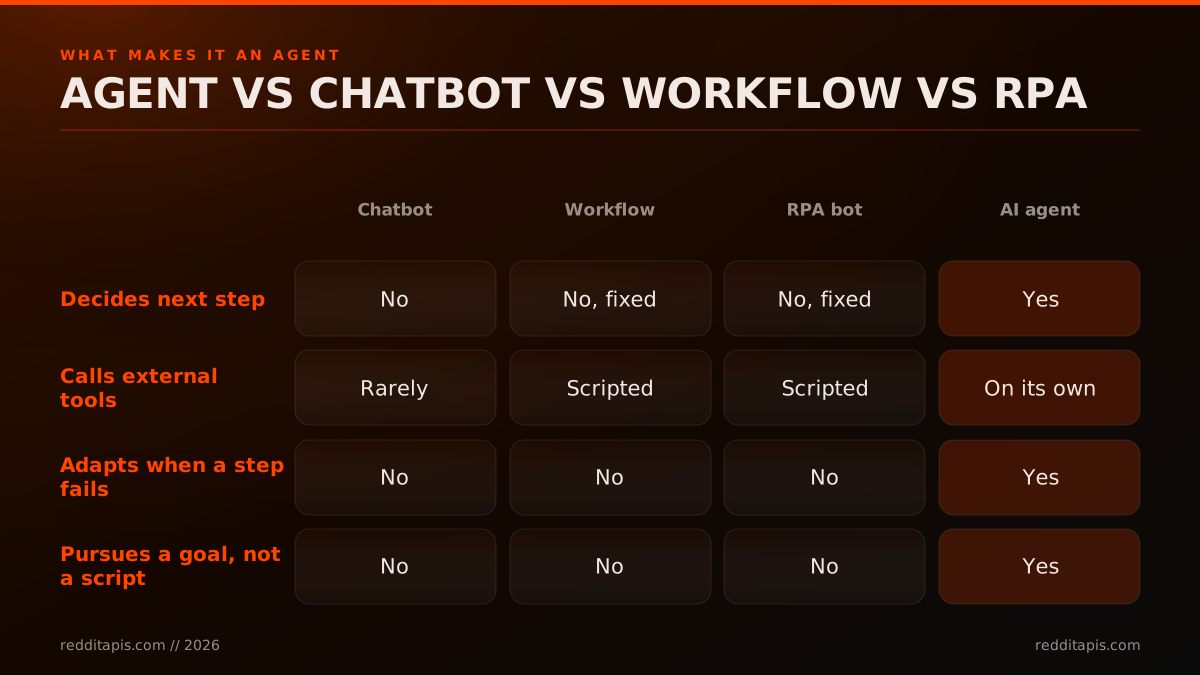
Vendors blur these lines constantly, and a lot of products marketed as agents are really workflows with a chat box bolted on. That is not a criticism, scripted workflows are often the right tool, but it matters for understanding what you are building. As IBM puts it in its definition, agents are AI tools that can automate complex tasks that would otherwise need a human. The key word is automate: the agent fills in the steps you did not spell out.
How does an AI agent actually work? The reason and act loop
An agent works by running a short loop over and over: reason, act, observe, repeat. The model reads the goal and the current state, reasons about the single best next action, acts by calling a tool, then observes whatever the tool returns and folds that into its next decision. This pattern is usually called ReAct, short for reasoning and acting, and it is what lets an agent recover from a bad result instead of confidently returning a wrong answer. Each turn of the loop gives the model new, real information to plan against. The approach was formalized in the original ReAct research, which showed that interleaving reasoning steps with tool actions outperforms doing either one alone (Yao et al., 2022).
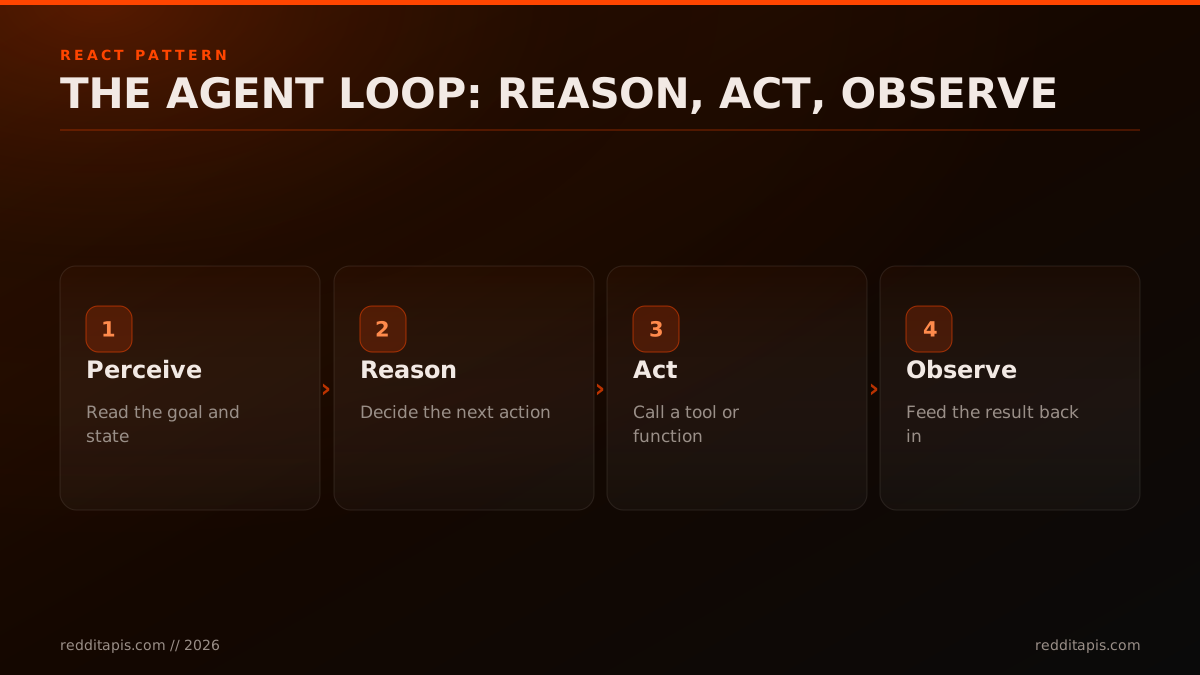
The loop is deceptively simple, and that is the point. Most of the engineering work in a good agent is not clever prompting; it is making each step of this loop reliable. The reasoning step needs a model strong enough to pick the right tool. The act step needs tools that are well described so the model knows when to use them. The observe step needs results in a format the model can read. When any of those three slips, the loop drifts, and the agent either loops forever or quietly produces nonsense. The rest of this guide is really about making each step of this loop solid.
What is tool use in AI agents?
Tool use is the ability of an agent to reach outside the model and interact with software, databases, and APIs to get something done. A model on its own only knows what was in its training data and what you typed; it cannot check today's prices, query your database, or search a live forum. A tool fixes that. A tool is just a function you expose to the model with a clear description of what it does and what inputs it needs. The agent decides when to call it, and your code runs the real work behind it.
Tool use is the capability that turns a clever text generator into something useful for real work, and the industry has noticed.

Aaron Levie
@levie
GPT-5.6 is real and looks very strong. Going to be very strong for knowledge worker tasks that require heavy tool use and long running agents doing work. We're not hitting any walls in AI progress right now. https://t.co/5Apn3VzmkY

There is a standard menu of tool categories agents reach for. Web search and extraction tools fetch live information from the internet. Code execution tools run scripts to do math or transform data. Workflow tools trigger webhooks, send messages, or update records. And data retrieval tools query internal files, databases, or external APIs for specific facts. As Microsoft's tool-use design pattern guide and the Hugging Face agents course both lay out, the tool is defined as a function with a clear objective, and the agent's job is to pick the right one at the right time. Reddit search, the example we build later, is a data retrieval tool.
Function calling vs tool use vs MCP: what is the difference?
These three terms describe one loop from three altitudes, and conflating them is the most common confusion in the space. Tool use is the capability: an agent acting on the outside world. Function calling is the mechanism underneath it: the model emits a structured JSON object naming a function and its arguments, and your runtime executes that function and returns the result. MCP, the Model Context Protocol, is a transport standard on top: it lets a tool live behind a server so any MCP-aware app can use it, instead of each app redefining the same tool. Same loop, three layers.
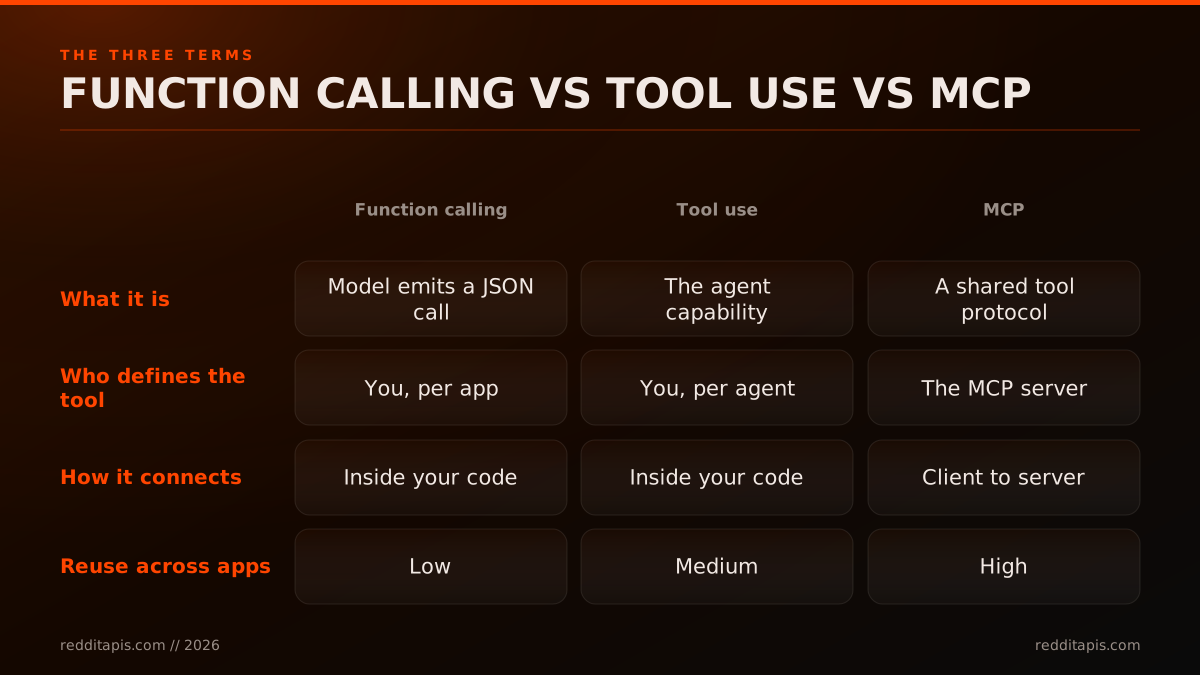
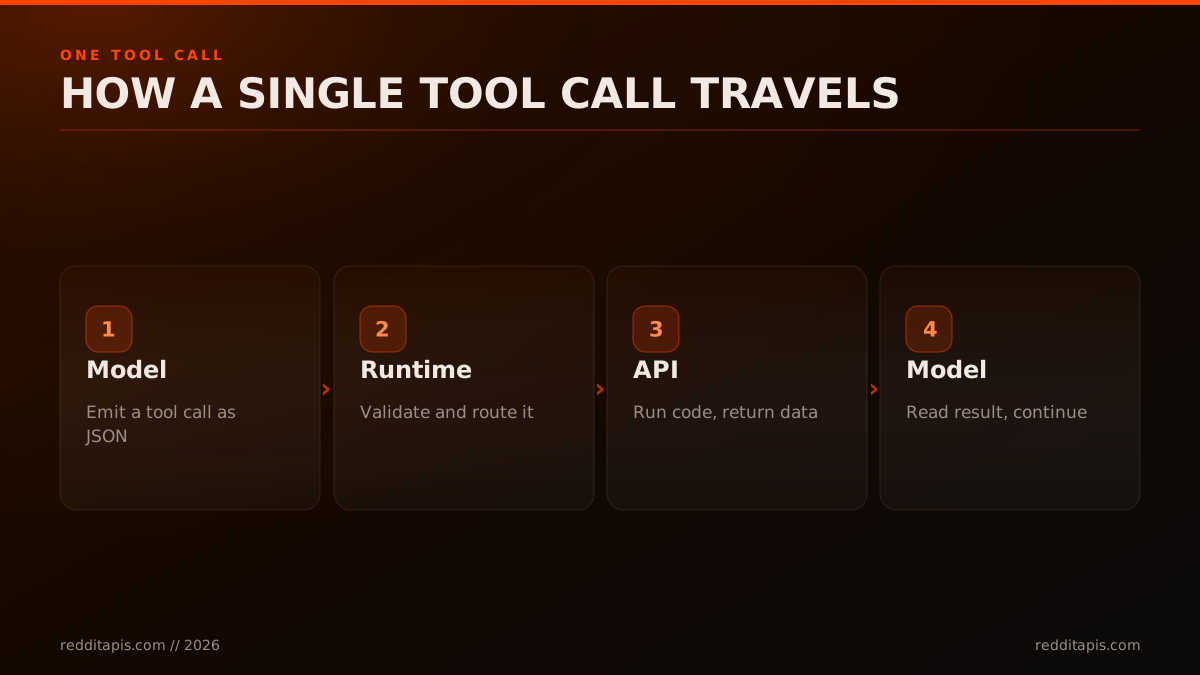
The mechanical detail that trips people up is that the model never executes anything. When an agent calls a tool, it only writes out a request. Your runtime is what validates that request, runs the real code or HTTP call, and hands the result back to the model. Tracing one call from end to end makes it click.
If you want the same explanation in motion, this short walkthrough covers tool use, function calling, and MCP together.
The practical takeaway: reach for plain function calling when your tools live inside one application, and reach for MCP when you want a tool to be reusable across many clients. OpenAI's function calling guide documents the JSON mechanism, and Anthropic's writeup on writing tools for agents covers the MCP side, where a single server can expose hundreds of tools to an agent. You do not have to choose ideologically; many production systems use function calling for app-specific tools and MCP for shared ones.
Start building with RedditAPI
Reads $0.002, votes $0.005, writes $0.012, DMs $0.025. $0.50 free credits.
What does a tool definition actually look like?
To the model, a tool is an instruction manual written in a fixed format, usually a JSON schema. The schema names the tool, describes what it does in plain language, and lists the parameters it accepts along with their types. The description is not decoration; it is the only thing the model reads to decide when and how to call the tool, so a vague description produces a confused agent. Here is the schema for the Reddit search tool we will wire up shortly, written the way an agent expects to see it.
{
  "name": "search_reddit",
  "description": "Search Reddit for recent posts matching a query. Use this when the user asks what people are saying about a topic. Returns each post's title, subreddit, and upvote count.",
  "parameters": {
    "type": "object",
    "properties": {
      "query": {
        "type": "string",
        "description": "The search phrase, for example 'ai agents' or 'local llm'."
      },
      "limit": {
        "type": "integer",
        "description": "How many posts to return, 1 to 100. Default 10."
      }
    },
    "required": ["query"]
  }
}
Notice how much work the description fields do. They tell the model the tool exists, when it is appropriate, and exactly what shape the arguments take. As Anthropic's tool-writing guide stresses, the quality of these descriptions is one of the biggest levers on whether an agent calls the right tool with the right inputs. Good tool design is mostly good documentation aimed at a model instead of a human.
What is the Model Context Protocol (MCP)?
MCP is an open standard, introduced by Anthropic and now widely adopted, for serving tools to agents over a client-server connection. Instead of defining a tool inside one application's code, you run an MCP server that exposes the tool, and any MCP-aware client, a desktop assistant, an IDE, a custom agent, can discover and call it. The win is reuse and distribution: write a Reddit tool once as an MCP server, and every MCP client can use it without you rewriting the integration. As Neo4j's explainer on agent tools and MCP describes it, MCP standardizes the messy part, how tools are described, discovered, and invoked. The protocol is openly specified and versioned in public (modelcontextprotocol.io), which is part of why adoption moved quickly.
MCP is not magic, and it is not free of friction. The community is candid that authentication is the rough edge: there is no clean, universal way to get an OAuth token to an MCP tool yet, which pushes people toward bearer tokens or service accounts. That is one reason a single-token REST API can be simpler to hand to an agent than a full OAuth-bound MCP server, especially for a focused data source. The practitioners working through these tradeoffs are worth reading, and few communities are more direct about the real costs than r/redditdev, where the price of every API call gets counted line by line.
Lets talk about those API calls
The honest framing is that MCP and function calling are complementary, not rivals. Function calling is the low-level act of invoking a tool; MCP is a way to package and share tools so the same one works in many places. Pick MCP when reuse across clients is the goal, and pick plain function calling when you just need one app to talk to one API.
Agentic workflows: single agent, multi-agent, and orchestration
An agentic workflow is what you get when you arrange one or more agents into a system that completes a larger job. The simplest is a single agent in a loop with a handful of tools, which is the right default for most tasks. From there you can add an orchestrator that routes work between specialized agents, or run a crew of agents that each own a sub-task and hand off to each other. More agents is not automatically better; each hand-off is a place where context can be lost and errors can compound, so the discipline is to use the smallest arrangement that does the job. The three common arrangements, smallest first:
Single agent: one model, one loop, a handful of tools. The right default for most tasks.Orchestrator: a router agent hands sub-tasks to specialized agents and stitches the results.Crew: several agents each own a sub-task and hand off to each other.
The community is split on how far to push multi-agent designs, and the skeptics make a fair point: a lot of multi-agent systems work beautifully in a demo and then collapse a few steps into a real task, because nothing enforces a contract between the agents. The practical middle ground that experienced builders land on is to keep each agent small, keep its prompt concise, keep its tools atomic, and only add another agent when one genuinely cannot hold the whole job. The orchestrator-plus-specialists pattern earns its complexity when sub-tasks are truly independent; otherwise a single well-equipped agent wins on reliability. When an agent needs a steady stream of fresh data rather than a one-off pull, the design question shifts to polling versus push, which is covered in /blogs/webhooks-vs-polling-for-reddit-data-streams.
How do agents get real-world data?
Agents get real-world data the same way any program does: by calling an API, except the agent decides when to call it. This is the bridge between a clever model and a useful one. A model is frozen at its training cutoff and blind to anything happening now; a data tool gives it eyes. The pattern is always the same three moves: you define a tool that wraps an API, the model emits a call to that tool when it needs the data, and your runtime makes the request and returns the result for the model to reason over. Web data, database records, and live forum discussion all enter the agent this way.
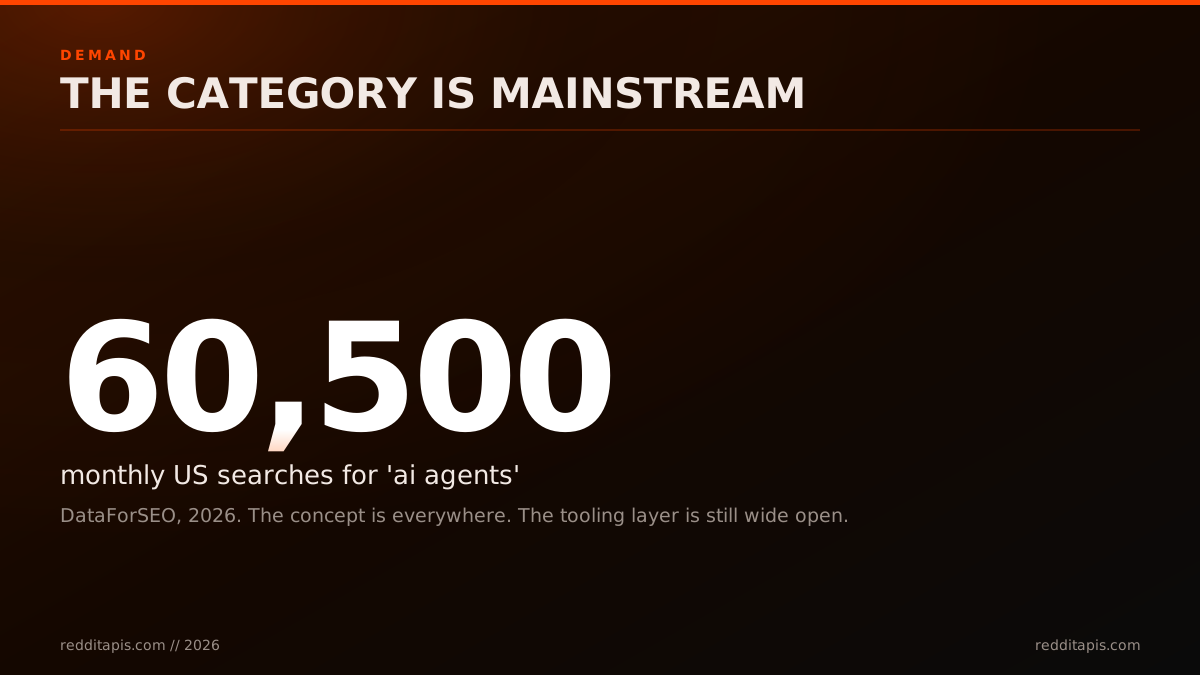
The friction is rarely the model; it is the data source. Real APIs have authentication, rate limits, pagination, and error states, and an agent has to survive all of them mid-loop. Reddit is a textbook example of a high-value, messy data source: it is where people argue about products, tools, and problems in public, which makes it gold for an agent doing research or monitoring, but its official API uses an OAuth flow and enforces rate limits that an agent has to respect. That is exactly the kind of real-world friction that separates a demo from a system. The next section turns this abstract bridge into running code.
The cheapest Reddit API. Try it free.
Reads from $0.002 per call. $0.50 free credits. No credit card required.
A worked example: giving an agent the Reddit API as a tool
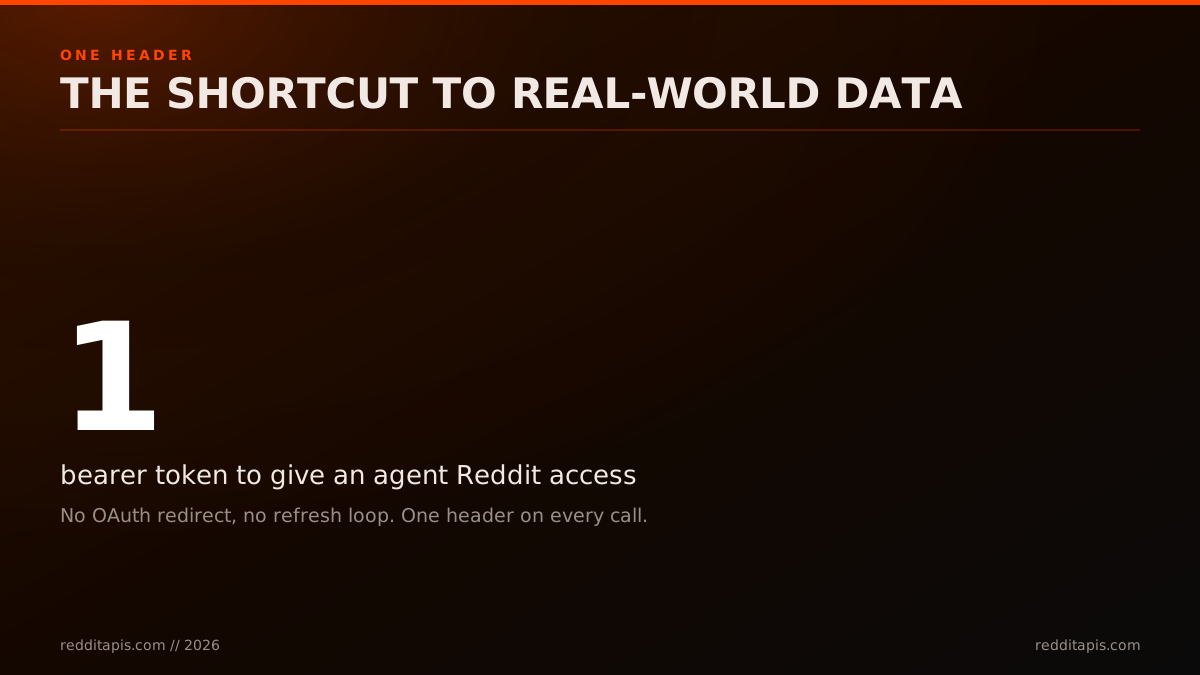
Here is the whole loop, made concrete. We give an agent a single tool, search_reddit, that wraps a Reddit search endpoint. The model decides to call it, emits a function call with a query, your runtime makes the HTTP request, and the JSON of matching posts comes back for the model to summarize. The only genuinely fiddly part of wiring a real API into an agent is authentication, and this is where a hosted REST API earns its keep: instead of running an OAuth app and refreshing tokens, you authenticate every call with one bearer token. The four steps look like this.
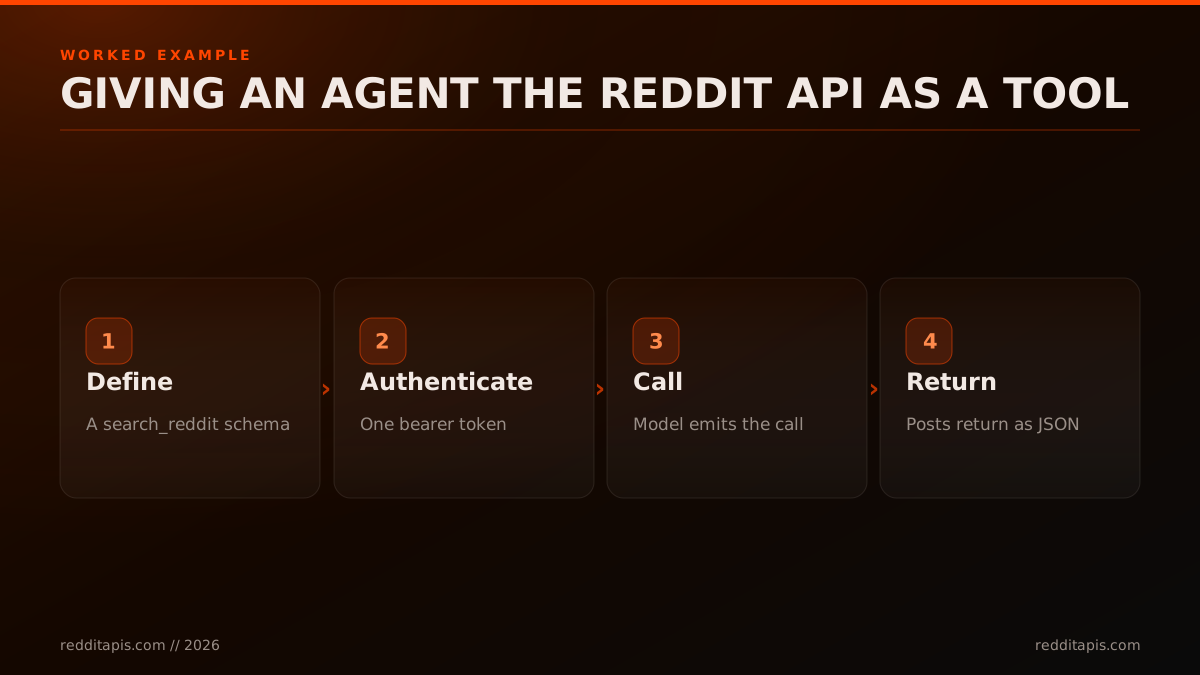
The tool body is the function your runtime runs when the model emits a search_reddit call. It is an ordinary HTTP request. This example hits the redditapis.com search endpoint, which is an independent third-party Reddit API that returns posts over a bearer-token REST call, and prints each result the way you would feed it back to the model.
import json
import urllib.parse
import urllib.request

def search_reddit(query, limit=10):
    """The function your runtime runs when the model calls the search_reddit tool."""
    url = "https://api.redditapis.com/api/reddit/search?" + urllib.parse.urlencode(
        {"q": query, "limit": limit}
    )
    req = urllib.request.Request(
        url, headers={"Authorization": "Bearer YOUR_API_KEY"}
    )
    with urllib.request.urlopen(req, timeout=30) as resp:
        data = json.load(resp)
    return data["posts"]

# Simulate the model deciding to call the tool with query="ai agents".
for post in search_reddit("ai agents", limit=5):
    print(f"r/{post['subreddit']}: {post['title']} ({post['upvotes']} upvotes)")
The same call with curl is a one-liner, which is useful when you are testing the tool before you wire it into an agent.
curl -s "https://api.redditapis.com/api/reddit/search?q=ai+agents&limit=5" \
  -H "Authorization: Bearer YOUR_API_KEY"
What comes back is a JSON object with a posts array, where each post carries a title, subreddit, upvotes, comments, and permalink. You hand that array back to the model as the tool result, and the loop continues: the model reads the posts and answers the user's question with current, real discussion instead of a guess. To go deeper on the search endpoint and its parameters, see /blogs/reddit-search-api-tutorial-2026 and the full /blogs/reddit-api-python-tutorial. For the bearer-token-versus-OAuth tradeoff in detail, see /blogs/reddit-api-authentication-oauth-2026 and /blogs/how-to-get-reddit-api-key-2026.
Why Reddit specifically, and why does this matter for agents at all? Because nobody owns the search result for it yet. When you look at what ranks today for developers trying to connect an agent to Reddit, the entire page is forum threads and a stray GitHub repo, with no real vendor guide in sight.
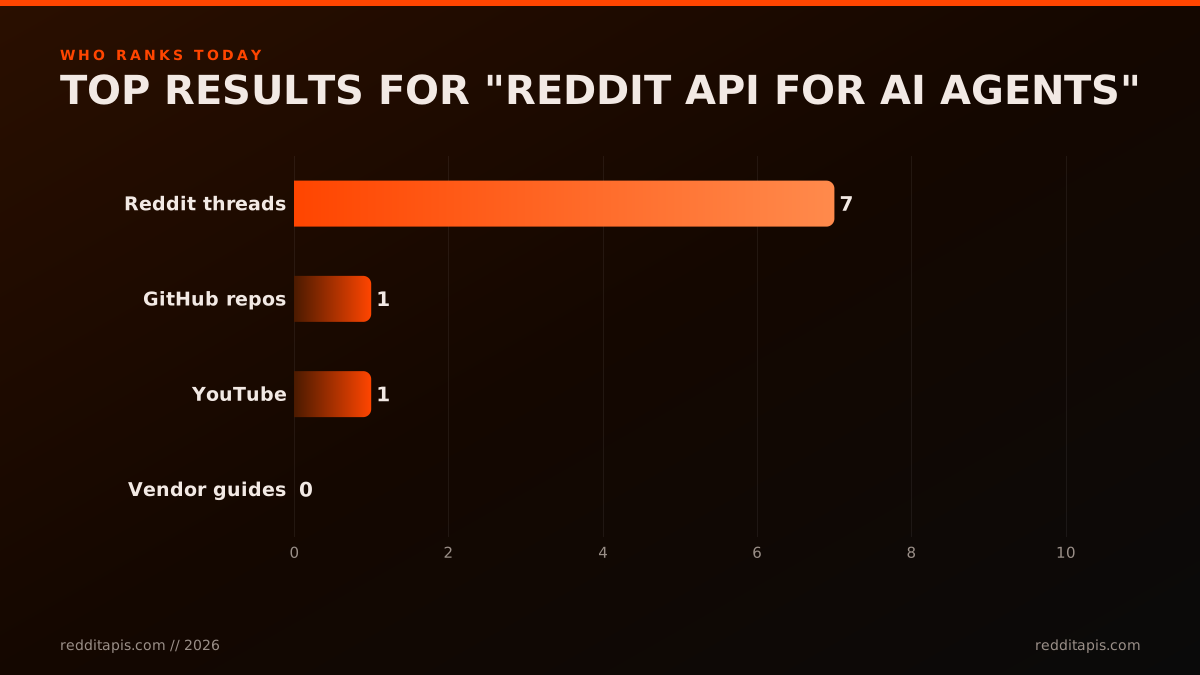
That gap is the point. The concept of agents is mainstream, but the practical knowledge of how to feed them reliable real-world data is still scattered across forum posts. The full Reddit endpoint reference lives in the API documentation, and the listings and search endpoints are the two an agent reaches for most.
What can you build with an AI agent?
The clearest answer to why agents matter is the list of jobs an agent does that a plain model cannot. Because it can call tools in a loop, an agent can research a question across live sources, monitor a topic and act the moment something changes, triage and route incoming messages, enrich a record by looking up external data, and run a multi-step job end to end without a human nudging each step. The common thread is that every one of these needs fresh, external data, which is exactly the tool layer doing its work. The model supplies the judgment; the tools supply the facts. The jobs an agent unlocks tend to fall into a few buckets:
Research: pull current discussion on a topic from live sources.Monitoring: watch for new posts or events and trigger an action.Triage: classify and route incoming messages or tickets.Enrichment: look up external data to complete a record.
Reddit happens to sit under a surprising number of these use cases, because it is where real people discuss products, tools, and problems in the open. A research agent can pull current discussion on a topic with a search tool. A monitoring agent can watch for new posts about a keyword and trigger an alert, the pattern walked through in /blogs/reddit-keyword-monitor-python-2026. A lead-generation agent can find relevant communities and surface conversations worth joining, drawing on /blogs/how-to-find-subreddits-api-2026, and decide which channel to act on per /blogs/reddit-dm-vs-email-vs-slack-which-channel-converts-best-for-b2b-outreach. In every case the agent is only as good as the data tool behind it, and the official surface those tools wrap is documented in the Reddit developer docs. The capability is the loop; the value is the data.
Which framework should you use to build agents?
Pick the smallest framework that does the job, and do not assume you need one at all. LangChain is popular for quick prototypes, LangGraph suits stateful multi-step graphs, and CrewAI models role-based crews, but a large share of experienced builders skip frameworks and call the model API directly with their own tool definitions, because it is simpler to read and debug. The honest community consensus is that the orchestration libraries add value when your control flow is genuinely complex, and add friction when it is not. Start direct, reach for a framework when the wiring hurts.
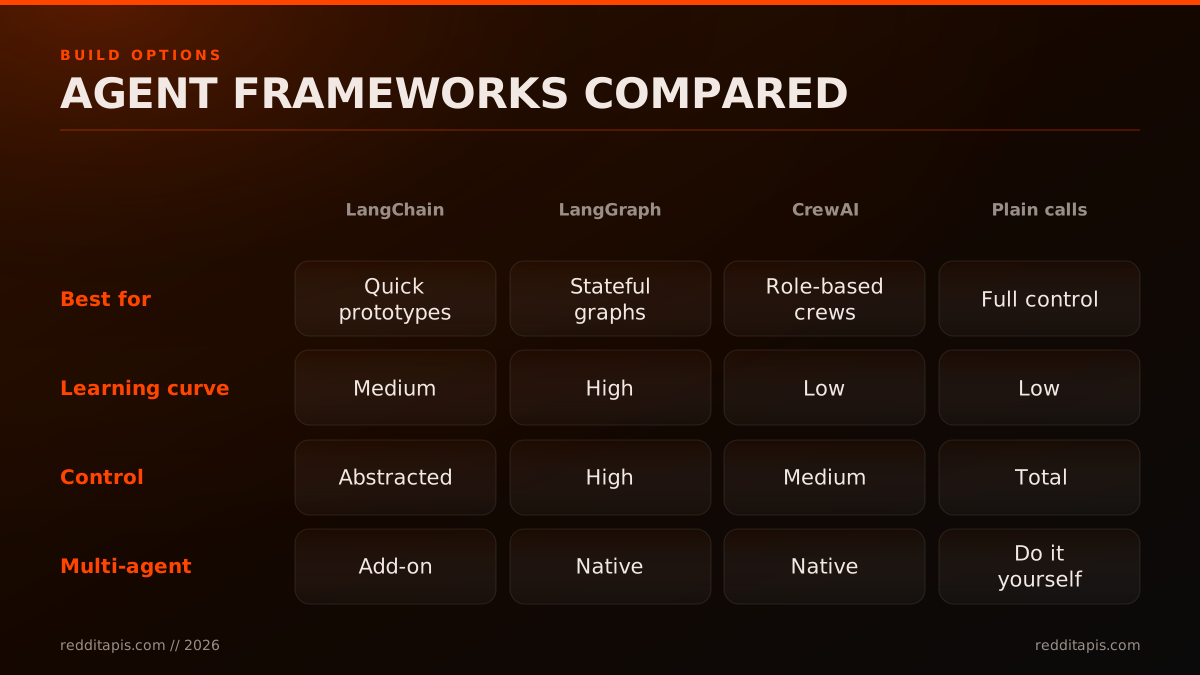
This is a place where the loudest online opinions are worth weighing against your own use case. Plenty of engineers report that the leading frameworks are over-abstracted and that interfacing with the model directly is often simpler, more flexible, and easier to debug, while others find LangGraph mature enough to anchor a real product. Both can be true depending on what you are building. The LangChain documentation is the reference if you go that route, and the IBM agents overview is a solid vendor-neutral primer on how the pieces fit. Whatever you choose, the tool definitions and the loop matter far more than the framework wrapping them.
What breaks, and how to handle it
The failures that bite agents in production are not exotic; they are the boring realities of calling real APIs inside a loop. A model can hallucinate a tool or an argument that does not exist. A rate limit can return HTTP 429 in the middle of a run and leave the agent with missing data. A tool's schema can drift so calls silently break. And an agent with no step budget can loop forever, burning money. Each of these has a known fix, and building them in from the start is the difference between a toy and something you can trust.
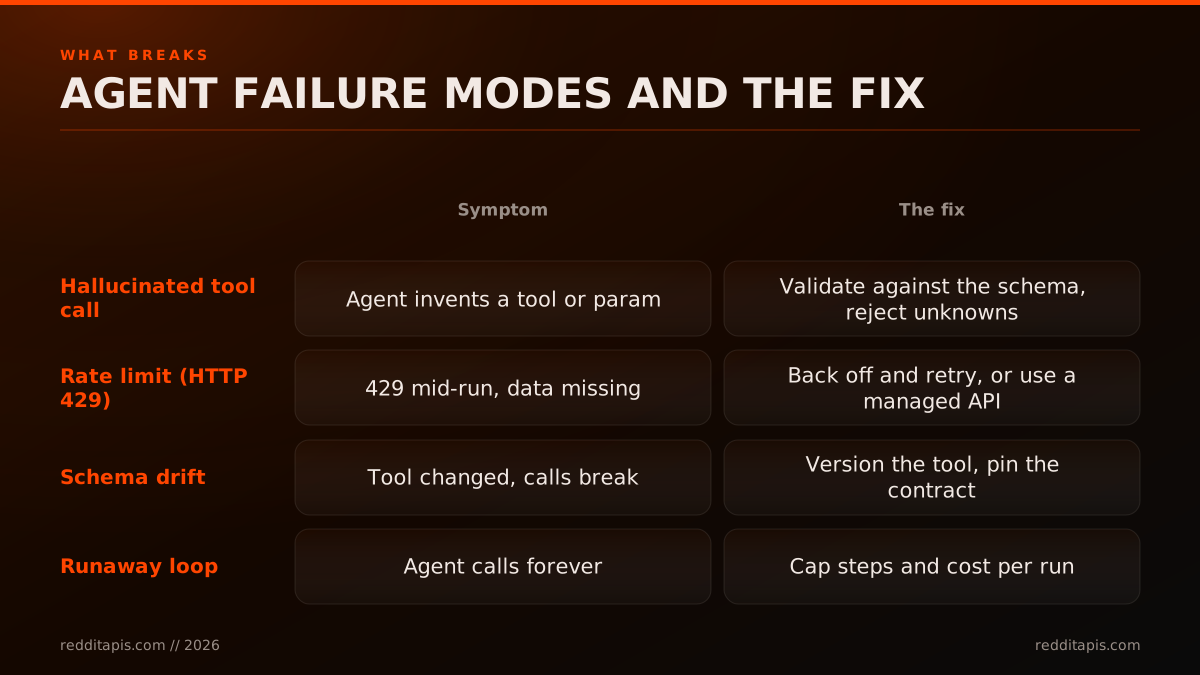
The single most underrated of these is the cost and etiquette of the API calls themselves. Every action an agent takes against an external service is a real request that counts against a quota and, on a public platform, against the goodwill of the people running it. The r/redditdev community has a long-running norm about this that any agent builder should read before pointing automation at the platform.
Please be a good 'bot' citizen of reddit
The practical defenses are straightforward: validate every tool call against its schema and reject unknown tools or parameters, back off and retry on a 429 rather than crashing, version your tool contracts so a change does not silently break calls, and cap both the number of steps and the spend per run. Offloading authentication and rate-limit backoff to a managed API removes an entire category of these failures, which is one more reason a single-token REST endpoint is friendlier to an agent than a raw OAuth integration. For the specifics of Reddit's limits, see /blogs/reddit-api-rate-limits-2026, and for the broader build-versus-buy tradeoff, /blogs/praw-vs-redditapis-rest-2026 and /blogs/reddit-data-api-rest-vs-praw-2026.
The agent stack (2026)
The shape of the agent stack is settling into layers: a strong model at the core, a loop around it, tool definitions that expose real capabilities, and a transport layer (plain function calling or MCP) that connects those tools. The models keep improving at the reasoning and tool-selection that make the loop reliable, which means more of the remaining work is in the tools and the data behind them. The hard, unglamorous part, the part that decides whether an agent is useful, is feeding it accurate, current, well-shaped data without drowning in auth and rate-limit plumbing.
That is the throughline of this whole guide. An AI agent is not a mystery: it is a model in a loop, reaching for tools. Tool use is the capability, function calling is the mechanism, MCP is the standard for sharing tools, and agentic workflows are how you compose them. The part that separates a demo from a product is the data layer, and the friction there is almost always authentication and reliability, not intelligence. Reddit is one of the richest public data sources an agent can reach, and the open question, also a live commercial one, is how that data gets licensed and accessed going forward, which is covered in /blogs/reddit-usage-based-ai-data-licensing-2026 and /blogs/reddit-api-ai-training-data-2026.
If you are ready to give an agent its first real tool, the fastest path is a single bearer token against a hosted Reddit endpoint. You can grab an API key with free credit to start, read the full API documentation, or compare access options on the pricing page. For a wider tour of what the API can do, /blogs/reddit-data-api-2026 and /blogs/subreddit-analytics-api-comparison are good next stops. redditapis.com is an independent, third-party service and is not affiliated with Reddit Inc.
Frequently asked questions.
An AI agent is a large language model that runs inside a loop and can take actions, not just produce text. It reads a goal, decides what to do next, calls a tool to do it, reads the result, and repeats until the goal is met. The four parts that turn a model into an agent are the model itself, instructions, a set of tools it can call, and an environment to act in. A plain chatbot answers a question and stops; an agent keeps going until the job is done. See the worked example below and [/blogs/reddit-data-api-2026](/blogs/reddit-data-api-2026).
They describe the same loop from two angles. Function calling is the low-level mechanism: the model outputs a structured JSON object naming a function and its arguments, and your code runs that function. Tool use is the higher-level capability the function calling enables: the agent reaching out to search engines, databases, and APIs to get things done. In practice people use the terms interchangeably. The thing to remember is that the model never runs code itself; it only emits a request, and your runtime executes it. See [/blogs/reddit-data-api-rest-vs-praw-2026](/blogs/reddit-data-api-rest-vs-praw-2026) and the comparison table in this guide.
MCP is an open standard for exposing tools to agents over a client-server connection, so the same tool works across different apps instead of being rewritten for each one. With plain function calling you define each tool inside your own codebase. With MCP, a tool lives behind an MCP server and any MCP-aware client can use it. MCP solves reuse and distribution; it does not replace function calling, it builds on it. See [/blogs/reddit-data-api-2026](/blogs/reddit-data-api-2026) and the MCP section below for when each one fits.
Yes. You describe a tool such as search_reddit with a JSON schema, the model emits a call to it, and your runtime makes the HTTP request and feeds the results back. The main friction is authentication: the official Reddit Data API uses an OAuth flow, while a hosted REST API like redditapis.com authenticates with a single bearer token, which is simpler to wire into an agent. The worked example in this guide shows the full loop with runnable code. See [/blogs/reddit-search-api-tutorial-2026](/blogs/reddit-search-api-tutorial-2026).
ReAct is the pattern most agents follow: reason, then act, then observe, then repeat. The model thinks about what to do, picks a tool and calls it, reads the result that comes back, and uses that new information to decide its next move. The loop continues until the model decides the task is finished. It is what separates an agent from a single model response: the agent can correct course based on what its tools return. See [/blogs/reddit-keyword-monitor-python-2026](/blogs/reddit-keyword-monitor-python-2026) for a loop in practice, plus the loop section above.
No. A chatbot maps your message to a reply and stops. An agent maps a goal to a sequence of actions, calling tools along the way, and keeps working until the goal is reached or it gives up. The dividing line is autonomy plus tools: an agent decides its own next step and can act on the outside world, where a chatbot only talks. Many products labelled agents are really scripted workflows; a true agent chooses what to do rather than following a fixed script. See [/blogs/webhooks-vs-polling-for-reddit-data-streams](/blogs/webhooks-vs-polling-for-reddit-data-streams) for how agents consume live data.
It depends on how much control you want. LangChain is common for quick prototypes, LangGraph suits stateful multi-step graphs, and CrewAI models role-based crews of agents. Many engineers skip frameworks entirely and call the model API directly with their own tool definitions, which is often simpler and easier to debug. Start with the smallest thing that works: a single model, a couple of well-described tools, and a loop. Add a framework only when the orchestration genuinely needs it. See [/blogs/praw-vs-redditapis-rest-2026](/blogs/praw-vs-redditapis-rest-2026) and the framework comparison in this guide.
Carefully, because every tool call is a real API request that can fail. Good agents validate each tool call against its schema, back off and retry on a rate-limit response such as HTTP 429, cap the number of steps and the cost per run so a loop cannot run away, and treat a failed call as an observation to reason about rather than a crash. Offloading auth and rate-limit backoff to a managed API removes a class of these failures. See [/blogs/reddit-api-rate-limits-2026](/blogs/reddit-api-rate-limits-2026).
Keep reading.
Continue exploring related pages.
Get a Reddit API key
Instant bearer token, no waitlist and no enterprise contract.
Reddit API use cases
14 use cases from AI training to brand monitoring and DMs.
Reddit Search API
Search posts, comments, users, and communities over one REST endpoint.
Reddit MCP server
Wrap the REST API as MCP tools for Claude, Cursor, and any MCP client.
Reddit API for AI agents
Live Reddit context for tool calls, MCP servers, and RAG pipelines.
RedditAPI pricing
Endpoint-level costs and quick monthly totals - reads from $0.002 / call.
Reddit API cost calculator
Estimate monthly spend using your request volume.
Reddit API guides and tutorials
Tutorials, walkthroughs, and API deep-dives for developers.
Reddit API alternatives
Evaluate alternatives by cost model, limits, and integration fit.
Official Reddit API vs RedditAPI
Access, setup, rate limits, and pricing, side by side.
Affiliate program
Earn 20% lifetime commissions - capped at $5,000/yr.
Reddit Vote API tutorial
Upvote and downvote a post programmatically via the REST API.
Reddit Data API: REST, no PRAW
REST endpoints for Reddit data with no PRAW and no OAuth dance.
Reddit scraping benchmarks
Real throughput, error rates, and cost benchmarks for Reddit scraping.
Reddit API answers
Direct answers on cost, access, rate limits, endpoints, and auth.
How much the Reddit API costs
Per-call pricing from $0.002 a read, with $0.50 in free credits.
Reddit API in Python
One requests call with a bearer token, no PRAW and no OAuth flow.
Reddit shadowban checker
Check if a Reddit account is shadowbanned in seconds, free and no login.
Similar reads.
More guides on the Reddit API, scraping, pricing, and MCP servers.

Reddit for AI Agents: The Complete Guide to MCP, Tool-Use, Function Calling, and Agentic Workflows (2026)
Give an AI agent access to Reddit as a tool: the four paths (function calling, MCP, framework tools, RAG), copy-paste code, and the data-layer decision.

How to Build a Reddit MCP Server (for Claude, Cursor, and AI Agents) in 2026
Build a Reddit MCP server in Python so Claude, Cursor, and AI agents can search and read Reddit as tools. Copy-paste FastMCP code, client config, and cost math.

Reddit API Rate Limits in 2026: Complete Guide to Budgets, 429 Errors, and Mitigation
Reddit's API rate limits shifted significantly in 2023 and have evolved since. Here's the complete 2026 state, the four patterns that blow through quotas, exponential backoff code, token rotation, async queuing for MCP servers, and how AI agent loops change the math.

Reddit as a RAG Data Source: The Complete Guide to Ingestion, Chunking, Embeddings, and Retrieval (2026)
Use Reddit as a retrieval source for RAG: batch ingestion through the API, cleaning, chunking the comment tree, embeddings, vector search, and LangChain and LlamaIndex loaders.

Reddit DM vs Chat vs Modmail: When to Use Each API Surface
Reddit has three message surfaces in 2026: Private Messages, Chat, and Modmail. What each one is, the endpoint and scope behind it, and how to pick.

Reddit's Usage-Based AI Data Licensing in 2026: What Developers Pulling Reddit Data Need to Know
Reddit is moving its AI data licensing from flat annual fees toward usage and dynamic pricing in 2026. Here is what pay-per-crawl, pay-per-inference, RSL, and the robots.txt License directive mean for developers who pull Reddit data for agents, RAG, and analytics.
How to Get Reddit Comments via the API: Fetch the Full Comment Tree (2026)
Fetch Reddit comments by permalink, walk the nested tree, expand the more / morechildren nodes, and flatten replies in Python. Copy-paste code and first-party numbers, 2026.
Reddit API Pagination: The after Cursor and Getting Past the 1000-Item Ceiling (2026)
How Reddit API pagination works: the after cursor, the 100-per-page cap, and getting past the ~1000-item ceiling. Copy-paste Python and first-party numbers, 2026.