
Reddit Scraper API in Python: When to Build Your Own vs Use a Managed API
A Reddit scraper API in Python is either a client you maintain or one you rent. Live 2026 endpoint tests, working code for both paths, and the volume where buying wins.

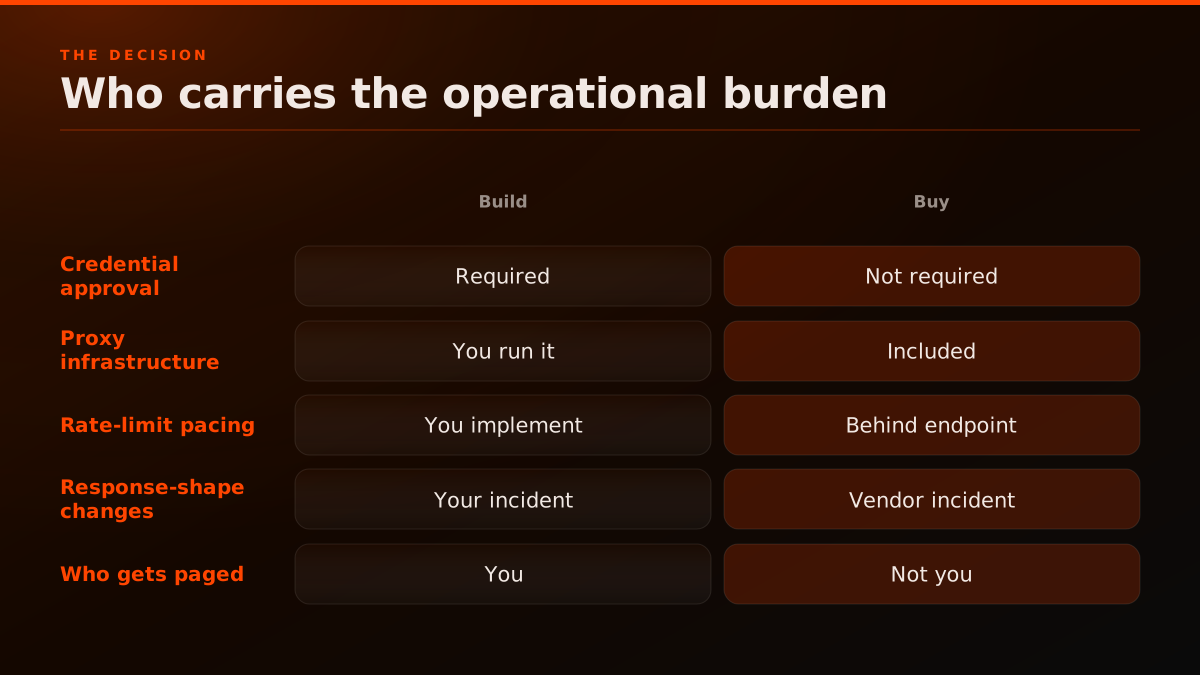
A Reddit scraper API in Python is an HTTP interface that hands your code structured JSON for Reddit posts and comments instead of HTML you have to parse. You have two ways to get one. You can build a client against Reddit's own endpoints and own the authentication, pagination, retries, and maintenance yourself. Or you can call a managed endpoint that returns the same JSON and absorb a per-call fee instead of the upkeep. The dataset is identical either way. The decision is entirely about who carries the operational burden, and at what volume that burden stops being worth carrying.
Not affiliated with Reddit Inc. redditapis.com is an independent third-party REST proxy for Reddit's API.
TL;DR: Build it yourself if you already have approved credentials, your volume is low and predictable, and an outage costs you nothing. Buy it if Reddit data feeds something customer-facing, if volume is high or spiky, or if nobody wants to own scraper maintenance forever. The code for both paths is below, and every sample was executed before publishing. The deciding factor is almost never the code, which is the easy part. It is whether you can reliably get access at all, which in 2026 is the part that actually fails.
What is a Reddit scraper API?
A Reddit scraper API is any HTTP interface that returns Reddit content as structured data. The name covers two genuinely different things, and conflating them is the reason most build-versus-buy discussions go in circles.
Three things get called a Reddit scraper API, and they are not interchangeable:
- Reddit's own Data API, the official OAuth-authenticated interface. Requires approved credentials.
- A managed third-party endpoint that sits in front of Reddit and returns normalized JSON without requiring you to hold Reddit credentials directly.
- HTML or undocumented JSON scraping, often described as a scraper API but not an API at all. It is a dependency on a page format nobody has promised to keep stable.
The first two are contracts. The third is an assumption.
The practical distinction for a Python developer is what you are on the hook for. With the official API you own credential approval, token refresh, rate-limit pacing, and pagination. With a managed endpoint you own an API key and a budget. With HTML scraping you own everything including the parts that change without notice.
Which free Reddit endpoints still work (2026 test)?
Most tutorials ranking for this topic were written against a version of Reddit that no longer behaves the way they describe. The single most repeated piece of advice, that you can append .json to any Reddit URL and read it for free, is still confidently offered in current forum threads. One developer in r/redditdev put it plainly:
"You can append
.rssor.jsonto any subreddit or thread to get it in json"
That advice was correct for years. So rather than repeat it or dismiss it, I tested every commonly recommended free path directly.
Methodology, stated so you can reproduce or refute it: each request was issued once with curl on 2026-07-28 from a single unproxied residential IP in the United States, with no session cookies and no authentication. Two user-agent strings were used, a default python-requests string and a current desktop Chrome string. This is a single-egress test, not a distributed one.
| Method | HTTP status | What came back |
|---|---|---|
www.reddit.com/r/python/hot.json (python-requests UA) |
403 | Network-security block page |
www.reddit.com/r/python/hot.json (Chrome UA) |
403 | Network-security block page |
old.reddit.com/r/python/.json (Chrome UA) |
403 | Network-security block page |
www.reddit.com/r/python/.rss (Chrome UA) |
500 | Empty error response |
oauth.reddit.com/r/python/hot (no token) |
403 | Network-security block page |
www.reddit.com/search.json (Chrome UA) |
403 | Network-security block page |
Every unauthenticated JSON route returned 403 with an identical response body, Reddit's network-security block page. Changing the user-agent string changed nothing, which is worth stating clearly because swapping user-agents is the most common suggested fix in the threads that rank for this query.
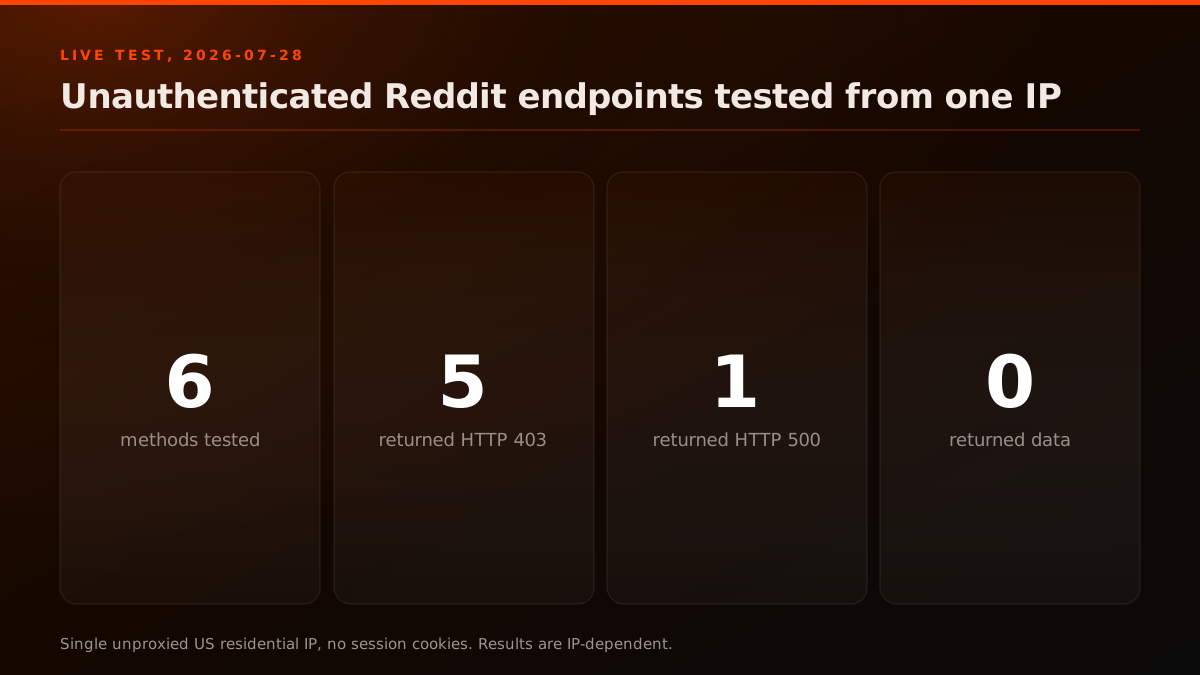
The RSS route deserves its own note because it is the fallback developers reach for once the JSON paths stop cooperating, and it is genuinely different in kind: RSS is a published feed format rather than an undocumented internal route, so it is a more defensible dependency. In this test it returned a 500 rather than a 403, which is a distinct failure and arguably a more recoverable one. It also returns far less per item than the JSON endpoints do, so it suits monitoring a subreddit for new titles rather than building a dataset. /blogs/reddit-rss-feed-vs-api-2026 compares what each actually gives you.
The honest caveat matters more than the result. This is one IP on one day. Your IP may be treated differently, and a residential address with clean history may well succeed where this one did not. But that is precisely the point rather than a weakness in the test: an access method whose reliability is a function of which IP address you happen to be calling from is not something you can build a product on. It will work on your laptop, work in staging, and then behave differently from a datacenter, which is exactly the failure that is expensive to diagnose.
Developers hit the same wall from the other direction, reporting rate limiting during ordinary human browsing:
Are humans supposed to get rate limited?
I just got a message that I was getting rate limited, to try again in 360 seconds? I'm an individual human participant. No bots, no API. Just a human person typing replies to posts on my cell phone. Not sure that it…
This is the context every build-versus-buy decision now sits inside. The relevant question today is not which parsing library to use. It is whether you can get dependable access at all.
The build path: a working Python client
The build path is a small amount of code and a large amount of judgment about what surrounds it. A production Reddit client needs a session, an explicit timeout, bounded retries that distinguish transient failures from permanent ones, and a pacing strategy that respects the request budget. How much of that you write yourself depends on whether your client library absorbs it. One developer put the ergonomics question plainly:
"A good client library should abstract away the rate limiting, at least. That is, it should keep track of how many requests you made over time, and if making another will put you over the rate limit, the library should block for however much time is needed before actually sending the request."
Here is a real client against the managed endpoint, structured the way a production build path should be. The same shape applies if you point it at Reddit's official API with OAuth credentials: a session, a timeout, bounded retries with backoff, and explicit error handling.
import os
import time
import requests

API_KEY = os.environ["REDDITAPI_KEY"]
BASE = "https://api.redditapis.com"

def fetch_posts(subreddit, sort="hot", limit=25, retries=3):
    for attempt in range(retries):
        r = requests.get(
            f"{BASE}/api/reddit/posts",
            params={"subreddit": subreddit, "sort": sort, "limit": limit},
            headers={"Authorization": f"Bearer {API_KEY}"},
            timeout=30,
        )
        if r.status_code == 200:
            return r.json()["posts"]
        if r.status_code in (408, 429, 500, 502, 503):
            time.sleep(2 ** attempt)
            continue
        r.raise_for_status()
    raise RuntimeError(f"failed after {retries} attempts")

posts = fetch_posts("webscraping", sort="top", limit=5)
print(f"Got {len(posts)} posts")
for p in posts[:3]:
    print(f"  {p['upvotes']:>5}  {p['title'][:60]}")
That is roughly thirty lines and it is not the hard part. Retry logic is a solved problem and every developer reading this could write it. The reason build-versus-buy is a real decision is everything that surrounds those thirty lines.
Note the retry branch treats 429 and the 5xx family as transient and retries with exponential backoff, while anything else raises immediately. That distinction matters: retrying a 403 forever is how a broken credential turns into a silent, expensive loop rather than a loud failure.
What breaks the build path first?
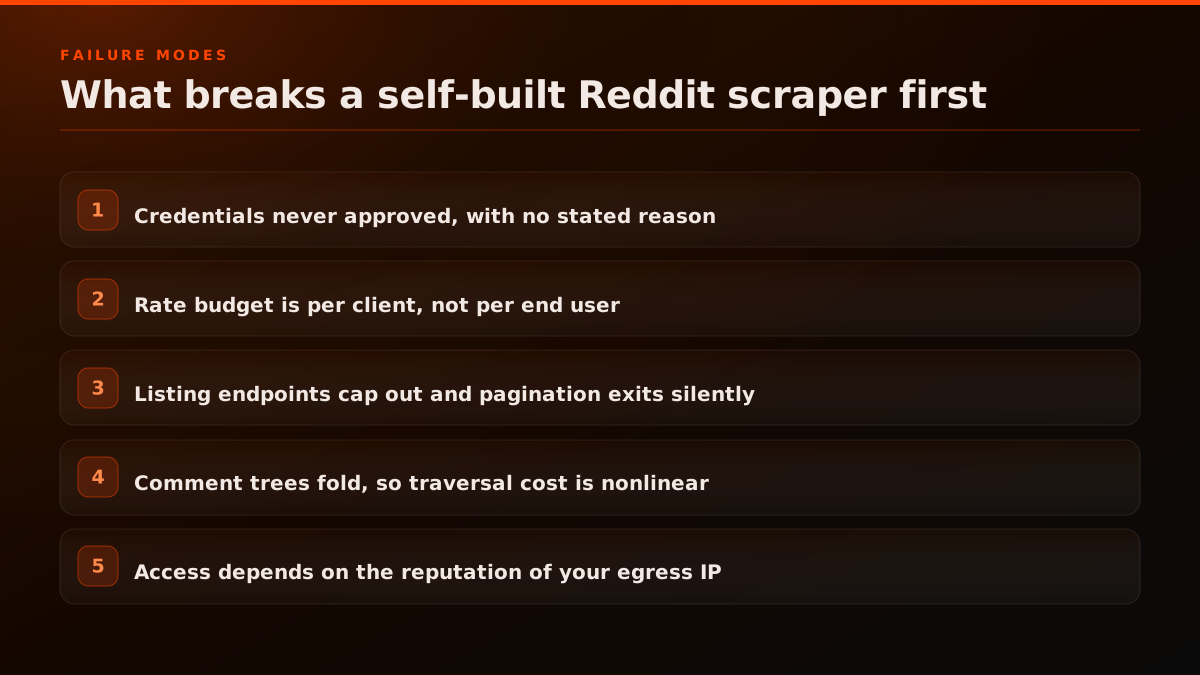
The failures that kill self-built Reddit scrapers are almost never parsing bugs. They are access failures: credentials that never get approved, a request budget shared across every user of your app, listing endpoints that quietly stop returning new rows, and blocks that depend on which IP you call from. All four live outside your repository, where your test suite cannot see them and code review cannot prevent them.
Getting credentials at all. This is the failure mode that most tutorials skip entirely, because when they were written credentials were self-serve. They are not now. Developers report repeated rejections through the approval process, and a recurring complaint is silence rather than a stated reason. One put it bluntly:
"Don't hold your breath, I've applied many times and they hardly ever respond to developer applications from small devs."
Another described routing around the problem rather than solving it:
"I needed to do an end run around API access for a saved post management program I made and I ended up using the feeds because getting API access is so difficult now."
A build plan that assumes credentials is a build plan with an unpriced dependency at the front of it. Check that you can actually obtain access before you estimate anything else. If you are working through that process now, /blogs/how-to-get-reddit-api-key-2026 covers the current path.
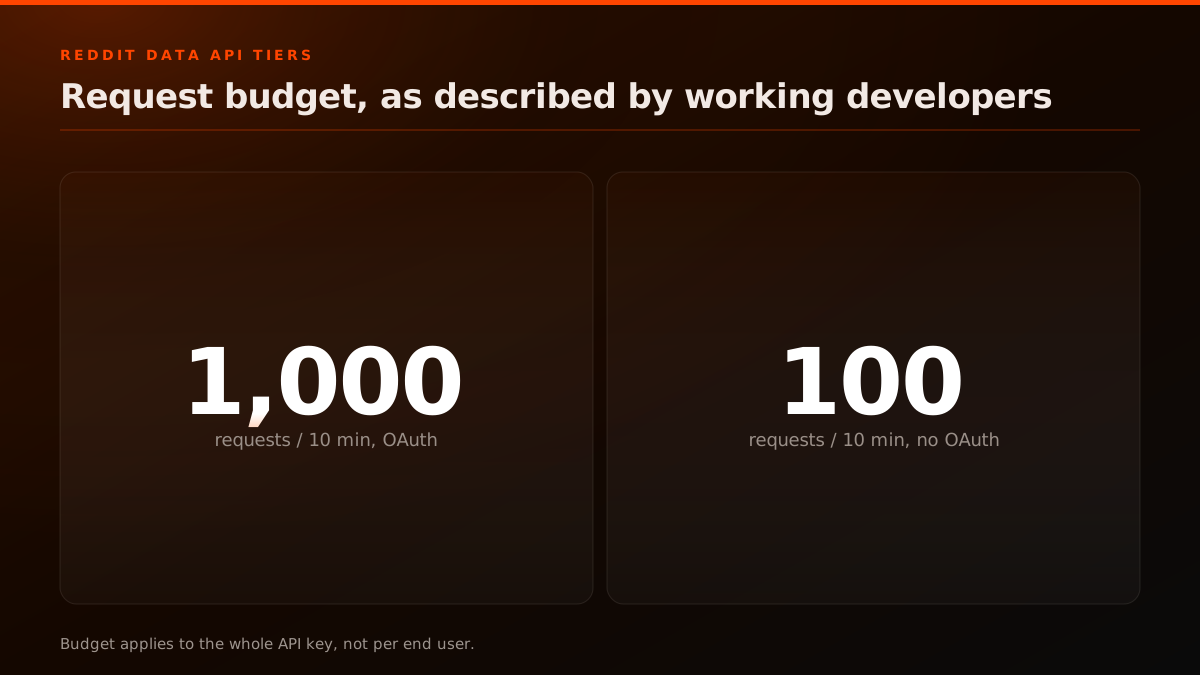
Rate budgets are per client, not per user. This catches teams who size their capacity against user count. As one developer summarized the tiers:
"Free: 1000 API requests per 10 minutes with OAuth; 100 per 10 minutes without. Note this is for your whole API key, not per-end-user. So if you made an app/website used by a thousand people, they would all be sharing the 1000 requests per 10 minutes, which adds up quickly."
That last clause is the trap. A budget that is comfortable for one developer testing locally is the same budget shared across your entire userbase in production. Growth does not expand it. The full current picture is at /blogs/reddit-api-rate-limits-2026.
Listing endpoints cap out. Reddit's listing routes return a bounded number of unique items per sort order no matter how far you paginate. Teams discover this when a backfill quietly stops returning new IDs and the job reports success. Working around it means fanning out across sort orders or slicing by time window, both of which are engineering you now own. /blogs/reddit-api-pagination-2026 covers the mechanics.
Comment trees are a separate problem. Fetching a post is one call. Fetching its full comment tree, including collapsed branches, is a recursive traversal with its own cost profile. One developer described why the current interface is structurally harder to traverse than the old one:
"old reddit shows more or less the raw comment tree, sorted, like HN. New reddit does aggressive folding. You get a couple comments for each branch and have to click "show more" to see more"
If your use case needs complete threads rather than top-level posts, budget for it explicitly. /blogs/reddit-api-comments-2026 goes into the traversal detail.
Start building with Redditapis
Reads $0.0015, votes $0.005, writes $0.012, DMs $0.025. $0.50 free credits.
The case for building it yourself
The strongest arguments for building come from people who have done it and found it straightforward, and it would be dishonest to write a build-versus-buy piece for a managed API vendor without giving them a fair hearing.
Several experienced scrapers argue the difficulty is overstated:
"it's not hard to build if you pay for rotating proxy"
And in more detail:
"Based on your description, you wont even come close to triggering reddit WAF, there would be no issue hitting the routes you need from your server without getting blocked. But if you do run into blocking, or need higher frequency scraping. Using a combination of jitter & a large proxy pool ( can be low quality data center IPs ) will be just fine."
A third made the economic argument that scale is cheap:
"Because you can simply spin up more instances and route over more proxies. Given the fact that you can scrap millions of pages per day, on a single cheap 1 CPU node..."
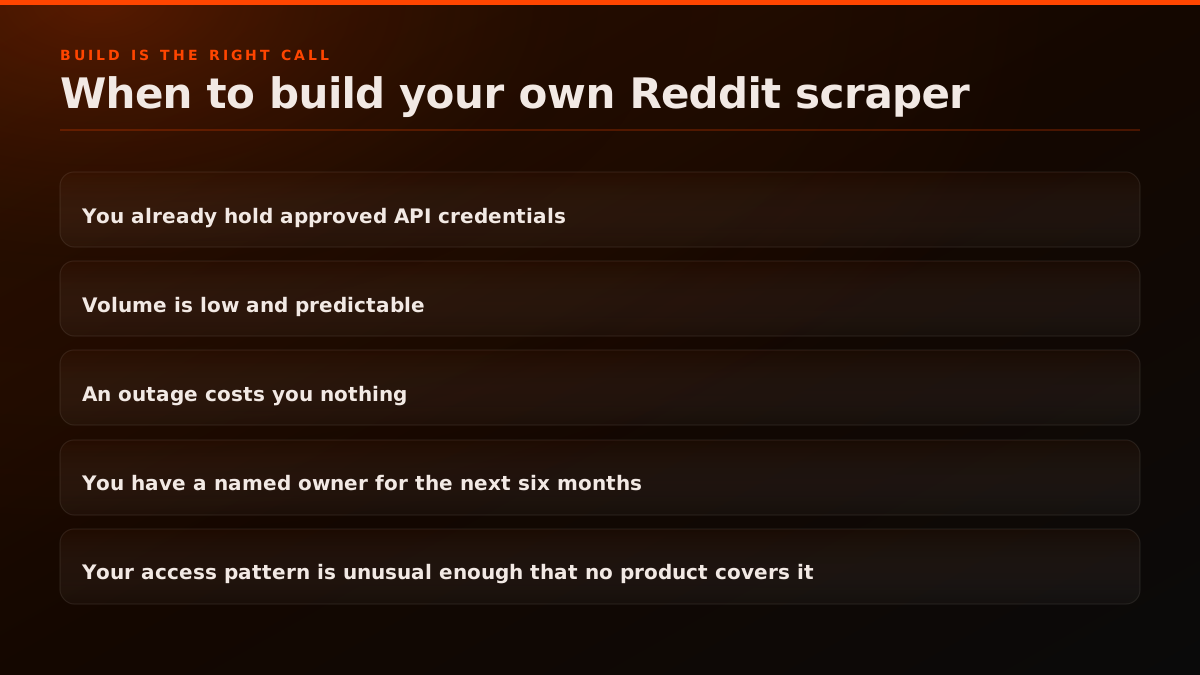
These are credible, and for the right project they are correct. If you are comfortable operating a proxy pool, your volume justifies the setup, and you want full control over the access pattern, building is a legitimate answer. It is also the only answer if your requirements are unusual enough that no managed product covers them.
The same optimism shows up on X, where zero-key access to Reddit and other platforms is a recurring promise:
@
Two honest qualifications. First, every one of those arguments introduces a proxy pool as a dependency, which is an operational surface with its own cost and its own failure modes, so "just build it" is really "build it and also run proxy infrastructure." If you go that way, /blogs/best-residential-proxies-reddit-scraping-2026 is the honest comparison. Second, none of these developers were describing a system with a customer-facing uptime commitment, which is the variable that changes the calculation more than volume does.
For the PRAW route specifically, the ergonomics argument is real and worth stating plainly. PRAW absorbs pacing so you do not have to think about it:
"A good client library should abstract away the rate limiting, at least. That is, it should keep track of how many requests you made over time, and if making another will put you over the rate limit, the library should block for however much time is needed before actually sending the request."
That is a genuine benefit. PRAW's constraint is not its code quality, which is good, but that it still requires approved credentials and still inherits the per-client budget. It makes the budget pleasant to live inside. It does not make the budget larger. The head-to-head is at /blogs/reddit-data-api-rest-vs-praw-2026.
The buy path
The managed path removes two specific burdens: credential approval and ongoing access maintenance. You authenticate with a single bearer token, and pagination, rate-limit pacing, proxy rotation, and response normalization all sit behind the endpoint rather than in your codebase. What you give up is direct control over the access pattern, and what you pay is a per-call fee instead of engineer-hours.
import os
import requests

API_KEY = os.environ["REDDITAPI_KEY"]
BASE = "https://api.redditapis.com"

def search(query, limit=25, sort="new"):
    r = requests.get(
        f"{BASE}/api/reddit/search",
        params={"q": query, "limit": limit, "sort": sort},
        headers={"Authorization": f"Bearer {API_KEY}"},
        timeout=30,
    )
    r.raise_for_status()
    return r.json()["posts"]

for p in search("python scraper", limit=5):
    print(f"{p['subreddit']:>20}  {p['title'][:60]}")
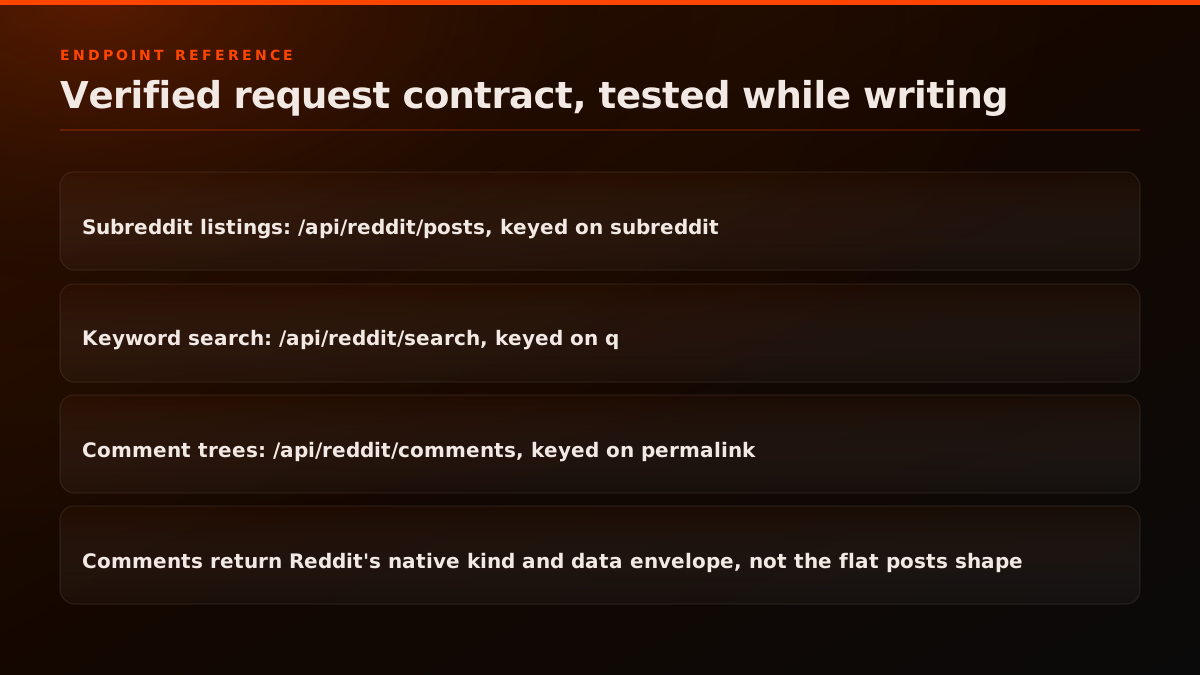
Both samples in this post were executed against the live endpoint before publishing rather than written from documentation. The response shape is a flat posts array with upvotes, title, permalink, author, subreddit, created_utc, and text on each item, which is the same normalized shape across endpoints. Full reference at the API documentation.
What you are actually buying is not the thirty lines of client code. It is that when Reddit changes something, the change is somebody else's incident rather than yours.
Fetching comment trees
Post listings are the easy half. Most real use cases, sentiment work, support monitoring, research corpora, need the discussion rather than the headline, and comment retrieval is where the two paths diverge most sharply in effort.
On the build path you are traversing a nested structure with continuation markers where Reddit has folded a branch. Handling those means recursion, a depth or budget limit so a viral thread cannot run away with your rate budget, and a decision about what "complete" means for your dataset.
import os
import requests

API_KEY = os.environ["REDDITAPI_KEY"]
BASE = "https://api.redditapis.com"

def fetch_comments(permalink, limit=100):
    r = requests.get(
        f"{BASE}/api/reddit/comments",
        params={"permalink": permalink, "limit": limit},
        headers={"Authorization": f"Bearer {API_KEY}"},
        timeout=30,
    )
    r.raise_for_status()
    body = r.json()
    # comments arrive in Reddit's native envelope: {"kind": "t1", "data": {...}}
    return [c["data"] for c in body["comments"] if c.get("kind") == "t1"]

thread = "/r/redditdev/comments/1nfk7uv/are_humans_supposed_to_get_rate_limited/"
for c in fetch_comments(thread, limit=5)[:3]:
    print(f"{c['ups']:>4}  {c['author']:>18}  {c['body'][:60]}")
Two details are worth calling out because they are easy to get wrong from documentation alone. The endpoint keys off the post permalink rather than a bare post id, and comments come back in Reddit's native {"kind", "data"} envelope rather than the flattened shape the posts endpoint returns, so you unwrap data and filter on kind == "t1" to skip the continuation stubs. Both of those were confirmed against the live endpoint while writing this rather than assumed.
The practical guidance is to decide up front whether you need the whole tree or the top-level replies, because "all comments" on a large thread is a materially different cost from "the first hundred." Teams that skip that decision tend to discover it as a rate-limit incident. The traversal detail and the full response shape are covered at /blogs/reddit-api-comments-2026.
Backfilling without silent truncation
The failure that costs the most engineering time is the one that does not raise an exception. Listing endpoints stop yielding new identifiers past a bound, and a naive pagination loop treats the empty page as "finished" and exits zero. Your job reports success. Your dataset is short. Nobody notices until somebody queries it.
The defensive pattern is to track identifiers you have already seen, assert that each page actually advanced the set, and fail loudly when a page returns nothing new before you expected the end.
def backfill(subreddit, sort="new", pages=5, limit=100):
    seen, after = set(), None
    for page in range(pages):
        params = {"subreddit": subreddit, "sort": sort, "limit": limit}
        if after:
            params["after"] = after
        r = requests.get(
            f"{BASE}/api/reddit/posts",
            params=params,
            headers={"Authorization": f"Bearer {API_KEY}"},
            timeout=30,
        )
        r.raise_for_status()
        body = r.json()
        posts = body.get("posts", [])
        new = [p for p in posts if p["id"] not in seen]
        if not new:
            print(f"page {page}: no new ids, stopping early")
            break
        seen.update(p["id"] for p in new)
        after = body.get("after")
        if not after:
            break
    return seen
Note the if not new branch. It prints and stops rather than looping silently, which is the difference between a truncated dataset you know about and one you do not. If you want a fuller treatment of cursors and the bound itself, /blogs/reddit-api-pagination-2026 covers it, and /blogs/reddit-search-api-tutorial-2026 covers slicing by time window when a single sort order is not enough.
If you are building rather than buying, do not hand-roll the retry layer. Tenacity handles backoff and jitter properly, requests is fine for synchronous work, and httpx plus asyncio is the sane path once you need concurrency. If you are going the official-credentials route, PRAW and its source are well maintained, and Reddit's own API reference is the authority on endpoint behavior.
The cheapest Reddit API. Try it free.
Reads from $0.0015 per call. $0.50 free credits. No credit card required.
What does each path actually cost?
Compare the two paths honestly and the runtime costs are close enough that they decide nothing. A server and a proxy pool are commodity line items, and per-call fees at ordinary volume are modest. The real difference is where maintenance lands, because engineer-hours spent keeping a scraper alive are invisible on a budget in a way that an invoice never is.
- Time to first working result. Build: hours to weeks, depending entirely on credential approval. Buy: minutes.
- Credential approval. Build: required, and it is the main risk. Buy: not required.
- Proxy infrastructure. Build: yours to run, if you need it. Buy: included.
- Rate-limit pacing. Build: yours to implement and tune. Buy: behind the endpoint.
- Response-shape changes. Build: your incident. Buy: the vendor's incident.
- Marginal cost per call. Build: near zero. Buy: a per-call fee.
- Fixed monthly cost. Build: server, proxies, and engineer time. Buy: a subscription.
- Who gets paged at 2am. Build: you. Buy: not you.
The row that decides it for most teams is the last one. Per-call pricing is easy to model and easy to compare against a server bill. Engineer-hours spent on scraper maintenance are harder to see on a budget, which is exactly why they tend to be underestimated. If you want to model your own volume against per-call pricing, /pricing has the current rates and /reddit-api-alternatives covers the wider option set including Apify and Bright Data.
For historical and bulk archives specifically, neither path above is the right answer. Academic-style dumps and archive projects serve that need better, and /blogs/best-pushshift-alternatives-2026 compares what still exists.
Should you build or buy?
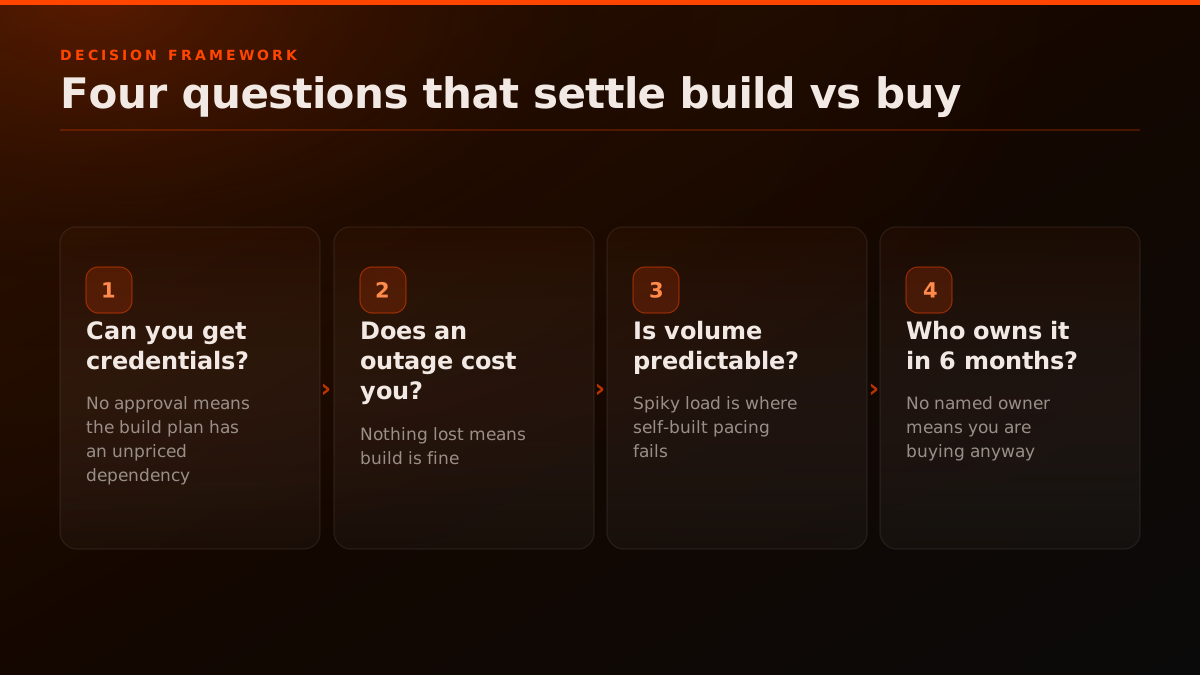
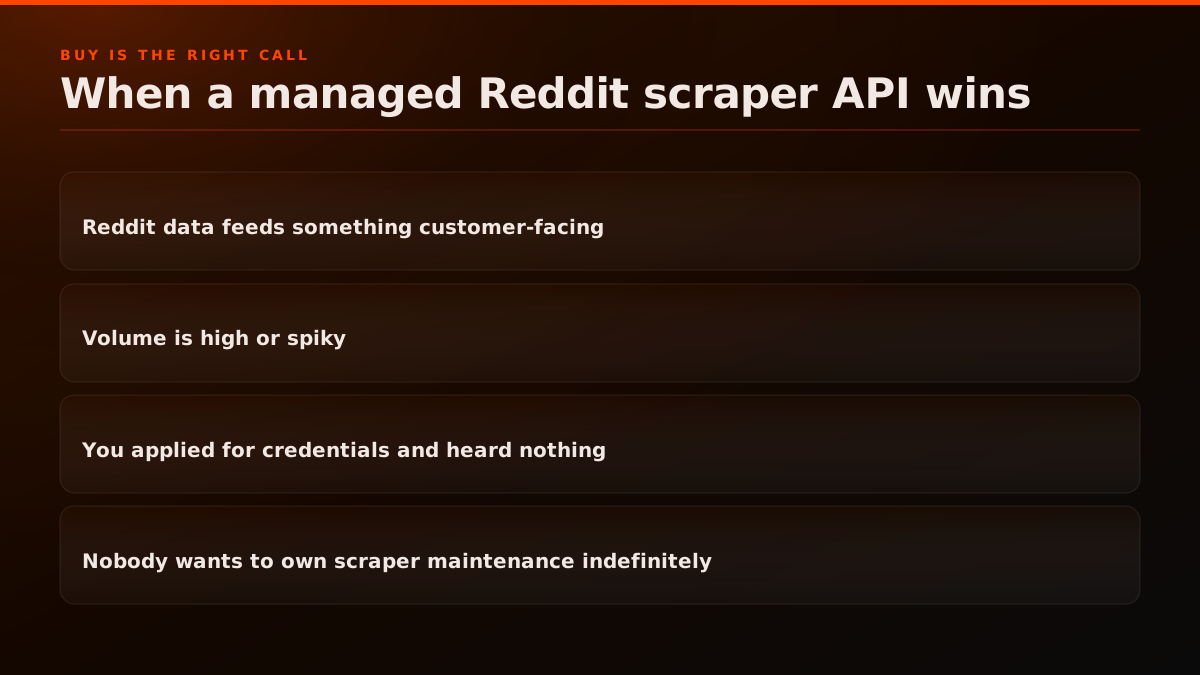
Skip the feature comparison entirely, because both paths return the same data and the feature lists will not separate them. Four questions settle this decision faster than any matrix, and they are about your operating context rather than about the technology: access, cost of failure, load shape, and ownership.
- Can you actually get credentials? If you have them, building stays open. If you have applied and heard nothing, your build plan has an unresolved dependency at the front and no amount of Python fixes it.
- Does an outage cost you anything? A research dataset that arrives on Thursday instead of Tuesday costs nothing. A customer-facing feature that returns empty results costs trust. If the answer is nothing, build. This single question separates more cases correctly than volume does.
- Is your volume predictable? Steady low volume fits comfortably inside a single client's budget. Spiky volume is where self-built pipelines fail, because the spike is exactly when pacing logic gets tested and exactly when you are not watching.
- Who owns it in six months? Scrapers are not finished software. They need an owner. If you cannot name that person, you are choosing the managed path whether you intend to or not, just with a delay and an outage in between.
If you answered "yes, nothing, yes, me" then build it, and the code above is a fine starting point. Any other combination and the per-call fee is buying something real.
If you already built one and want out
Most teams reading this are not at a greenfield decision. They have a scraper, it half works, and somebody is tired of fixing it. Migrating is less work than it looks because the interesting part of your codebase is not the fetch layer.
Do it in three steps rather than as a rewrite. First, put your existing fetch calls behind a single function that returns a normalized list of posts, if they are not already. Most self-built scrapers accumulate direct requests.get calls scattered through the code, and collapsing them into one seam is the actual migration work. Second, write a second implementation of that seam against the managed endpoint and run both against the same subreddits, comparing identifier sets rather than eyeballing output. Any divergence is either a pagination bug in the old path or a genuine coverage difference, and both are worth knowing before you cut over. Third, switch the seam and delete the proxy configuration.
The comparison step is the one people skip and the one that pays. Running both paths side by side for a day is how you find out that your existing backfill was silently truncating, which is a common discovery and a slightly uncomfortable one. If your identifier sets match, the cutover is boring, which is what you want.
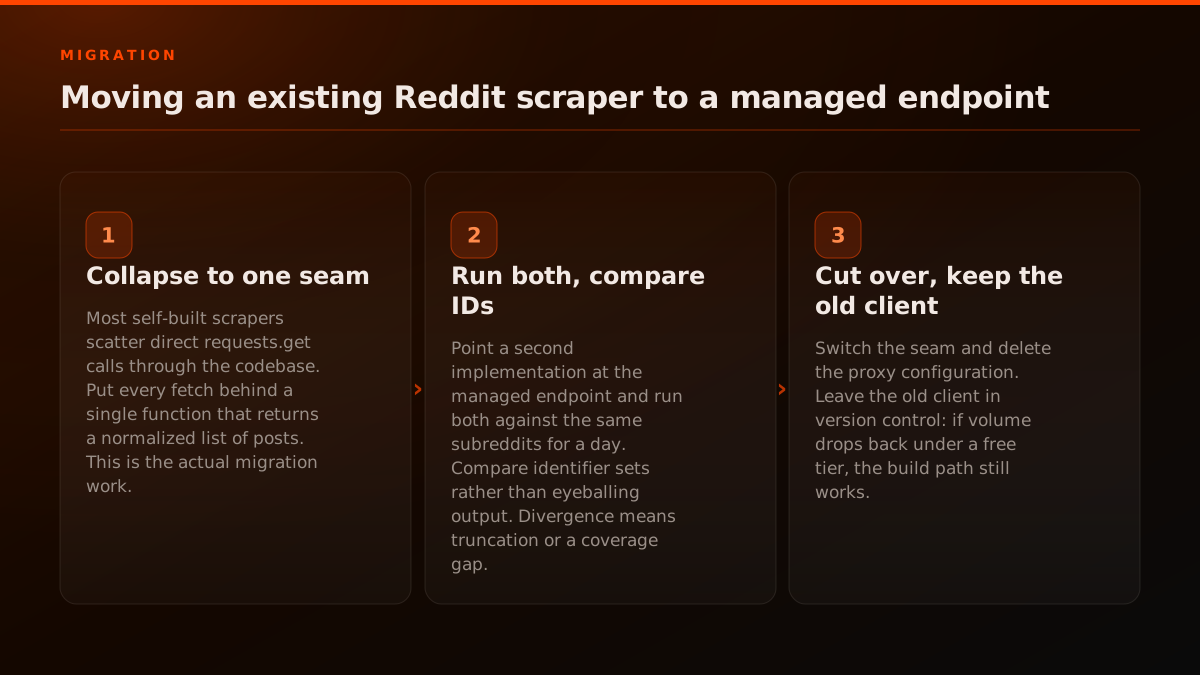
Keep the old client in version control rather than deleting it outright. If the economics change or your volume drops back under a free tier, the build path is still there and still works.
Is scraping Reddit compliant?
Two separate questions get conflated constantly here, and keeping them apart is the difference between a defensible position and a vague worry. The first is whether scraping public data is lawful, which is largely settled in United States case law. The second is whether a specific use complies with Reddit's own terms, which is a contract question with a different answer.
Whether scraping public data is lawful is largely settled in the United States. In hiQ Labs v. LinkedIn, the Ninth Circuit held that the Computer Fraud and Abuse Act does not reach publicly accessible data, reasoning that information open to the general public is not "without authorization" in the sense the statute contemplates. The opinion itself is worth reading rather than paraphrasing, and the Electronic Frontier Foundation's summary is a readable digest of what the ruling did and did not settle. A case history is useful context because the litigation ran long and is often cited at the wrong stage.
Keep the two apart like this:
- Is it lawful to access public data? Largely settled in US case law, and the answer is generally yes.
- Does this specific use comply with Reddit's terms? A separate contract question, and commercial use is where it bites.
That ruling is about the Computer Fraud and Abuse Act specifically. It is not a blanket permission slip, and it says nothing about contract claims.
Whether a given use complies with Reddit's own terms is the separate question, and commercial use is where it bites. Reddit's Data API Terms are the governing document and they distinguish between access and commercial exploitation of the data you retrieve. If you are building something commercial, read them and answer the question deliberately rather than discovering it later. /blogs/is-scraping-reddit-legal-2026 covers both threads properly.
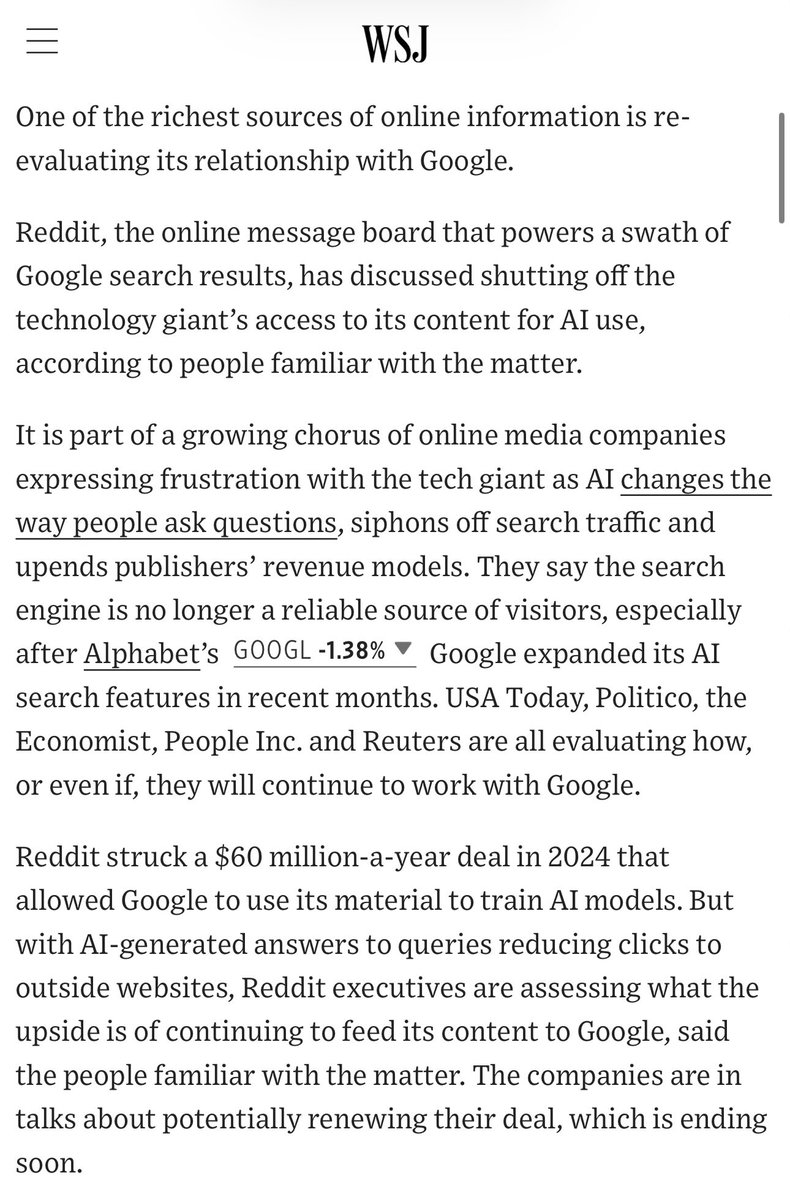
The market context is worth knowing too, because it explains why access tightened rather than leaving it as an unexplained inconvenience. Reddit's data has become a licensed asset with real revenue attached to it, which is why the free tier is not coming back.

Q-Cap
@qcapital2020
$RDDT down 5% because people think Reddit is walking away from Google? I actually see the opposite. This reads like a company telling Google, “The next contract won’t be $60M buddy” Google needs Reddit’s data 10x more today than it did when they signed the original deal https://t… Show more
The 2023 repricing that began all of this is still the reference point developers cite, usually through the headline projection published by one very large third-party app at the time.
The developer community's own summary thread from June 2023, written immediately after the moderator meeting with Reddit's leadership, is still the clearest record of what changed and why, and it is worth reading as history rather than as current pricing:
Takeaways and recommendations after API meeting with /u/spez and Reddit
On Wednesday, a group of 18 developers and moderators met with spez and other Reddit staff regarding the upcoming API changes. Call notes were published by Reddit for the RedditModCouncil ([here is an authorized public…
Those numbers described one app's specific situation at its own scale, not a general rate card, and they get requoted as though they were the latter. Current pricing is far more modest for ordinary volumes, and quoting 2023 shock figures at a team sizing a project today is actively misleading. /blogs/reddit-api-pricing-2026 has the current numbers rather than the 2023 ones.
Verdict
The code is not the decision. Both paths are about thirty lines of Python and any competent developer can write either one in an afternoon. What separates them is access reliability and who owns the maintenance.
Build it if all four of these hold:
- You hold approved credentials already
- Volume is low and predictable
- An outage costs you nothing
- You have a named owner for the next six months
Research projects, internal tools, and learning exercises land here and should.
Buy it if Reddit data feeds anything customer-facing, if volume is spiky, if you have applied for credentials and heard nothing, or if you cannot name the person who maintains it in six months. The per-call fee is buying the elimination of an entire category of incident, not thirty lines of code you could have written yourself.
The failure mode worth avoiding is choosing to build without pricing the maintenance, then migrating under pressure after an outage. That is the expensive version of both paths. Decide deliberately now and either answer is defensible.
Start with the full API documentation if you want to try the managed path, or sign up to get a key and run the samples above against your own subreddits. If you are still comparing options, /blogs/how-to-scrape-reddit-2026 is the wider survey of every current method and /blogs/reddit-api-python-tutorial is the deeper Python walkthrough.
Where these numbers come from.
Each row is a figure in this post and the artefact it was read from. Reddit's access rules and the third-party archives around them keep moving, so check the date on a source before you build against it.
- Requests: HTTP for Humans
- The HTTP client the hand-built Python scraper path uses.
- Reddit API JSON wiki
- The free .json endpoints the article live-tests in the build path.
- PRAW documentation
- The wrapper option on the build side of the build-vs-buy decision.
- redditapis.com API docs
- The managed buy-path endpoints and pricing benchmarked against building.
- Reddit Data API Terms
- The compliance terms behind the 'is scraping Reddit compliant' section.
Frequently asked questions.
A Reddit scraper API is an HTTP interface that returns Reddit posts and comments as structured JSON, so your code never has to parse Reddit's HTML. There are two kinds. The first is one you build: a Python client you write and maintain against Reddit's own endpoints, where you own authentication, pagination, retries, and whatever happens when a response shape changes. The second is one you rent: a managed endpoint that returns the same JSON and absorbs that maintenance for a per-call fee. Both produce the same dataset. They differ in who carries the operational burden. The wider survey of every current access method is at /blogs/how-to-scrape-reddit-2026.
Not reliably. The long-standing trick of appending .json to any Reddit URL is still widely recommended in forum threads, but it is no longer dependable from an ordinary server. Tested on 2026-07-28 from a single unproxied residential IP with no session cookies, every unauthenticated JSON path returned HTTP 403 with Reddit's network-security block page, including the classic /r/<sub>/hot.json route, the old.reddit.com equivalent, and search.json. Results are IP-dependent and yours may differ. That variance is the actual finding: an access method whose success depends on the reputation of the IP you happen to be calling from is not a foundation you can put a product on. Background on why the undocumented JSON route became unreliable is at /blogs/reddit-json-endpoint-dead-2026.
Yes, for the case it was designed for. PRAW handles OAuth and rate-limit pacing for you, and for a single-threaded script pulling modest volume it remains the shortest path from nothing to working code. Its constraints are structural rather than technical: PRAW still needs approved API credentials, and it inherits the per-client rate budget rather than removing it. If you can get credentials and your volume fits inside one client's budget, PRAW is a reasonable default. See the detailed comparison at /blogs/praw-vs-redditapis-rest-2026.
The runtime cost is small and the maintenance cost is the real number. A server and a proxy pool are commodity line items. The recurring expense is engineering attention: reauthenticating when tokens rotate, adjusting when a response field moves, re-tuning pacing after a rate-limit change, and being the person who gets paged when a pipeline stops returning rows. Budget in engineer-hours per month, not dollars per month. If that figure is more than a few hours, compare it against per-call pricing at /pricing before committing.
Build when the work is genuinely yours to own: research projects, one-off datasets, learning exercises, low and predictable volume, or any case where an outage costs you nothing and you already hold approved credentials. Build also when your access pattern is unusual enough that no managed product covers it. Buy when Reddit data feeds something customer-facing, when an outage has a cost, when volume is high or spiky, or when nobody on the team wants to own scraper maintenance indefinitely. Throughput and cost benchmarks across methods are at /blogs/reddit-scraping-benchmarks-throughput-error-rates-2026.
Access, not code. The most common failure is not a bug in your parser but losing the ability to call the endpoint at all, either because credentials were never approved, or because the IP you call from starts receiving blocks. Both failure modes are external to your repository, which is what makes them frustrating to own: no amount of code review prevents them, and they tend to surface in production rather than in tests. Current rate-limit behaviour is documented at /blogs/reddit-api-rate-limits-2026.
Scraping publicly available data is generally treated as lawful in the United States following hiQ Labs v. LinkedIn, in which the Ninth Circuit held that the Computer Fraud and Abuse Act does not reach publicly accessible data. That is a separate question from Reddit's own terms, which govern commercial use of its API and data. The practical position for a commercial project is that public-data access is not automatically a legal problem, but commercial use is a terms question you should answer deliberately. Full treatment at /blogs/is-scraping-reddit-legal-2026.
Keep reading.
Continue exploring related pages.
Reddit API documentation
The complete 2026 reference: auth, all 74 endpoints, and code.
Get a Reddit API key
Instant bearer token, no waitlist and no enterprise contract.
Reddit Responsible Builder Policy
Why Reddit denies API applications, and the managed REST bypass.
Reddit API use cases
14 use cases from AI training to brand monitoring and DMs.
Reddit Search API
Search posts, comments, users, and communities over one REST endpoint.
Reddit MCP server
Wrap the REST API as MCP tools for Claude, Cursor, and any MCP client.
Reddit MCP hub
Install tabs for every client, the full tool table, pricing and fixes.
Reddit API for AI agents
Live Reddit context for tool calls, MCP servers, and RAG pipelines.
Redditapis pricing
Endpoint-level costs and quick monthly totals - reads from $0.0015 / call.
Reddit API cost calculator
Estimate monthly spend using your request volume.
Reddit API guides and tutorials
Tutorials, walkthroughs, and API deep-dives for developers.
Reddit API alternatives
Evaluate alternatives by cost model, limits, and integration fit.
Cheap Reddit API
The cheapest way to get Reddit data: $0.0015 per call, no contract, no minimum.
Official Reddit API vs Redditapis
Access, setup, rate limits, and pricing, side by side.
PRAW alternative
A hosted Reddit REST API for any language, no app registration or OAuth.
Reddapi alternative
A maintained Reddit REST API with published pricing and write endpoints.
Reddit comment scraper alternative
The raw comment API: search and filter comments, historical and live, clean JSON.
Reddit scraper API
Hosted scraper API vs building your own: no proxies to manage, clean JSON.
RapidAPI Reddit alternative
A direct, maintained Reddit API with published pricing and write endpoints.
Bright Data Reddit alternative
A purpose-built Reddit API vs a general scraping platform: structured JSON, plus writes.
ScraperAPI Reddit alternative
A Reddit-native API vs a generic HTML fetcher: auth and pagination handled, typed JSON.
TikHub alternative
TikHub's Reddit surface is read-only; get comment, vote, and DM endpoints too.
EnsembleData alternative
No $100/month floor: pay per call from $0.0015, plus write, vote, and DM endpoints.
Scrape Creators alternative
7 read-only Reddit endpoints vs a dedicated API with real write, vote, and DM paths.
FetchLayer alternative
Posts, comments, and search only; add vote, comment, and DM over the same REST auth.
PullPush alternative
PullPush is free but volunteer-run and goes offline for reindexing; a maintained REST API that stays up.
Reddit monitoring API
Build your own keyword and brand-mention monitor: search, comment search, and subreddit streams over REST.
F5Bot vs Redditapis
F5Bot's Slack and Discord delivery needs its $49.99/mo Gold tier; Redditapis includes it from $19/mo.
Syften vs Redditapis
Syften caps you at 100 to 500 results a day; Redditapis allows 10,000 a day per monitor at the entry plan.
Octolens vs Redditapis
Octolens meters by mention with overage fees; Redditapis is flat-priced by subreddit slot from $19/mo.
Affiliate program
Earn 20% lifetime commissions - capped at $5,000/yr.
Reddit Vote API tutorial
Upvote and downvote a post programmatically via the REST API.
Reddit Data API: REST, no PRAW
REST endpoints for Reddit data with no PRAW and no OAuth dance.
Reddit scraping benchmarks
Real throughput, error rates, and cost benchmarks for Reddit scraping.
Reddit API answers
Direct answers on cost, access, rate limits, endpoints, and auth.
How much the Reddit API costs
Per-call pricing from $0.0015 a read, with $0.50 in free credits.
Reddit API in Python
One requests call with a bearer token, no PRAW and no OAuth flow.
Reddit shadowban checker
Check if a Reddit account is shadowbanned in seconds, free and no login.
Subreddit stats checker
See any subreddit's live subscriber count, active users, and age, free and no login.
Similar reads.
More guides on the Reddit API, scraping, pricing, and MCP servers.
RedditAPIs vs. ScrapingDog: Which Reddit Scraper API Should You Actually Use in 2026?
ScrapingDog is a general-purpose scraping API that can be pointed at Reddit. RedditAPIs is a Reddit-native API. Real 2026 pricing from both vendors, live-tested code, and the volume where each one wins.
How to Estimate Your Reddit API Bill: a Per-Call Cost Model in Python
A per-call Reddit API cost model in Python: price every read, write and DM, then size the monthly bill for a keyword monitor, a RAG refresh and a reply bot.
Reddit Scraping API in 2026: What the Term Actually Means
Reddit scraping API names three different products in 2026. What each costs, what Reddit's own announcements changed, and which one your app needs.
Does the Reddit Search API Support Boolean Queries? Every Operator, Tested
AND, OR, and NOT don't work like SQL against Reddit's search backend. Here's what actually works (subreddit:, author:, exact phrases, exclusion), tested live against the production API, plus why the boolean confusion exists in the first place.
How to Detect Trending Topics on Reddit With an API
Detect trending topics on Reddit with an API: snapshot hot and top listings, compute score and comment velocity, and surface rising posts, subreddits, and topics.

Most Popular Subreddits via the Reddit API: Trending and Hot Communities in 2026
How to pull the most popular, trending, and hot subreddits programmatically: the popular and community-search endpoints, why popular is not the subscriber ranking, with runnable code.

Advanced Reddit Search Filters API (2026)
Filter Reddit search by score, comment count, media type, and NSFW over one authenticated GET. Every filter parameter, the response meta, and real Python.

Reddit Bulk Fetch by ID: Hydrate Posts in One API Call
Fetch many Reddit posts in one call with the by_id API. Hydrate t3_ fullnames from a stream, backfill archives, and dedup at scale, with copy-paste Python for 2026.