
Best Residential Proxies for Reddit Scraping in 2026 (Verified Pricing) and When You Do Not Need One
Verified June 2026 per-IP pricing for static residential and ISP proxies (Webshare, Bright Data, IPRoyal, Oxylabs, Proxy-Seller and more), the fake-ISP risk, and the build-vs-buy math for scraping Reddit data.

Residential and ISP proxies for Reddit scraping range from approximately $0.30 per IP at the low end (Webshare) to $6.99 per IP (NovaProxy), with the per-IP versus per-gigabyte billing distinction being the most common budgeting mistake. Before buying any pool, developers building Reddit-specific data pipelines should price the API-first path: a managed REST API at $0.0015 per GET read removes the proxy layer entirely, with no IP rotation, no fake-ISP risk, and no pool maintenance. This guide covers verified June 2026 pricing for eight static and ISP providers, the fake-ISP detection problem, and the build-versus-buy math.
TL;DR: Every price in this guide was read directly from the vendor's live pricing page in June 2026, not copied from a review site. On a per-IP basis for static and ISP proxies, Webshare ($0.30) is the cheapest headline price, Proxy-Seller ($0.75) is the cheapest with unlimited bandwidth, Oxylabs ($2.10) is the premium pick, and Bright Data ($0.90, KYC-gated) sits in between. But the two things that actually burn buyers are not on any pricing page: "fake ISP" datacenter IPs sold as residential, and heavily seeded reviews. And if your goal is Reddit data specifically rather than general-web scraping, the lowest-maintenance option is to skip the proxy pool and read the data through an API.
If you are scraping Reddit at any real volume with your own code, you eventually meet the same constraint: a single IP making thousands of requests gets rate-limited, then challenged. The standard workaround is proxies, spreading those requests across many residential or ISP IP addresses so no single address carries the whole load. So the question becomes which proxy provider to buy, and that is where most guides stop being useful, because most proxy guides are written by proxy vendors or by affiliate sites paid to rank them.
This one is different in two ways. First, the pricing is verified: read from live vendor pages in June 2026, so you are comparing real numbers. Second, it does not assume you need proxies at all. For general-web scraping, you do. For Reddit data specifically, there is a cheaper layer to buy, and we will do the actual math. If you only want the read path, our breakdown of the REST API versus PRAW approaches compares the options, and the Reddit API cost comparison carries the full spend model.
What static residential and ISP proxies actually are
A residential proxy routes your request through an IP that belongs to a real consumer internet connection, so the target sees traffic that looks like an ordinary home user rather than a server in a datacenter. An ISP proxy (sometimes called static residential) is a hybrid: hosted in a datacenter for speed and uptime, but the IP is registered to a consumer ISP, so it carries a residential-looking ASN while behaving like a stable server IP. For the underlying primitive, see the proxy server overview.
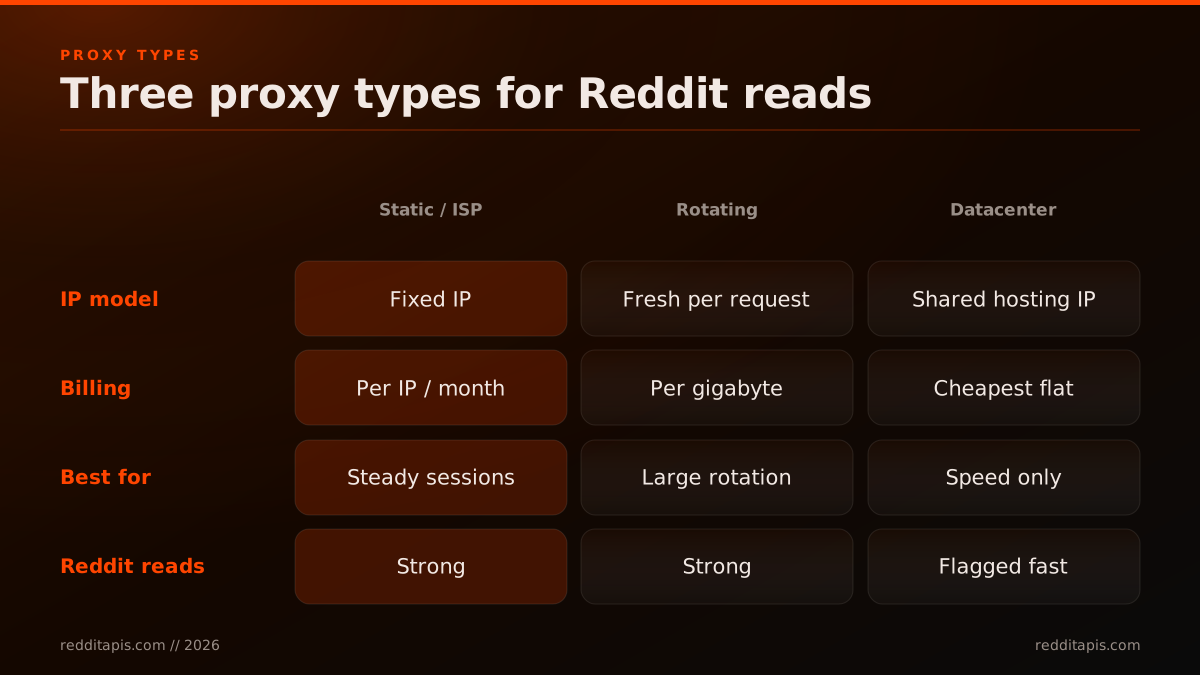
The distinction that matters for your budget is sticky versus rotating. Static residential and ISP proxies give you a fixed IP that persists across sessions, billed per IP per month. That suits long sessions or anything that needs the same identity over time. Rotating residential proxies hand you a fresh IP per request from a large pool, usually billed per gigabyte. People scraping Reddit tend to want the sticky kind for consistent sessions and the rotating kind for high-volume anonymous reads, and the two are priced on completely different models, which is the first place comparisons go wrong.
The three options you will actually compare:
- Static residential / ISP: a fixed IP, billed per IP per month, best for consistent sessions.
- Rotating residential: a fresh IP per request from a large pool, billed per gigabyte.
- Datacenter: cheapest and fastest, but trivially flagged, so rarely used for Reddit reads.
The verified price ladder (June 2026, read from live vendor pages)
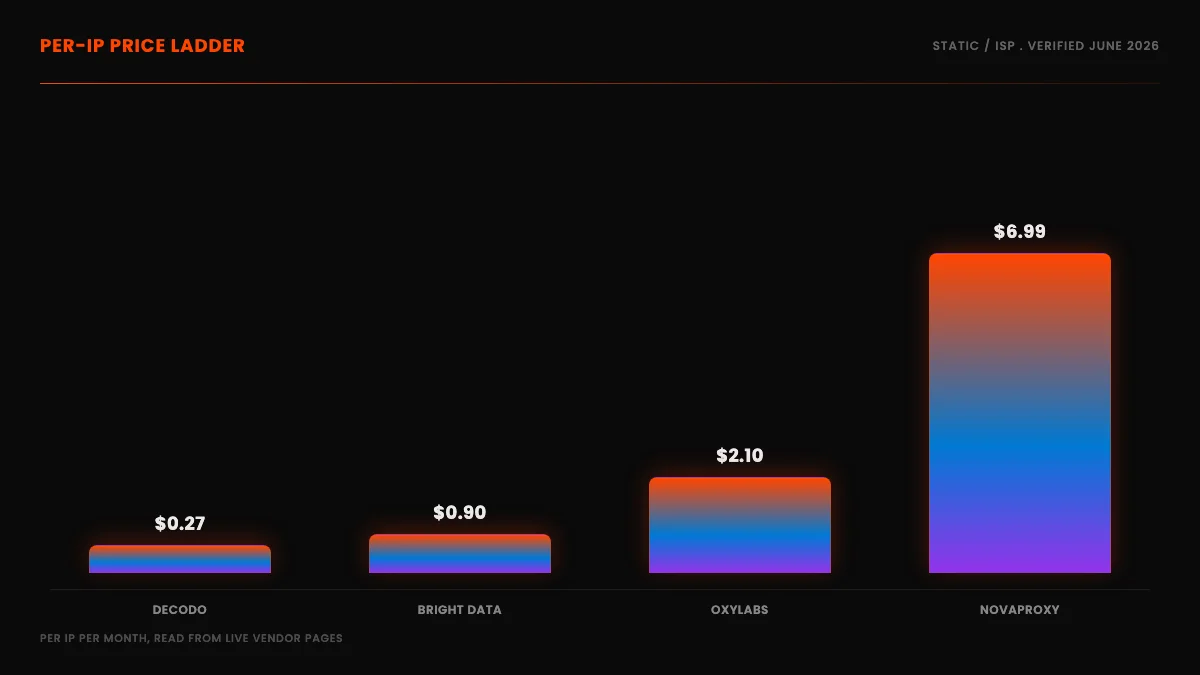
Here is every provider, with pricing read directly from the live vendor page in June 2026. Verify current pricing before purchase, because vendors change tiers often, but this is the real landscape as of writing.
| Provider | Static / ISP price (Source: live vendor pricing pages, verified June 2026) | Bandwidth | Model | Notes |
|---|---|---|---|---|
| Webshare | $0.30/IP (20 IPs = $6/mo), down to $0.24/IP at volume | 250 GB entry, up to unlimited higher | per-IP | Cheapest entry. Bandwidth-capped on cheap plan. |
| Proxy-Seller | from $0.75 to $0.90/IP (region-dependent) | Unlimited | per-IP | Cheap and unlimited; per-region stock, no rotation. |
| Bright Data | from $0.90 to $1.30/IP, or $2.5 to $5/GB | metered or per-IP | both | KYC and business verification; some targets gated. |
| IPRoyal | $1.80/IP per 30 days (longer commits about $2.40/IP) | Unlimited | per-IP | Static tier unlimited; long sticky sessions. |
| Oxylabs | from $2.10/IP | Unlimited (fair-use) | per-IP | Premium reliability, priced for scale. |
| ProxyWing | $3/IP down to $2.0/IP at volume | Unlimited | per-IP | Smaller provider; limited independent data. |
| Rayobyte | $5/IP down to $4.60/IP at volume | Unlimited | per-IP | Ethics-focused; support reportedly inconsistent. |
| NovaProxy | $6.99/IP per month (dedicated) | Unlimited (soft-throttled) | per-IP | Newer; testimonials only on own site. |
| NetNut | $99 / 7 GB ($14.4/GB) down to $4.5/GB | metered | per-GB | Enterprise-oriented, traffic-billed. |
| DataImpulse | $1/GB down to $0.80/GB ($5 min) | metered | per-GB | Rotating residential, not static. Socket-level billing. |
| ProxyEmpire | $2.85 to $5.71/GB (static resi) | metered | per-GB | Static product is GB-priced, not per-IP. |
| Proxy4U | PAYG packages from $9.9 (no expiry) | metered | per-GB | Rotating residential PAYG; no static-ISP per-IP product. |
Read as a single per-IP ladder, cheapest to most expensive for static ISP, approximately: Webshare $0.30, Proxy-Seller $0.75, Bright Data $0.90, IPRoyal $1.80, Oxylabs $2.10, ProxyWing $2 to $3, Rayobyte $4.60, NovaProxy $6.99. The last four (NetNut, DataImpulse, ProxyEmpire, Proxy4U) are GB-metered, a different model you cannot compare on a per-IP number.
Provider-by-provider: the honest verdicts
Eight providers are covered here with pricing verified from live pages in June 2026. Proxy-Seller offers the best unlimited-bandwidth per-IP value; IPRoyal has the strongest static sticky sessions; Oxylabs is the premium pick at scale; Bright Data is enterprise-grade but gated by KYC. The smaller providers, ProxyWing, NovaProxy, and Proxy4U, have limited independent data, so treat them with caution.
Quick picks before the detail:
- Best value: Proxy-Seller (unlimited bandwidth, low per-IP).
- Best sticky sessions: IPRoyal static tier.
- Premium at scale: Oxylabs.
- Enterprise plus compliance: Bright Data, if you can clear KYC.
Webshare has an unbeatable headline price at approximately $0.30 per IP, but the cheap plan caps bandwidth at 250 GB and reliability is the trade-off. We cover the trust issue in the next section because it is the most-cited cautionary tale in the community.
Proxy-Seller is quietly one of the cheapest unlimited options at approximately $0.75 to $0.90 per IP. Good as a secondary or independent provider; the caveats are no rotation and per-region stock.
Bright Data is cheaper per IP than its enterprise reputation suggests at approximately $0.90 to $1.30, with serious scale and a compliance focus. The friction is onboarding: KYC and business verification, and some targets are gated for new accounts.
IPRoyal is mid-priced at approximately $1.80 per IP with unlimited bandwidth on the static tier and long sticky sessions. Sentiment is mixed-to-negative lately, which we get into below, but the static product is the better-regarded half of its lineup.
Oxylabs is premium at approximately $2.10 per IP with high success rates and unlimited fair-use bandwidth. Worth it mainly at scale.
ProxyWing, NovaProxy, and Proxy4U are smaller or newer providers. Pricing is an estimated $2 to $3 per IP, $6.99 per IP, and PAYG from $9.9 respectively, but independent community data is thin, so most testimonials live on their own sites. Treat with caution.
Rayobyte is ethics-focused but pricey for ISP at approximately $4.60 to $5 per IP. The community view is "solid budget brand, inconsistent support."
NetNut, DataImpulse, and ProxyEmpire are GB-metered. NetNut is enterprise (approximately $99 / 7 GB minimum). DataImpulse is genuinely cheap rotating residential at $1/GB, but socket-level billing burns gigabytes fast. ProxyEmpire's static product is GB-priced at approximately $2.85 to $5.71/GB.
The fake-ISP problem nobody selling you proxies will mention
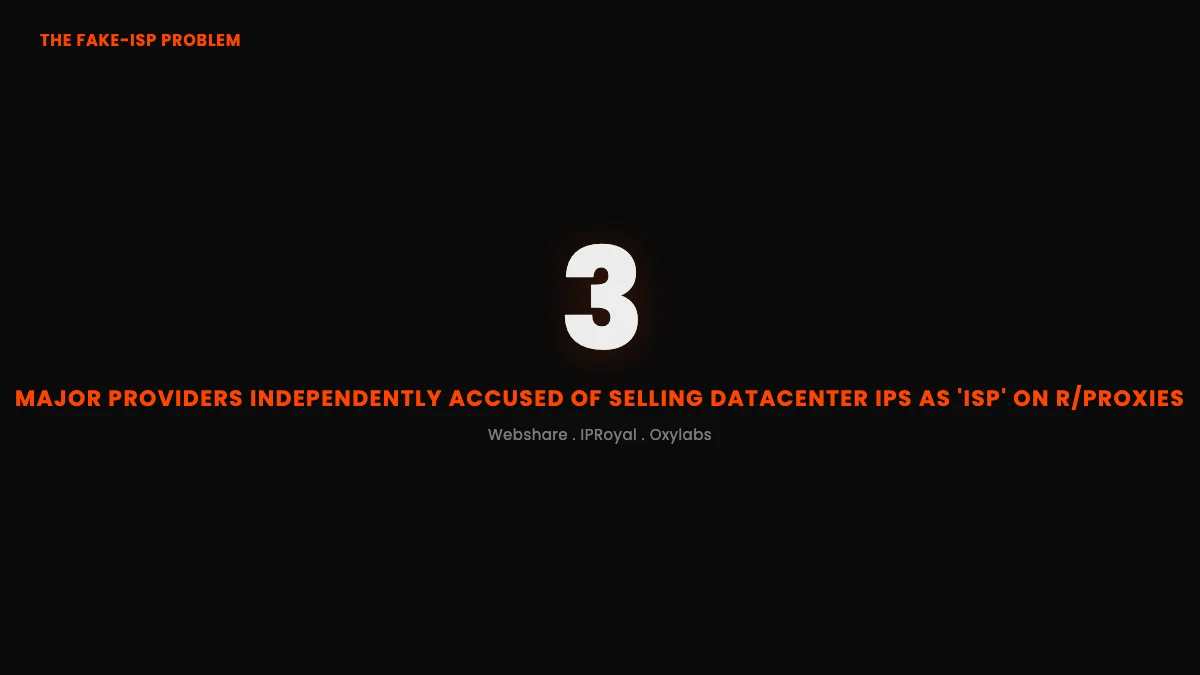
Here is the single most important thing in this guide, and it is on no pricing page: a large share of the loudest complaints on r/proxies are about "fake ISP" proxies, meaning datacenter IPs sold as residential or ISP. The accusation is not limited to one budget brand. It has been leveled publicly at cheap providers and premium ones alike.
The most-cited cautionary thread is blunt about Webshare:
webshare.io residential proxy is a scam!
They advertise as using residential proxies in their network pool, but every single IP is a datacenter IP on a host that is known for fraud/abuse. Stay away from these guys and their false advertising.
The poster's claim is specific: "every single IP is a datacenter IP on a host that is known for fraud/abuse." But the same pattern shows up against providers at the other end of the ladder. One r/proxies user bought supposedly dedicated ISP proxies from Oxylabs and found "most of them show up as datacenter or VPN/proxy on multiple IP checkers" (see the Oxylabs thread). Another, after two years on IPRoyal, wrote that "the proxies they sell under the name 'ISP proxies' are actually datacenter proxies, sold at a much higher price." These are the same structural accusation, made independently, against a budget brand, a mid-tier brand, and a premium brand, which tells you the problem is the supply chain, not any single vendor.
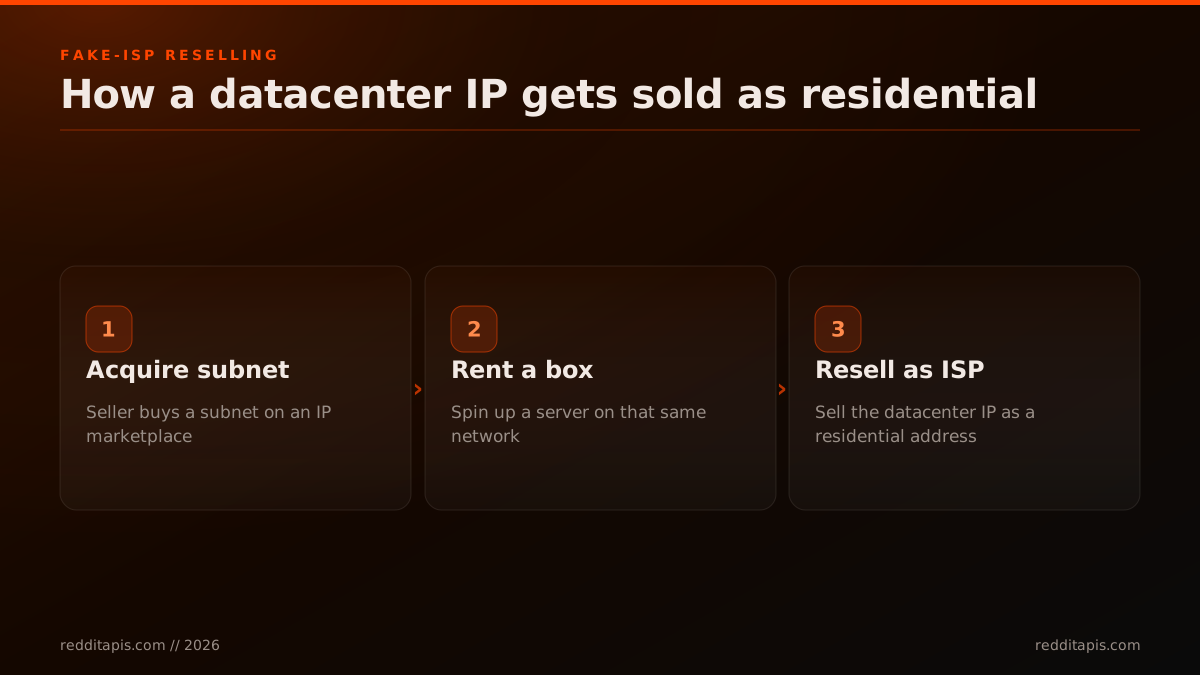
That same Oxylabs thread is where the community explains the mechanism most clearly: a seller grabs a subnet on an IP marketplace, rents a datacenter box on that same network (marketplaces like IPXO broker exactly these subnets), and you receive a datacenter IP wearing an ISP label. The IP passes a superficial ASN check but gets flagged the moment a target runs a real fraud score on it. The detection side is well documented in Cloudflare's bot-management docs. The reason it works as a business is that most buyers never check. They read the product page, see the word "residential," and assume the label is the product.
The same three-part accusation, made independently across the price ladder:
- Webshare (budget): "every single IP is a datacenter IP."
- IPRoyal (mid): "ISP proxies are actually datacenter proxies."
- Oxylabs (premium): IPs "show up as datacenter or VPN/proxy on multiple IP checkers."
What makes this hard to shop around is that the accusation does not track price. You might assume paying more buys you out of the problem, but the complaints land on the cheapest brands and the premium ones at roughly the same rate, because they can all draw from the same resold-subnet supply. Spending more is not a fix; checking the IP is.
The practical takeaway: the label on the box is not the product. Validate the ASN and fraud score of the actual IPs you receive, on a trial, before you trust any "residential" or "ISP" claim. We give you the exact check sequence later in this guide.
Start building with Redditapis
Reads $0.0015, votes $0.005, writes $0.012, DMs $0.025. $0.50 free credits.
Why proxy reviews lie to you (the astroturfing tax)
The second buried cost is informational. The proxy review ecosystem, including Reddit, is heavily seeded. Threads asking for the best provider are full of removed comments and one-off accounts shilling obscure brands, and the same provider gets praised in one place and trashed in another.
IPRoyal is the cleanest example of the split. On X, a verified user posts a glowing two-and-a-half-year endorsement:

Ibrahim Koros
@Ibrahkiprotich
I’ve been using @IPRoyal_proxies for 2½ years and it’s been one of the most reliable proxy providers I’ve worked with. Here’s why: 👉They offer a variety of proxies (for different needs) ✓ Residential Proxies: great for web scraping, social accounts, and geo-targeting with htt… Show more

On r/proxies, a different two-year customer reaches the opposite conclusion in public:
2 Years With IPRoyal and I Feel Completely Scammed. Looking for a New Proxy Provider
Hello everyone, I’ve been working with IPRoyal for about two years, but I’m now looking for another provider due to extreme overpricing and misleading practices. The proxies they sell under the name “ISP proxies” are…
Same provider, same tenure, opposite verdicts. That is not a contradiction to resolve by picking a side. It is the signal: no single review source is trustworthy on its own, because both seeded praise and seeded outrage are cheap to manufacture. The only review that counts is the one you run yourself on a trial IP.
What to distrust in any proxy review:
- Single-thread "best provider" recommendations (heavily seeded).
- One-off accounts pushing one obscure brand.
- Any verdict you cannot reproduce on a trial IP yourself.

The per-IP versus per-GB trap
Notice that the price table has two billing models, and they are not comparable on a single number. Per-IP providers (Webshare, Proxy-Seller, IPRoyal, Oxylabs) sell you a fixed IP for a flat monthly fee, often with unlimited bandwidth. Per-GB providers (NetNut, DataImpulse, ProxyEmpire) sell you traffic, and you pay for every gigabyte.
For scraping, per-GB pricing is a trap if you do not model your traffic carefully. Socket-level billing, as DataImpulse uses, counts overhead you do not see, and a Reddit workload that pulls full comment trees and large JSON listings burns gigabytes faster than the headline rate suggests. A "cheap" plan at approximately $1/GB can cost more per month than a flat per-IP plan once your real traffic lands.
Where per-GB quietly costs more:
- Socket-level billing counts overhead you never see.
- Comment-tree pulls and large JSON listings burn gigabytes fast.
- A cheap headline rate can lose to a flat per-IP plan in production.
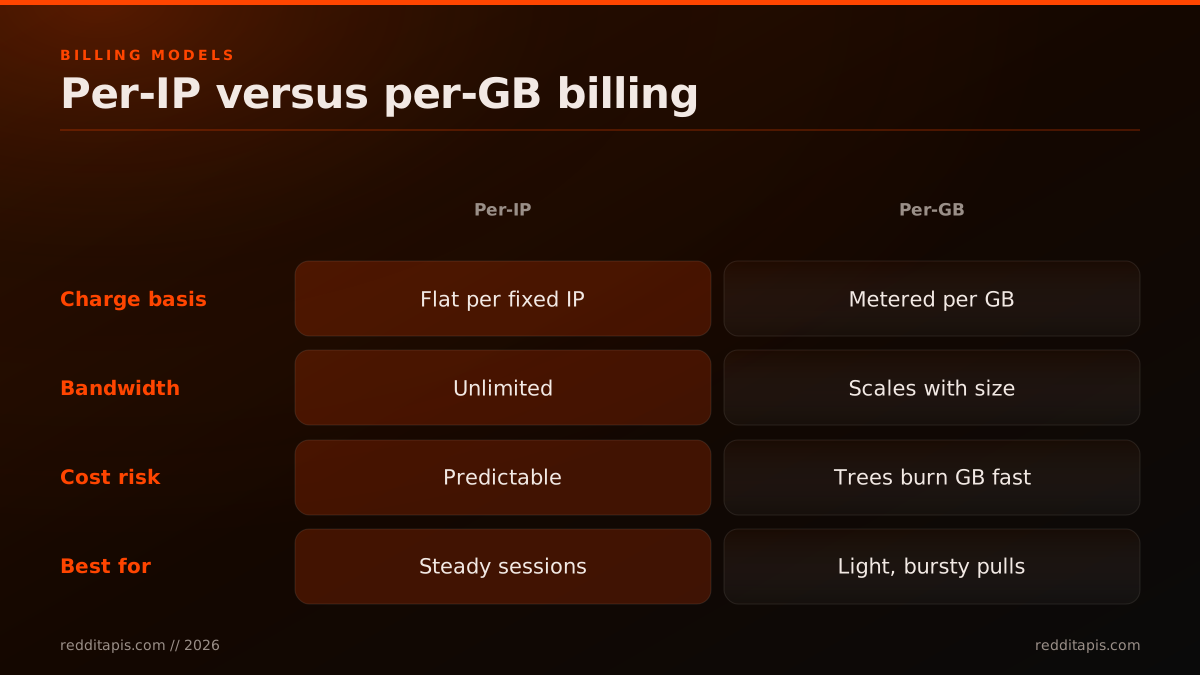
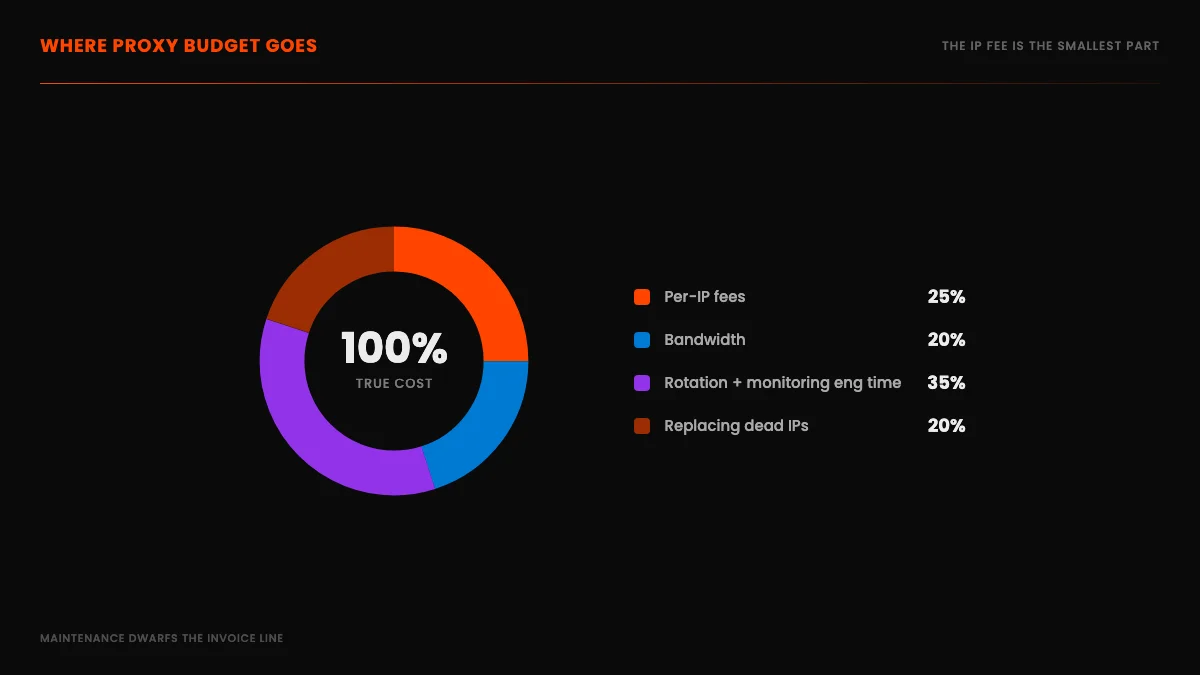
There is also the hidden line item nobody quotes: where your proxy budget actually goes once you are running a pool in production. It is not just the IP fee. It is bandwidth, the engineering time to rotate and monitor IPs, and the cost of replacing addresses that stop working on your target.
Sticky versus rotating: which model to buy for Reddit scraping
Sticky proxies (static residential or ISP) assign you a fixed IP billed per IP per month, suited for consistent sessions where the same identity needs to persist across requests. Rotating residential proxies give you a fresh IP per request from a large pool, billed per gigabyte, suited for high-volume anonymous reads. Buying the wrong model wastes budget: rotating IPs break a sticky session, and sticky IPs exhaust quickly under bulk-rotation load.
If you have decided you genuinely need proxies, the next fork is sticky versus rotating, and it maps onto what you are doing with Reddit data.
Sticky (static residential or ISP) is for anything that holds an identity over time: a consistent session or a sequence of requests that should look like one user. You buy these per IP, keep them for the month, and treat each as a stable persona. Webshare, Proxy-Seller, IPRoyal, and Oxylabs all sell this tier, and it is the right model when you are reading from a session that needs to persist. For the rate-limit math that governs how hard you can push, see the Reddit API rate limits guide.
Rotating residential is for high-volume anonymous reads where you want a different IP on every request so no single address accumulates the whole load. You buy these per gigabyte, and they suit bulk public-data pulls, like the kind of throughput documented in our Reddit scraping benchmarks.
The mistake is buying the wrong model for the job: rotating IPs for a sticky session (your identity changes mid-task) or sticky IPs for a high-rotation bulk pull (you exhaust a small set of addresses). Before you commit, use a no-card trial to validate on your actual target. A recurring r/proxies thread catalogues which providers offer free trials precisely because experienced buyers refuse to pay before testing, and the most upvoted buying-advice thread is full of people who learned that lesson the expensive way.
Match the model to the workload:
- Sticky (per-IP): consistent sessions and persistent identity.
- Rotating (per-GB): high-volume anonymous reads, a fresh IP per request.
What scraping Reddit data actually requires, and where proxies fit
Step back and look at why you wanted proxies in the first place. Proxies are not the goal. They are a workaround for one specific problem: a target rate-limits a single IP making too many requests. Proxies spread the load so no single address carries it all.
If you are scraping the general web (many sites, your own crawler), that workaround is genuinely necessary, and the comparison above is what you need. But if your end goal is Reddit data specifically, the access problem is already solved by a different layer. A REST API gives you posts, comments, and search results through a single authenticated endpoint, and the provider runs the IP infrastructure so you never touch a pool.
Here is the read path with no proxy involved at all, using the redditapis.com search endpoint:
import requests

API_KEY = "YOUR_API_KEY"
BASE = "https://api.redditapis.com"

# Read public Reddit posts matching a query. No proxy pool, no IP rotation.
resp = requests.get(
    f"{BASE}/api/reddit/search",
    params={"q": "residential proxies", "limit": 25},
    headers={"Authorization": f"Bearer {API_KEY}"},
)
data = resp.json()
posts = data.get("posts", [])
print(f"Got {len(posts)} posts")
for p in posts[:3]:
    print(p["subreddit"], "-", p["title"][:70])
That is the entire access layer. One bearer token, one REST call, results back as JSON. No residential IPs to buy, no ASN to validate. Pulling a subreddit listing is the same shape on the posts endpoint:
resp = requests.get(
    f"{BASE}/api/reddit/posts",
    params={"subreddit": "webscraping", "sort": "new", "limit": 25},
    headers={"Authorization": f"Bearer {API_KEY}"},
)
listing = resp.json().get("posts", [])
Listings page through a cursor: the response carries an after token you feed back in to get the next page, with no IP rotation because the access layer is not yours to scale:
def fetch_all(subreddit, max_pages=10):
    posts, after, pages = [], None, 0
    while pages < max_pages:
        params = {"subreddit": subreddit, "sort": "new", "limit": 25}
        if after:
            params["after"] = after
        r = requests.get(
            f"{BASE}/api/reddit/posts",
            params=params,
            headers={"Authorization": f"Bearer {API_KEY}"},
        )
        data = r.json()
        posts.extend(data.get("posts", []))
        after = data.get("after")
        if not after:
            break
        pages += 1
    return posts
Because paged results overlap at the boundaries, deduplicate on post id before you store anything, exactly as you would with any scraper, except here there is no dead IP to swap if a page retries:
seen, unique = set(), []
for p in posts:
    if p["id"] not in seen:
        seen.add(p["id"])
        unique.append(p)
Error handling is a single status-code check rather than a recovery state machine, because there is no IP to retire:
r = requests.get(
    f"{BASE}/api/reddit/search",
    params={"q": "residential proxies", "limit": 25},
    headers={"Authorization": f"Bearer {API_KEY}"},
)
if r.status_code == 200:
    posts = r.json().get("posts", [])
elif r.status_code == 429:
    time.sleep(2)  # transient rate limit, simple backoff
else:
    raise RuntimeError(f"API error {r.status_code}: {r.text[:200]}")
The point is not that the code is clever. It is that the entire category of work proxies exist to support, rotating IPs and validating that your "residential" IPs are not flagged datacenter addresses, simply does not appear. Even sophisticated practitioners spend real effort sourcing proxy supply for direct scraping, as security researcher Bill Demirkapi noted while hunting residential IPs for a high-WAF target:

Bill Demirkapi
@BillDemirkapi
one of my projects requires mass scraping against top WAFs. found a fun trick to get ~infinite residential ipv6 proxies. if your ISP supports IPv6, chances are it uses DHCPv6-PD. you can automate prefix delegation using dhclient & proxy through random IPs in the /56 when bann… Show more
For the full endpoint set, see the Reddit API Python tutorial and the OAuth authentication guide. If you are coming from PRAW, the REST vs PRAW comparison and the PRAW vs REST deep dive cover the migration. For a neutral third-party walkthrough of the proxy landscape before you decide, this Cybernews review is a reasonable starting point:
The cheapest Reddit API. Try it free.
Reads from $0.0015 per call. $0.50 free credits. No credit card required.
The real cost: a proxy pool versus an API for Reddit data
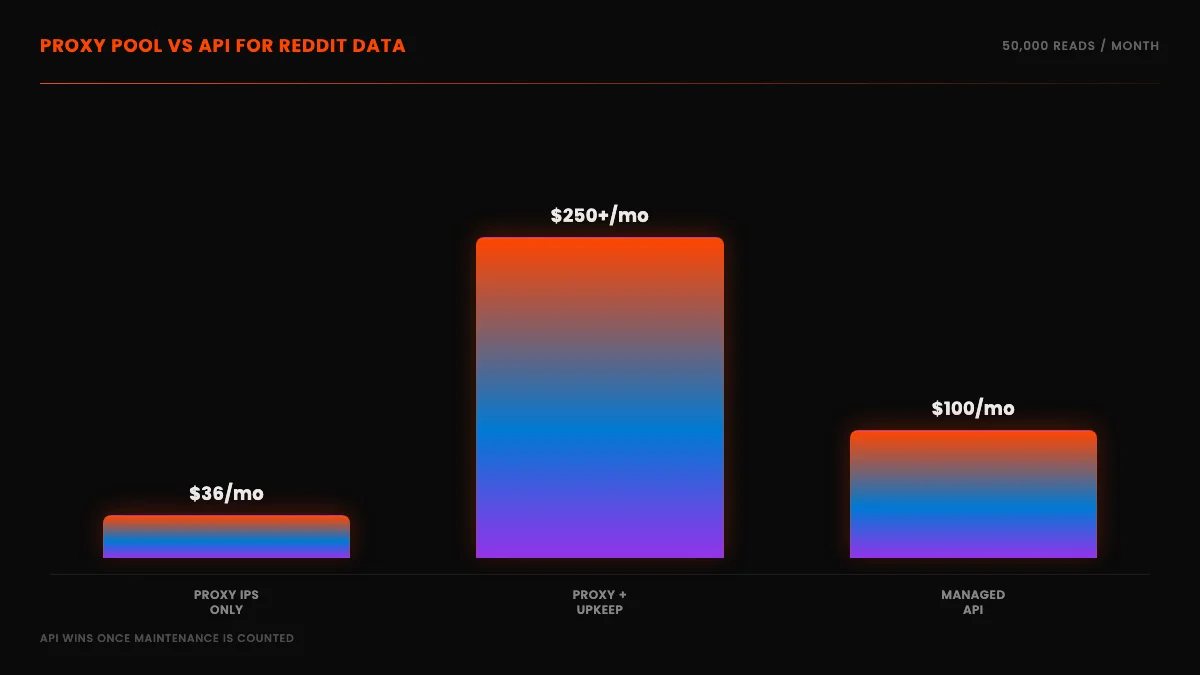
For a 50,000-post-per-month Reddit monitoring workload, the proxy route costs an estimated $36 in IP fees (20 IPRoyal static IPs at approximately $1.80 each) plus significant engineering time for scraper maintenance, IP rotation, and dead-IP replacement. The API route costs an estimated $75 at $0.0015 per GET read with no IP fees, no rotation logic, and no fake-ISP risk. The invoice shows only the $36; the engineering overhead is the larger cost that does not appear there.
Let us put numbers on it. Say you want to read roughly 50,000 public Reddit posts a month for a monitoring product.
The proxy route: you buy a static-residential pool to run your own Reddit scraper. Twenty IPs at approximately $1.80 each (IPRoyal static tier) is an estimated $36 a month before bandwidth. Add the engineering time to build the scraper, rotate IPs, monitor data completeness, and replace addresses that stop working. Add the risk that some of those "ISP" IPs are datacenter IPs that get flagged on day one. The IP fee is the smallest part of the real cost.
The API route: at $0.0015 per GET read, reading 50,000 posts through redditapis.com is about $75 a month, with no IP fees, no bandwidth metering, no pool maintenance, and no fake-ISP exposure because you never touch an IP. Once you count the engineering and maintenance time the proxy route demands, the API is usually lower total cost and always lower-maintenance for a read-only Reddit workload. The Reddit API pricing vs Apify and Reddit API cost comparison guides carry the full workload-by-workload model.
The headline IP fee makes the proxy route look cheaper than it is, because the fee is the part that shows up on an invoice. The parts that do not show up are larger: the days of engineering to build a scraper that survives Reddit's listing changes, the ongoing work to rotate IPs and watch data completeness, the dead time when a batch of "ISP" IPs turns out to be flagged datacenter addresses, and the opportunity cost of a senior engineer maintaining proxy plumbing instead of building product. A pool that looks like an estimated $36 a month on the pricing page is rarely $36 a month in practice once a person has to keep it alive.
There is a second scenario where the proxy route wins, and it is worth being honest about: if you are scraping many different sites, not just Reddit, then you are buying general-web access infrastructure that a Reddit-specific API cannot replace, and a validated residential pool is the correct purchase. The decision is not "proxies bad, API good." It is "match the tool to the job," and the job determines the answer. For a single-platform Reddit read workload, the API removes a whole category of work. For a sprawling multi-site crawl, the pool is the foundation. A common pattern is to run the API for Reddit data and reserve the proxy pool for everything else.
What the invoice hides:
- Engineering days to build and maintain the scraper.
- Rotation, monitoring, and dead-IP replacement.
- Dead time when a batch of "ISP" IPs turns out to be datacenter addresses.
The community knows this intuitively. The buyer in the most upvoted "looking to buy" thread on r/proxies wants exactly what an API delivers: "high speeds, stable connections and IP pool large enough to never get the same IP again, and most importantly, the IP's should be clean." That is a description of solved access infrastructure, which is precisely what you rent when you call an API instead of assembling a pool.
How to validate any provider before you pay
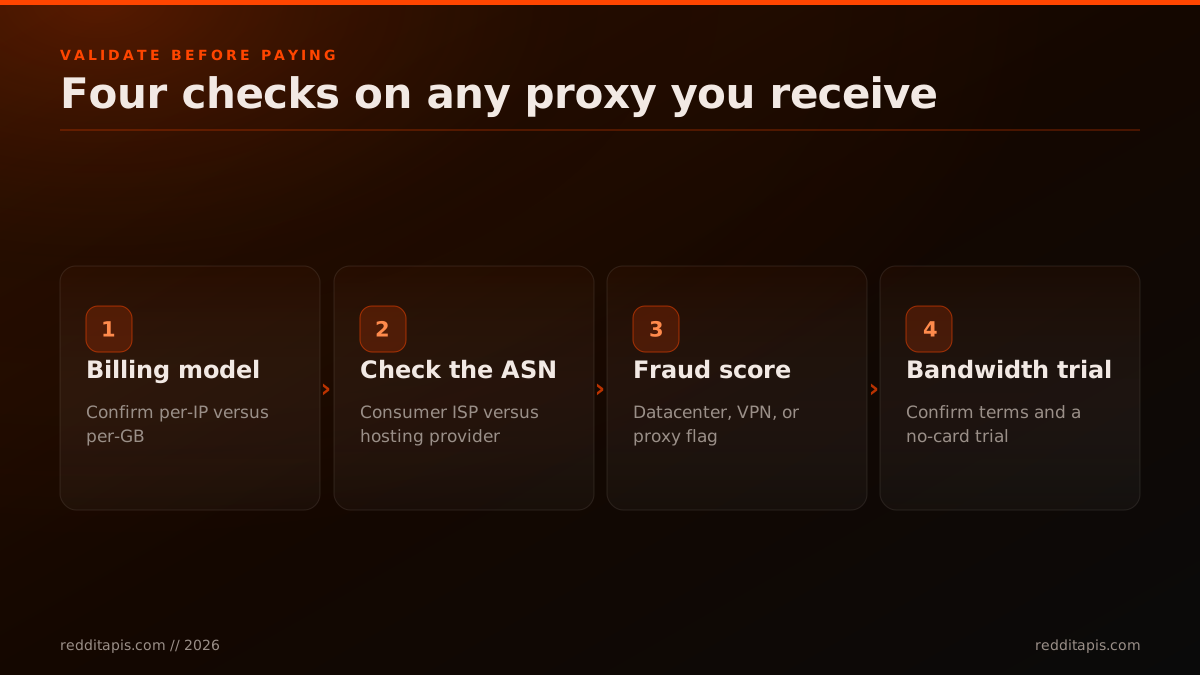
Before paying any residential or ISP proxy provider, run four checks on a trial IP: confirm the billing model (per-IP versus per-GB), look up the IP's ASN with ipinfo.io to confirm it resolves to a consumer ISP rather than a datacenter hosting provider, run the IP through a fraud-score checker like Scamalytics, and confirm bandwidth terms and whether a no-card trial is available. This catches fake-ISP reselling before any money changes hands.
Whichever route you take, if you do buy proxies, never trust the label. Run this check on a trial IP before committing real money.
First, confirm the billing model you are actually buying: per IP (static or ISP) or per gigabyte (rotating). They are not comparable on a single number, and vendors blur the line on purpose.
Second, take a trial IP and look up its ASN with a tool like ipinfo.io. A genuine ISP proxy resolves to a consumer ISP's ASN. (An autonomous system number is the network an IP belongs to, assigned through registries like RIPE.) A datacenter IP resolves to a hosting provider's ASN no matter what the product page calls it. This single check catches most fake-ISP reselling before you have paid a cent.
Third, run the same IP through a fraud-score checker such as Scamalytics. If it shows up as datacenter, VPN, or proxy on multiple checkers, it will be flagged on a real target regardless of the label. Run a handful of trial IPs, not just one, because providers can serve clean IPs to a trial and dirtier ones to paying volume.
The four-check validation, in order:
- Confirm the billing model (per-IP versus per-GB).
- Look up the trial IP's ASN (consumer ISP versus hosting provider).
- Run a fraud-score check (datacenter, VPN, or proxy flag).
- Confirm bandwidth terms and a no-card trial.
Build versus buy: a decision tree
The proxy-versus-API decision comes down to what you are scraping. For general-web scraping across many sites, a validated residential pool is the right purchase, with Proxy-Seller as the value pick and Oxylabs for premium scale. For Reddit data specifically, a managed REST API at $0.0015 per call removes the proxy layer entirely, because the access problem is already solved at the provider level and you pay per call instead of managing IP infrastructure.
Put it together and the decision is straightforward once you separate the two jobs.
If you are scraping the general web across many sites with your own crawler, you need proxies, and the value pick is Proxy-Seller for unlimited per-IP, Oxylabs if you need premium reliability at scale, and Bright Data if you need a vetted enterprise vendor and can clear KYC. Validate every IP before you commit.
If your goal is Reddit data specifically, the proxy pool is undifferentiated infrastructure cost: per-IP fees, fake-ISP risk, monitoring, and rotation logic, all to solve an access problem an API already solves. Read the data through a REST API, pay per call, and put your engineering time into your product instead of your proxy pool. The legal backdrop for public-data scraping is summarized in the EFF reverse-engineering FAQ. The REST vs PRAW guide and the Reddit API cost comparison walk the read path end to end, and the Reddit API pricing vs Apify comparison covers the managed-versus-actor switch.
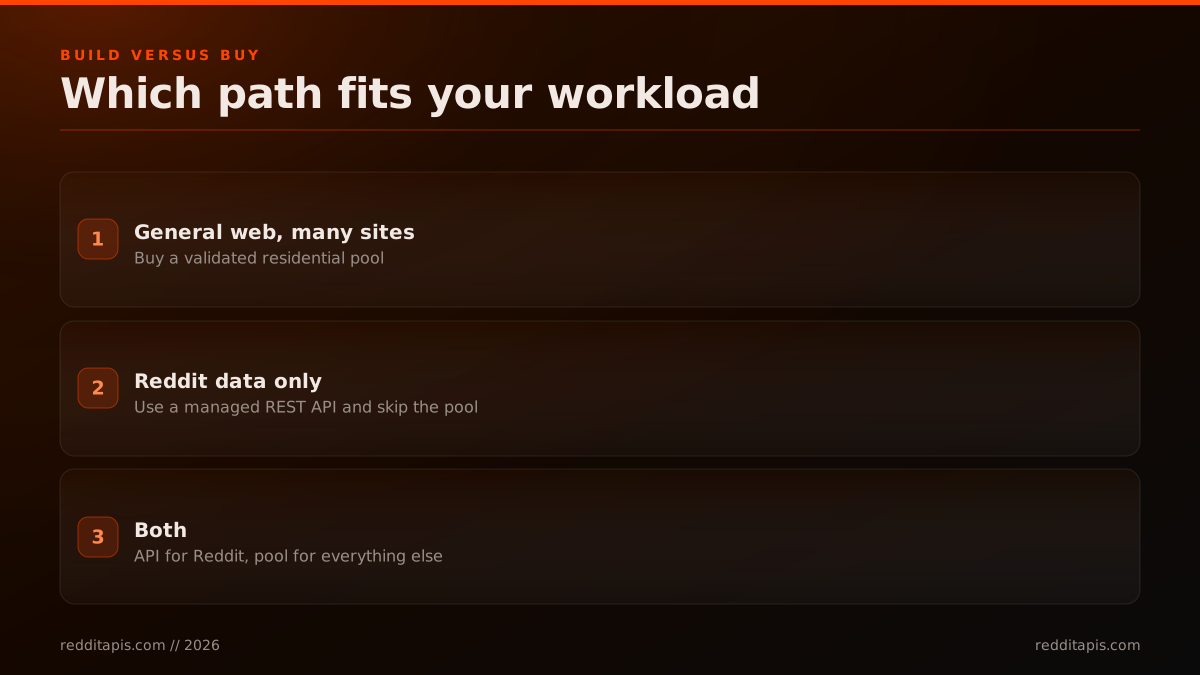
The decision in one line each:
- General web, many sites: buy a validated residential pool.
- Reddit data only: use a managed REST API and skip the pool.
- Both: API for Reddit, pool for everything else.
The verdict
On verified June 2026 pricing, the cheapest per-IP static and ISP proxy headline is Webshare ($0.30), which trades reliability and bandwidth for the price. Proxy-Seller gives the best value with unlimited bandwidth, IPRoyal has the best static sticky sessions, and Oxylabs is the premium pick at scale. But two costs never appear on a pricing page: fake-ISP datacenter IPs sold as residential, and seeded reviews that make any single recommendation untrustworthy. Validate the ASN and fraud score of the IPs you actually receive, and treat every review as potentially planted.
And before you buy any pool at all, ask what you are really after. If it is Reddit data, the proxy layer is the wrong thing to be buying. A managed REST API solves the access problem at $0.0015 per read with no IPs to manage and no fake-ISP risk, which is why for read-only Reddit workloads it is the simpler answer once the maintenance is counted. The proxy market is real and useful, but it is also full of mislabeled inventory and seeded reviews, so the discipline is the same whichever route you choose: validate what you actually receive, price the full cost including maintenance, and match the tool to the job. Start with the pricing page and a free API key, then decide whether you are in the proxy business or the product business.
The takeaways:
- Cheapest per-IP: Webshare ($0.30).
- Best value with unlimited bandwidth: Proxy-Seller.
- The label is not the product: validate ASN and fraud score.
- For Reddit data specifically, an API removes the proxy line item.
Where these numbers come from.
Each row is a figure in this post and the artefact it was read from. Reddit's access rules and the third-party archives around them keep moving, so check the date on a source before you build against it.
- Webshare pricing
- One of the live vendor pricing pages this guide's per-IP ladder was read from in June 2026.
- Bright Data pricing
- Bright Data's live pricing, the KYC-gated mid-tier reference in the per-IP comparison.
- Oxylabs pricing
- Oxylabs' live pricing, the premium per-IP reference point in the ladder.
- Proxy server overview
- Background on the proxy primitive and the residential-versus-datacenter distinction the guide builds on.
- Reddit Data API Terms
- The managed API-first path this guide weighs against a proxy pool runs on Reddit's official commercial terms.
Frequently asked questions.
On verified June 2026 per-IP pricing for static residential and ISP proxies, Webshare is the cheapest headline entry at $0.30 per IP, but it trades reliability and bandwidth for that price (its cheap plan caps at 250 GB and has recurring complaints about flagged IPs). Proxy-Seller is the cheapest unlimited-bandwidth option at about $0.75 per IP. For Reddit data specifically, a managed Reddit API removes the proxy line item entirely at $0.0015 per GET read. See /pricing.
Static residential and ISP proxies give you a fixed IP that stays the same across sessions, billed per IP per month, which suits long sessions. Rotating residential proxies hand you a new IP per request from a large pool and are usually billed per gigabyte. For Reddit scraping that holds a session you buy per-IP static or ISP; for high-rotation anonymous reads you buy per-GB rotating. Mixing the two billing models up is the most common budgeting mistake. See /blogs/reddit-api-rate-limits-2026.
Only if you are hitting Reddit directly with your own scraper. Proxies spread requests across many IPs so the target does not rate-limit a single address. If your end goal is Reddit data specifically rather than general-web scraping, a REST API removes the proxy layer: the provider runs the access infrastructure and you call an endpoint. You pay per call instead of paying per IP plus bandwidth plus the maintenance of keeping the pool healthy. See /blogs/reddit-data-api-rest-vs-praw-2026.
A fake ISP proxy is a datacenter IP sold as a residential or ISP IP. On r/proxies, multiple users describe the pattern: a seller grabs a subnet on an IP marketplace, rents a datacenter box on that same network, and you receive a datacenter IP labeled as ISP. The same accusation has been made publicly against budget and premium providers alike. Always run the IPs you receive through an ASN and fraud-score checker before trusting the label. See /blogs/reddit-scraping-benchmarks-throughput-error-rates-2026 for throughput context.
Threads asking for the best provider on r/proxies are heavily seeded. You see removed comments, one-off accounts pushing obscure brands, and the same provider praised in one thread and called a scam in another. The lesson is not to pick a winner from a recommendation thread; it is to validate the specific IPs you receive and treat every review, including Reddit, as potentially vendor-seeded. See /blogs/reddit-api-pricing-ranked-2026 for the cost comparison.
A small static-residential pool of 20 IPs at roughly $1 to $2 per IP runs $20 to $40 a month before bandwidth, plus the engineering time to rotate, monitor, and replace IPs. A managed Reddit API like redditapis.com is $0.0015 per GET read with no IP fees, no bandwidth metering, and no pool maintenance. For a read-only Reddit workload the API is usually cheaper once you count the maintenance, and it removes the fake-ISP risk because you never touch an IP pool. See /pricing.
Bright Data is cheaper per IP than its enterprise reputation suggests, from around $0.90 to $1.30 per IP, with strong scale and compliance. The catch for new users is onboarding: it requires KYC and business verification, and some targets are gated for new accounts until you clear it. If you need a vetted enterprise vendor and can clear KYC it is solid. If you just want Reddit data without a verification queue, a per-call API is the faster path. See /pricing for the managed route.
Check four things. First, the billing model: per IP (static or ISP) versus per gigabyte (rotating), because they are not comparable on a single number. Second, the ASN and fraud score of a trial IP, to confirm it is not a datacenter IP in disguise. Third, whether bandwidth is unlimited or capped. Fourth, whether the provider offers a no-card trial so you can validate before committing. If your real goal is Reddit data, also price out an API call route before you buy any pool at all. Start at /signup for a free key.
Keep reading.
Continue exploring related pages.
Reddit API documentation
The complete 2026 reference: auth, all 74 endpoints, and code.
Get a Reddit API key
Instant bearer token, no waitlist and no enterprise contract.
Reddit Responsible Builder Policy
Why Reddit denies API applications, and the managed REST bypass.
Reddit API use cases
14 use cases from AI training to brand monitoring and DMs.
Reddit Search API
Search posts, comments, users, and communities over one REST endpoint.
Reddit MCP server
Wrap the REST API as MCP tools for Claude, Cursor, and any MCP client.
Reddit MCP hub
Install tabs for every client, the full tool table, pricing and fixes.
Reddit API for AI agents
Live Reddit context for tool calls, MCP servers, and RAG pipelines.
Redditapis pricing
Endpoint-level costs and quick monthly totals - reads from $0.0015 / call.
Reddit API cost calculator
Estimate monthly spend using your request volume.
Reddit API guides and tutorials
Tutorials, walkthroughs, and API deep-dives for developers.
Reddit API alternatives
Evaluate alternatives by cost model, limits, and integration fit.
Cheap Reddit API
The cheapest way to get Reddit data: $0.0015 per call, no contract, no minimum.
Official Reddit API vs Redditapis
Access, setup, rate limits, and pricing, side by side.
PRAW alternative
A hosted Reddit REST API for any language, no app registration or OAuth.
Reddapi alternative
A maintained Reddit REST API with published pricing and write endpoints.
Reddit comment scraper alternative
The raw comment API: search and filter comments, historical and live, clean JSON.
Reddit scraper API
Hosted scraper API vs building your own: no proxies to manage, clean JSON.
RapidAPI Reddit alternative
A direct, maintained Reddit API with published pricing and write endpoints.
Bright Data Reddit alternative
A purpose-built Reddit API vs a general scraping platform: structured JSON, plus writes.
ScraperAPI Reddit alternative
A Reddit-native API vs a generic HTML fetcher: auth and pagination handled, typed JSON.
TikHub alternative
TikHub's Reddit surface is read-only; get comment, vote, and DM endpoints too.
EnsembleData alternative
No $100/month floor: pay per call from $0.0015, plus write, vote, and DM endpoints.
Scrape Creators alternative
7 read-only Reddit endpoints vs a dedicated API with real write, vote, and DM paths.
FetchLayer alternative
Posts, comments, and search only; add vote, comment, and DM over the same REST auth.
PullPush alternative
PullPush is free but volunteer-run and goes offline for reindexing; a maintained REST API that stays up.
Reddit monitoring API
Build your own keyword and brand-mention monitor: search, comment search, and subreddit streams over REST.
F5Bot vs Redditapis
F5Bot's Slack and Discord delivery needs its $49.99/mo Gold tier; Redditapis includes it from $19/mo.
Syften vs Redditapis
Syften caps you at 100 to 500 results a day; Redditapis allows 10,000 a day per monitor at the entry plan.
Octolens vs Redditapis
Octolens meters by mention with overage fees; Redditapis is flat-priced by subreddit slot from $19/mo.
Affiliate program
Earn 20% lifetime commissions - capped at $5,000/yr.
Reddit Vote API tutorial
Upvote and downvote a post programmatically via the REST API.
Reddit Data API: REST, no PRAW
REST endpoints for Reddit data with no PRAW and no OAuth dance.
Reddit scraping benchmarks
Real throughput, error rates, and cost benchmarks for Reddit scraping.
Reddit API answers
Direct answers on cost, access, rate limits, endpoints, and auth.
How much the Reddit API costs
Per-call pricing from $0.0015 a read, with $0.50 in free credits.
Reddit API in Python
One requests call with a bearer token, no PRAW and no OAuth flow.
Reddit shadowban checker
Check if a Reddit account is shadowbanned in seconds, free and no login.
Subreddit stats checker
See any subreddit's live subscriber count, active users, and age, free and no login.
Similar reads.
More guides on the Reddit API, scraping, pricing, and MCP servers.
Reddit Scraping API in 2026: What the Term Actually Means
Reddit scraping API names three different products in 2026. What each costs, what Reddit's own announcements changed, and which one your app needs.
RedditAPIs vs. ScrapingDog: Which Reddit Scraper API Should You Actually Use in 2026?
ScrapingDog is a general-purpose scraping API that can be pointed at Reddit. RedditAPIs is a Reddit-native API. Real 2026 pricing from both vendors, live-tested code, and the volume where each one wins.

Reddit Scraper API in Python: When to Build Your Own vs Use a Managed API
A Reddit scraper API in Python is either a client you maintain or one you rent. Live 2026 endpoint tests, working code for both paths, and the volume where buying wins.
Reddit's .json Endpoint Is Dead in 2026: Every Way to Still Pull Reddit Data
The old reddit.com/....json scraping trick is rate-limited and blocked in 2026. Here is every current way to still pull Reddit data, the official Data API, your own OAuth app, PullPush and Arctic Shift for history, a managed REST API, data dumps, and headless scraping, with the tradeoffs.

Is Scraping Reddit Legal in 2026? A Developer's Guide to ToS and Case Law
Is scraping Reddit legal in 2026? An honest developer guide to the Reddit User Agreement, the Perplexity lawsuit, CFAA and copyright case law, and compliant access.

Reddit API Scraping in 2026: Real Throughput, Error Rates, and Cost Benchmarks
Scraping 1M Reddit posts costs $240 to $3,400 depending on method. Real throughput, error rates, and latency benchmarks from 30 days of production data.
Reddit Comment IDs Are Now 13 Characters and Out of Order: What Breaks in Your Code
Reddit's new comment IDs are 13 characters and no longer increasing. When the change went live, what it breaks in your code, and the fix for each case.
Reddit Stops New Data API Requests on October 31: What to Do If You Have Not Applied
Reddit stops accepting new Data API requests on October 31, 2026. What closes, why the request form keeps failing, and how a new project reads Reddit after.